
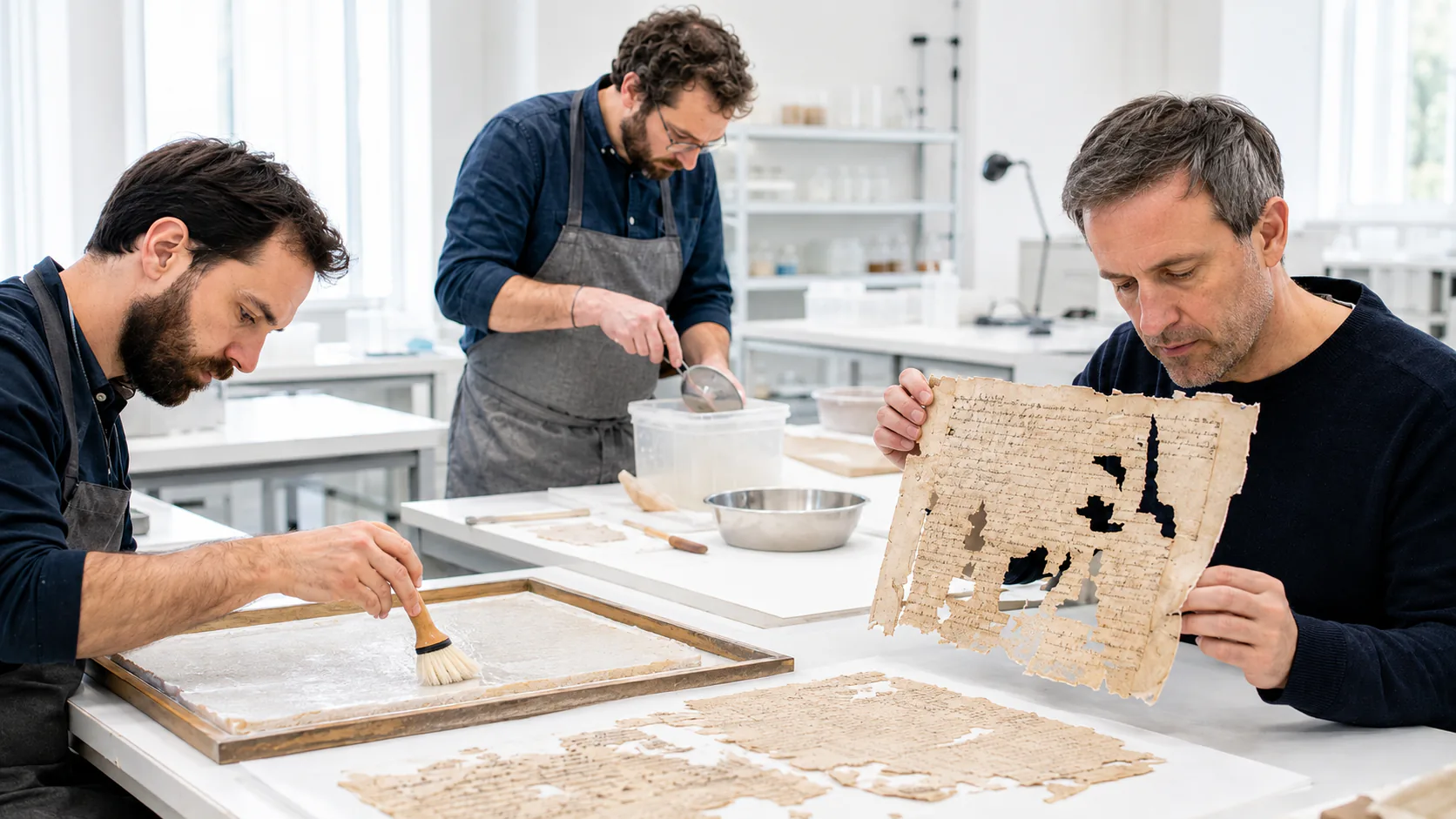
1. What Is Leafcasting?
Leafcasting is a paper-conservation technique used to fill missing areas of damaged sheets with new paper fibres.
The method is related to papermaking.
A damaged sheet is placed on a screen within a leafcasting machine. A dilute suspension of paper fibres is introduced, and water is drawn through the screen by gravity, suction or a controlled combination of both.
Because the intact paper blocks the flow, fibres preferentially deposit in:
- holes;
- missing margins;
- tears;
- lacunae;
- insect-damaged areas.
After drying, the deposited fibres form a new paper fill mechanically integrated with the original sheet.
AIC Book and Paper Group literature describes leafcasting as a way to stabilise paper weakened by holes or ragged borders and emphasises that the amount of pulp is critical to achieving satisfactory results.
2. What Problems Can Leafcasting Address?
Leafcasting can be particularly useful for:
- insect-damaged manuscripts;
- documents with extensive edge losses;
- maps and large sheets with multiple lacunae;
- bound text blocks after disbinding where many leaves require similar repair;
- weakened paper that needs continuous fibre fills around irregular losses.
It can be more efficient than individual hand infills when a large number of losses must be repaired.
However, efficiency is not the only criterion.
The object must first be suitable for immersion or controlled wet treatment.
3. Material Assessment Comes First
Leafcasting usually involves substantial contact with water.
Before treatment, examine:
- paper fibre type;
- degree of brittleness;
- previous sizing;
- inks;
- pigments;
- stamps;
- annotations;
- watercolours;
- adhesives;
- previous repairs;
- mould damage;
- tears and fragments.
Media solubility
Water-sensitive inks or pigments can bleed, feather or migrate.
Testing should therefore be performed before immersion.
When media is too vulnerable for full wetting, alternative hand-pulp or local suction methods may sometimes be more appropriate.
AIC literature notes that hand pulp application can provide greater local control and can be useful when complete immersion is not safe.
4. How Leafcasting Works
The physical principle is straightforward.
Step 1 — Position the sheet
The object lies flat on a supporting screen.
Step 2 — Introduce pulp slurry
A suspension of dispersed paper fibres is added to the tank.
Step 3 — Draw water through the support
The machine creates downward flow through the screen.
Step 4 — Fibres deposit in losses
Where original paper is present, flow resistance is higher.
Where paper is missing, water passes through and carries fibres toward the open area.
Step 5 — Fibres interlock
As water leaves, deposited fibres form a sheet structure.
After pressing and drying, fibre-to-fibre bonding gives the infill mechanical integrity.
The treatment is therefore not simply “gluing paper pulp into a hole.”
5. Pulp Selection
The repair pulp should be selected according to:
- fibre type;
- fibre length;
- beating;
- colour;
- opacity;
- thickness;
- ageing behaviour.
Conservators may use fibres such as:
- cotton;
- linen;
- abaca;
- suitable high-quality cellulose pulps;
- blends developed to match the original sheet.
The ideal pulp is not necessarily chemically identical to the original paper.
It should provide a compatible visual and mechanical repair.
Colour matching
Pulp may be toned to reduce visual contrast.
The objective is normally not to create an invisible falsification.
A conservation repair should remain sympathetic and legible under appropriate examination.
6. Calculating Pulp Quantity
One of the most important technical variables is the amount of fibre introduced.
Too little pulp can produce:
- thin fills;
- weak edges;
- incomplete losses.
Too much pulp can produce:
- thick patches;
- ridges;
- excess deposition;
- uneven drying;
- visual disruption.
AIC literature on leafcasting has described systems for measuring the exact area of loss and calculating the amount of pulp required.
Modern systems may use:
- digital imaging;
- area calculation;
- basis weight or target thickness;
- calibrated pulp concentration.
A simplified logic is:
Loss area × Target paper mass per area → Required dry fibre mass
The slurry concentration is then used to determine the liquid volume required.
Accuracy is particularly useful when many leaves are treated.
7. Preparing the Paper
Preparation may include:
- surface cleaning;
- removal of damaging old repairs;
- testing media;
- controlled washing;
- deacidification;
- fragment alignment.
Not every object needs every step.
The treatment plan should define the purpose of each operation.
Wetting
Uniform wetting helps the sheet lie flat and can support even fibre deposition.
However, differential expansion can occur when degraded areas absorb water differently.
Fragile material may require support during transfer.
8. The Casting Process
A typical machine workflow may be:
Assess → Prepare → Wet → Position → Calculate Pulp → Cast → Drain → Inspect → Size if Required → Dry
Positioning
Fragments and torn edges should be aligned before the pulp is introduced.
Masking
Masks or deckles may limit the area in which new paper is formed.
This helps prevent unnecessary fibre deposition around the object.
Suction
Controlled suction draws water through the screen.
The flow should be strong enough to produce even fibre deposition but not so abrupt that fragments move or distorted paper is damaged.
Inspection before removal
Before lifting the sheet, check:
- whether all intended losses are filled;
- whether fragments have shifted;
- whether pulp has deposited over original media;
- whether the new fill has reasonable thickness.
9. Sizing and Strength
Freshly cast fibres may require sizing depending on the treatment objective and pulp.
Sizing can:
- alter surface strength;
- reduce absorbency;
- improve handling;
- integrate weakened paper.
Possible conservation sizes include suitable cellulose ethers, gelatin or other materials selected for the object.
Sizing is not automatically required after every leafcast.
The decision depends on:
- original paper;
- new pulp;
- intended handling;
- additional lining or repair.
10. Drying and Flattening
Drying strongly influences the final result.
Poor drying control can produce:
- planar distortion;
- cockling;
- edge tension;
- offsetting;
- adhesion to drying materials.
A treated sheet may be:
- blotted;
- pressed;
- dried under controlled restraint;
- dried between suitable felts or blotters;
- subsequently flattened.
The exact method depends on paper strength, media and conservation objectives.
11. When Leafcasting May Not Be Appropriate
Leafcasting is not a universal repair method.
Caution is required with:
- highly water-soluble media;
- paper that cannot tolerate immersion;
- friable pigments;
- heavily coated paper;
- composite sheets;
- extremely weak fragments that cannot survive wet handling;
- objects where the aesthetic effect of fibre infill is undesirable.
Other methods may include:
- Japanese-paper repair;
- hand pulp infill;
- lining;
- local suction treatment;
- encapsulation;
- limited handling with supportive housing.
The conservator should select the least interventive method that meets the treatment goal.
12. Treatment Quality
A good leafcast repair should be evaluated for:
Fill completeness
Losses are filled where intended.
Thickness
The new paper is not excessively thick or thin.
Fibre integration
The fill attaches reliably to the original edge.
Surface quality
There is no unnecessary pulp deposition over media or sound paper.
Colour
The infill is visually compatible with the object.
Dimensional stability
The sheet dries without unacceptable distortion.
Handling strength
The treatment gives enough support for intended use without making the object unnaturally rigid.
13. Production Workflow for Large Projects
Leafcasting can be efficient for collections with repeated paper-loss problems.
A larger programme should define:
- selection criteria;
- media testing;
- pulp recipes;
- colour groups;
- calculation method;
- batch tracking;
- drying capacity;
- post-treatment QA.
The leafcaster itself may not be the throughput bottleneck.
Drying, washing, sizing, documentation and conservator assessment can require more time than casting.
System planning should therefore consider the complete laboratory workflow.
Planning & Verification
Assess
Confirm that the paper and media are suitable for wet treatment.
Prepare
Select pulp, calculate loss area and align fragments.
Cast
Deposit the required fibres using controlled flow.
Finish
Size if required, dry, flatten and inspect.
Assess → Prepare → Cast → Finish
Frequently Asked Questions
What is a leafcaster used for?
A leafcaster fills missing areas in paper with a controlled suspension of paper fibres, helping stabilise sheets with holes, insect damage, tears or lost margins.
Does leafcasting use glue?
The primary fill is formed through paper-fibre bonding rather than conventional patch adhesive. Additional sizing or lining may be used when appropriate.
Can leafcasting repair insect-damaged books?
Yes, it can be effective when many sheets have compatible losses and the paper and media can safely tolerate wet treatment.
Is leafcasting suitable for water-soluble inks?
Not automatically. Solubility testing is required because immersion may cause bleeding or migration.
How is the amount of pulp calculated?
The required dry fibre mass can be estimated from the area of loss and the desired thickness or basis weight of the new paper.
Can the pulp colour be matched?
Yes. Fibre selection and toning can produce a visually sympathetic repair.
Does leafcasting strengthen the whole sheet?
It can reinforce losses, cracks and weak areas, but it should not be assumed to restore all degraded paper strength. Additional sizing or support may be needed.
Is leafcasting reversible?
The new fibres become mechanically integrated with the paper, so the concept of reversibility differs from an adhesive patch. Treatment should be justified by conservation need and documented.
Can very large maps be leafcast?
Large-format leafcasting is possible when the machine, screen, handling system and drying workflow can safely support the object.
Planning a Paper Repair Laboratory?
Leafcasting works best when pulp preparation, wet treatment, casting, sizing and drying are planned as one workflow.
Sinoalta can support equipment configuration according to sheet size, batch volume and conservation process.
Explore Leafcasting Systems →
Selected Technical References
- American Institute for Conservation Book and Paper Group, Calculating the Exact Area of Loss and the Amount of Pulp Necessary to Fill Voids for Leaf Casting
- Library of Congress, conservation case studies using leafcasting for damaged manuscripts
- Journal of the American Institute for Conservation, Leaf Casting on the Suction Table
- NEDCC, educational resources on the leafcasting process
Scope and review note: Written by Stella Wynn for Sinoalta. Sinoalta is responsible for this institutional content. Issued and most recently reviewed in August 2026. It summarizes selected conservation sources for project planning and does not replace object-specific assessment, qualified conservation advice, applicable safety requirements or project validation.
 Guide
Guide Guide
Guide Guide
Guide