
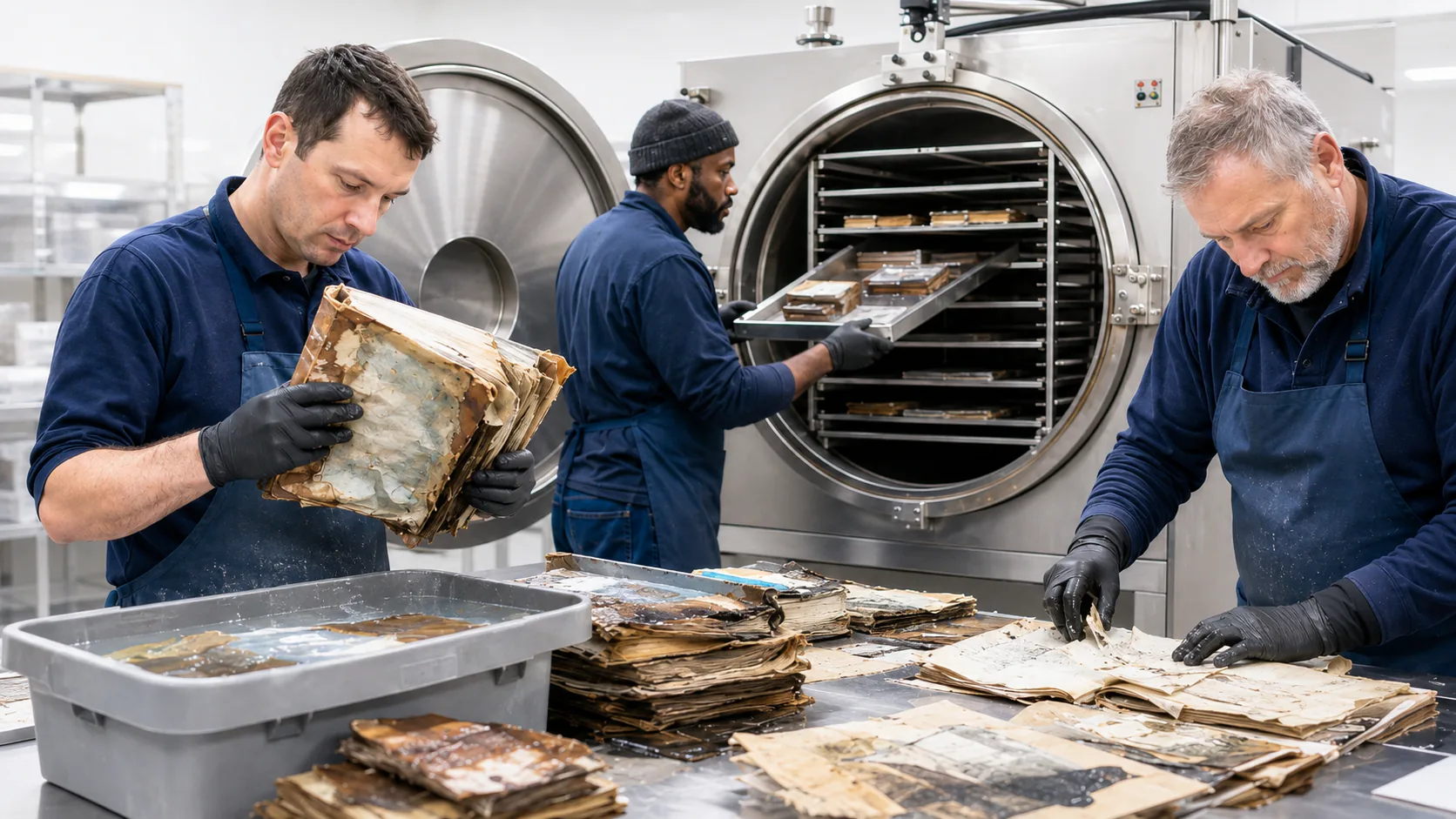
1. Water Damage Is a Time-Critical Preservation Problem
Leaks, floods, fire suppression and building failures can wet large quantities of books and records within minutes.
Once paper is wet, several deterioration mechanisms begin at the same time:
- paper fibres swell;
- bindings distort;
- soluble inks may bleed;
- coated papers may block together;
- adhesives soften;
- dirt and contaminants migrate;
- mould risk increases.
The first objective is therefore not perfect restoration.
It is stabilization.
NARA advises that quantities too large to handle within the first 48 hours should be frozen or referred to a professional drying service.
NEDCC likewise warns that mould can begin to develop on wet material within approximately 48 hours, sometimes sooner.
This makes the initial response sequence critical.
2. First Priorities After a Water Incident
Before handling collections:
Protect people
Determine whether the water contains:
- sewage;
- chemicals;
- fuel;
- mould;
- structural hazards;
- electrical hazards.
Contaminated-water incidents may require specialist recovery services.
Stop the source
Repair the leak or stop water entry.
Stabilize the room
Where possible:
- remove standing water;
- lower RH;
- reduce heat;
- increase appropriate air circulation;
- protect unaffected collections.
Triage the collection
Separate material into groups such as:
- damp;
- slightly wet;
- wet;
- saturated;
- coated paper;
- water-soluble media;
- photographs;
- leather or vellum;
- high-priority or unique objects.
The drying method should follow this assessment.
3. Freezing Is Stabilization, Not Drying
A common misunderstanding is:
“Once the books are frozen, the recovery is complete.”
Freezing does not remove the water.
It converts liquid water to ice and dramatically slows:
- mould growth;
- ink movement;
- adhesive flow;
- biological activity.
This buys time.
The institution can then:
- organise funding;
- select a drying vendor;
- prioritise material;
- repair the building;
- plan treatment.
NEDCC describes freezing as one of the most useful ways to extend decision-making time after a large water incident.
4. When Air Drying Is Appropriate
Air drying can be effective for:
- small quantities;
- damp books;
- slightly wet records;
- material that can be spread safely;
- situations with sufficient staff and controlled space.
It requires:
- low RH;
- cool conditions;
- continuous air movement;
- clean absorbent materials;
- frequent changing of interleaving where used.
Air drying becomes difficult when:
- hundreds or thousands of volumes are affected;
- books are saturated;
- coated paper is present;
- space is limited;
- mould risk is increasing.
Large incidents often require freezing and commercial drying.
5. How Vacuum Freeze-Drying Works
Vacuum freeze-drying removes water while the material remains frozen.
The basic sequence is:
Freeze → Load Chamber → Reduce Pressure → Add Controlled Heat → Sublimate Ice → Remove Water Vapour → Complete Drying
Sublimation
Under the correct vacuum and temperature conditions, ice changes directly from solid to vapour without first becoming liquid.
This is the key advantage.
Because the collection does not return to a fully wet state during drying, vacuum freeze-drying can reduce additional swelling and distortion.
NARA describes vacuum freeze-drying as especially suitable for large quantities of wet books and paper.
6. Why Vacuum Freeze-Drying Is Important for Coated Paper
Coated papers can become permanently blocked when wet.
As the coating softens, adjacent pages may bond together.
Once they dry in contact, separation may become extremely difficult or impossible without damage.
NEDCC recommends that wet books containing coated paper be frozen while still wet and then vacuum freeze-dried rather than air dried.
Historical Library of Congress/NARA emergency guidance similarly emphasises rapid freezing for coated paper.
For disaster planning, coated-paper publications should therefore be identified as a high-priority format.
7. Water-Sensitive Inks and Media
If inks are running or blurred, further liquid-water movement can cause permanent information loss.
Freezing can slow this movement.
Vacuum freeze-drying may therefore be appropriate for selected:
- water-sensitive inks;
- colourants;
- manuscript records;
- printed materials.
However, material-specific assessment remains necessary.
Not every photograph, drawing or mixed-media object should be treated like an ordinary book.
8. Vacuum Freeze-Drying Versus Vacuum Thermal Drying
These terms are frequently confused.
Vacuum Freeze-Drying
Material remains frozen.
Water is removed primarily through sublimation.
Advantages can include:
- reduced additional swelling;
- lower distortion;
- good recovery of wet books and records;
- suitability for coated paper.
Vacuum Thermal Drying
Material may be placed in the chamber wet or frozen but is heated above freezing.
Water therefore passes through the liquid state during drying.
This can produce:
- greater distortion;
- blocking of coated paper;
- tide lines;
- binding deformation.
NEDCC advises that vacuum thermal drying is not appropriate for many long-term or unique materials when better methods are available.
The drying process must be selected according to collection value and format, not only speed.
9. Freezer Drying Is Different Again
Some damp or moderately wet material can dry slowly in a self-defrosting freezer.
This is sometimes called freezer drying.
It can take:
- weeks;
- months.
It is not the same as vacuum freeze-drying.
Freezer drying may be useful for small quantities but can be too slow for major incidents.
Coated papers may still present blocking risks and should receive specialised advice.
10. Packing Before Freezing
Poor packing can lock distortion into the material.
Before freezing:
Maintain identification
Every crate, box or batch should retain:
- shelf location;
- call number;
- record group;
- priority status.
Disaster recovery can fail intellectually even when the paper is physically saved if collection order is lost.
Support books
Wet books are heavier and mechanically weak.
Packing should prevent:
- crushing;
- excessive spine deformation;
- uncontrolled swelling.
Avoid overpacking
Air movement and later handling become difficult when containers are packed too tightly.
Separate special material
Use appropriate interleaving or separation for items likely to stick together.
Keep material frozen during transport
Material selected for vacuum freeze-drying should remain frozen through transport and staging.
Partial thawing can restart distortion and mould activity.
11. Dirty or Contaminated Water
Flood water may contain:
- mud;
- silt;
- salts;
- rust;
- sewage;
- oils.
For suitable stable paper with insoluble media, gross dirt may sometimes be rinsed before freezing.
NEDCC cautions that documents with soluble inks should not be rinsed.
Sewage-contaminated collections require professional health-and-safety assessment.
The recovery plan must therefore consider what was in the water, not just how wet the books are.
12. The Vacuum Freeze-Drying Chamber Process
A professional process may include:
1. Receive frozen material
Confirm identity and frozen condition.
2. Load
Arrange books or boxes to support vapour removal and avoid unnecessary crushing.
3. Establish vacuum
Reduce chamber pressure to support sublimation.
4. Apply controlled heat
Energy is required for sublimation.
Heat input must be controlled so the material remains within the intended frozen-drying regime.
5. Capture water vapour
A condenser or cold trap collects moisture removed from the collection.
6. Monitor progress
Relevant variables may include:
- chamber pressure;
- shelf or chamber temperature;
- condenser temperature;
- product temperature where monitored;
- water removal;
- elapsed time.
7. Determine endpoint
The batch should not be released simply because a programmed time has elapsed.
Residual moisture and object condition should be evaluated.
13. How Long Does Freeze-Drying Take?
There is no universal cycle.
NARA guidance notes that large batches may require approximately one to two weeks, while actual duration depends on:
- amount of water;
- book thickness;
- packing;
- chamber load;
- paper porosity;
- vacuum performance;
- heat transfer;
- equipment capacity.
Industrial claims should therefore be stated for a specific load and validated process.
14. What Freeze-Drying Can and Cannot Fix
Vacuum freeze-drying can reduce further distortion compared with some alternatives, but it cannot reverse damage that occurred before freezing.
If a book entered the chamber:
- swollen;
- misshapen;
- mud-stained;
- mould-damaged;
- with bleeding ink,
some of that damage will remain.
NARA notes that materials tend to come out of freeze-drying in the condition in which they were frozen.
Good stabilization and packing therefore directly affect the final result.
15. Post-Drying Recovery
After drying, collections may require:
- acclimatisation;
- surface cleaning;
- mould-residue removal;
- flattening;
- rebinding;
- repair;
- new folders or boxes;
- shelf-space adjustment.
Dried paper often occupies more space than undamaged material.
The building must also be dry and safe before collections return.
16. Materials Requiring Special Caution
Do not assume every wet cultural object should be frozen.
Special assessment is needed for:
- photographs;
- film;
- magnetic media;
- optical media;
- vellum and parchment;
- leather bindings;
- composite objects;
- paintings;
- some historic plastics.
Guidance varies by material and condition.
Rare or unique objects should be triaged by a conservator whenever possible.
17. Disaster Planning Before a Flood
The best freeze-drying programme begins before the emergency.
Institutions should know:
- who can provide freezer trucks;
- where frozen material can be stored;
- which vendor offers vacuum freeze-drying;
- chamber capacity;
- emergency contact details;
- high-priority collections;
- insurance requirements;
- packing supplies;
- staff roles.
A pre-arranged recovery plan can save many hours during the 48-hour decision window.
Planning & Verification
Stabilize
Stop water, control the building and triage material.
Freeze
Freeze material that cannot be dried safely within the available time.
Dry
Use air drying, freezer drying or vacuum freeze-drying according to format and scale.
Recover
Inspect, clean, repair, rehouse and return only to a stable environment.
Stabilize → Freeze → Dry → Recover
Frequently Asked Questions
How quickly should wet books be treated?
If books and records cannot be air dried within roughly 48 hours, professional guidance commonly recommends freezing them to reduce mould risk and buy time for recovery.
Does freezing dry books?
No. Freezing stabilises the collection by turning liquid water into ice. A separate drying method is still required.
What is vacuum freeze-drying?
It is a process in which frozen water is removed under vacuum by sublimation, changing from ice directly to vapour.
Why is freeze-drying good for coated paper?
It reduces the time coated pages spend in a wet, adhesive state, helping reduce permanent blocking compared with methods that thaw the material during drying.
Can damp books simply be air dried?
Small quantities of damp or slightly wet books can often be air dried in a cool, low-RH area with strong air circulation.
What is the difference between vacuum freeze-drying and vacuum thermal drying?
Vacuum freeze-drying keeps water frozen during removal. Vacuum thermal drying allows material to thaw and dry through the liquid phase, which can create greater distortion and blocking.
Does freeze-drying remove mould?
Drying stops the moisture conditions required for active growth but does not automatically remove mould residues, staining or spores. Post-drying cleaning may be required.
How long does vacuum freeze-drying take?
Cycle length depends on load, thickness, water content and equipment. Large batches may require days to weeks.
Can leather-bound books be freeze-dried?
Leather, vellum and other special bindings require individual assessment because freezing and drying can cause distortion or other damage.
Can contaminated flood material be freeze-dried?
Potentially, but sewage or chemical contamination introduces occupational-health and cleaning requirements that should be managed by qualified recovery professionals.
Planning an Archive Disaster-Recovery System?
A freeze-dryer is only one part of a recovery plan.
Freezer capacity, transport, collection triage, chamber loading, monitoring, cleaning and post-treatment storage should be designed as one workflow.
Explore Freeze-Drying Solutions →
Selected Technical References
- National Archives and Records Administration, Comparison of Drying Techniques
- National Archives and Records Administration, Wet Records
- Northeast Document Conservation Center, Emergency Salvage of Wet Books and Records
- Northeast Document Conservation Center, Freezing and Drying Wet Books and Records
- Library of Congress, Salvaging Wet Collections and collection-emergency resources
- Smithsonian cultural-heritage emergency guidance on freezing and vacuum freeze-drying
Scope and review note: Written by Stella Wynn for Sinoalta. Sinoalta is responsible for this institutional content. Issued and most recently reviewed in August 2026. It summarizes selected conservation sources for project planning and does not replace object-specific assessment, qualified conservation advice, applicable safety requirements or project validation.
 Guide
Guide Guide
Guide