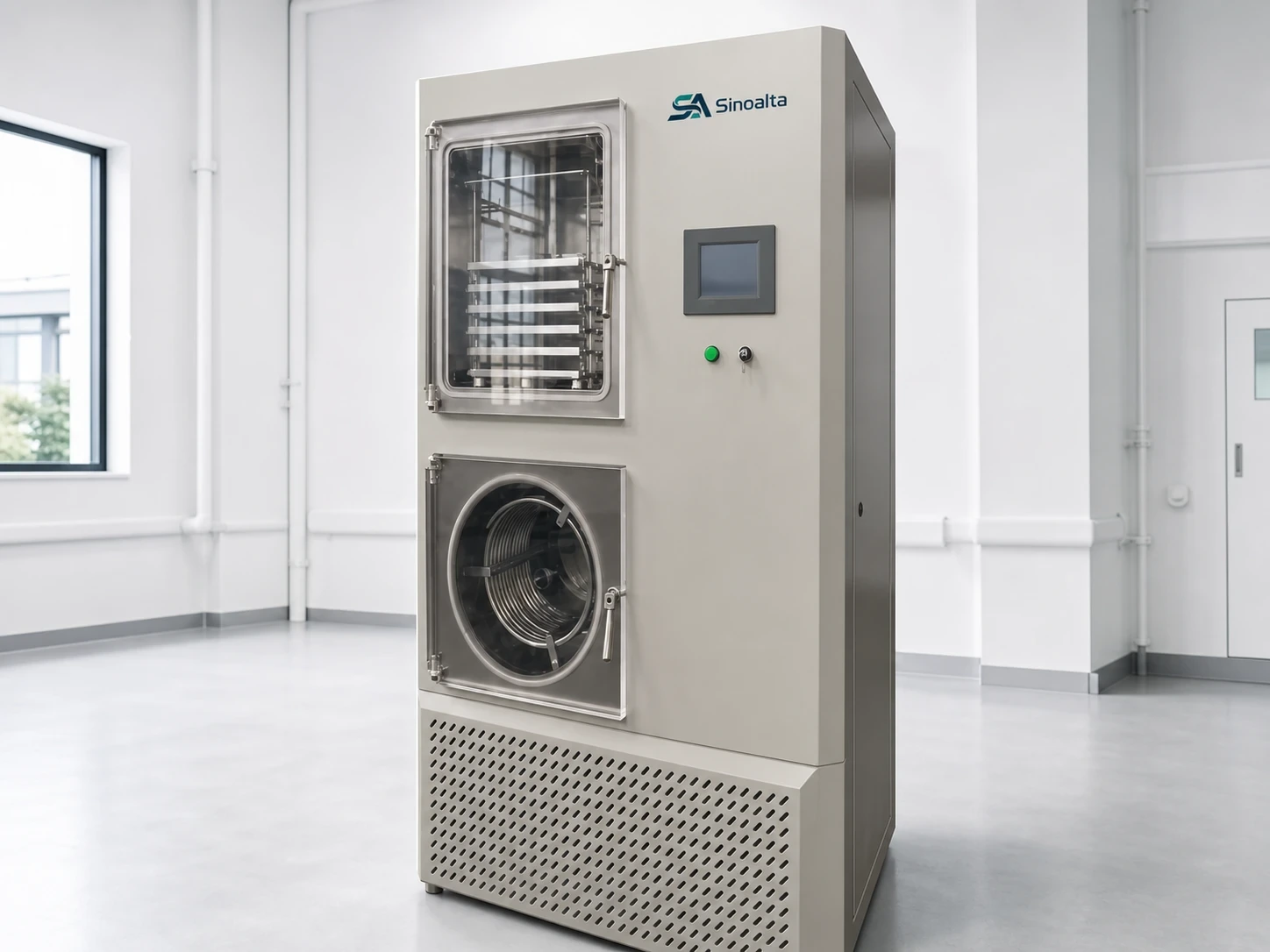
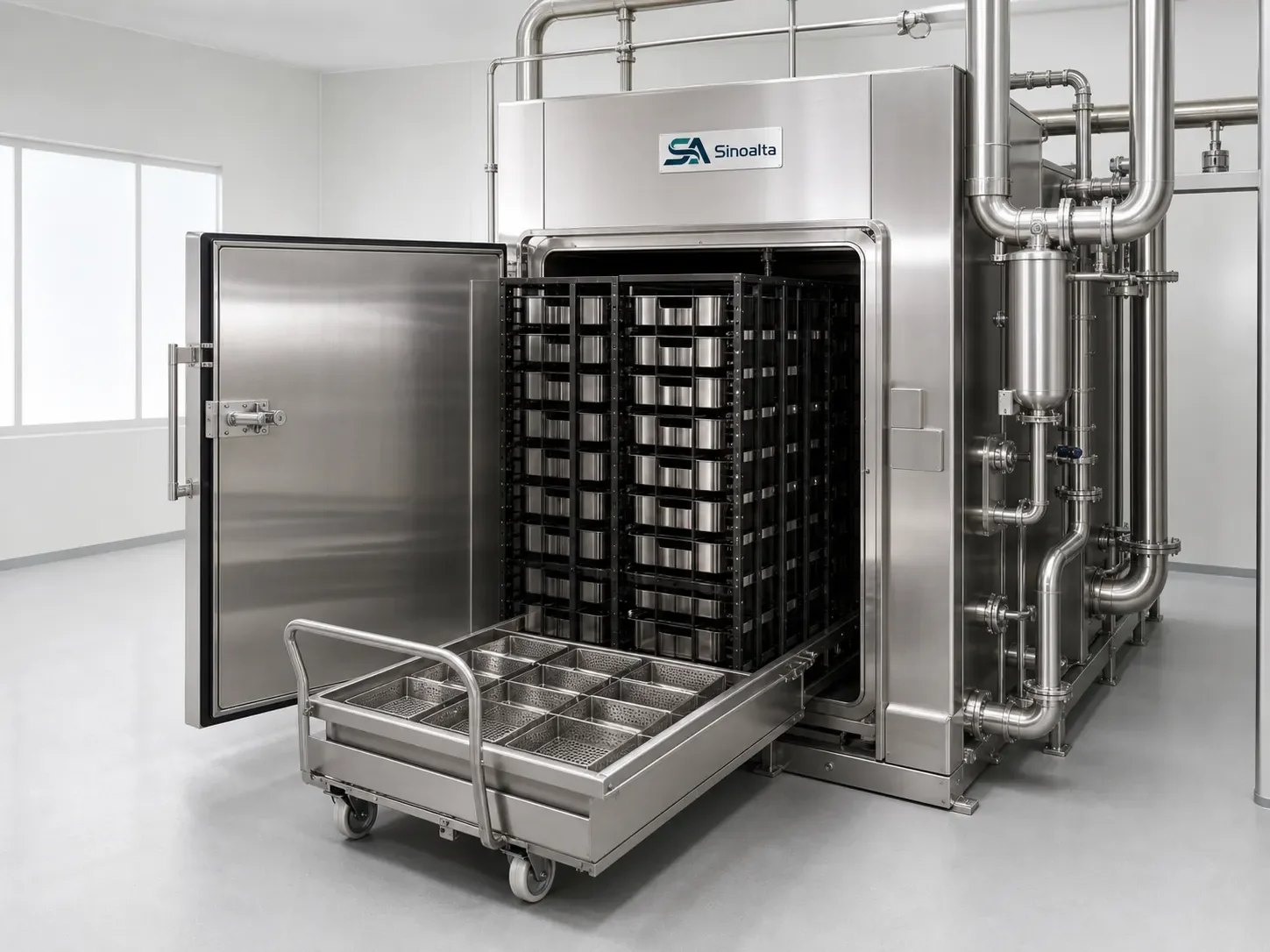
Product Positioning
For freeze-drying and recovery treatment of damp or water-damaged paper documents, archives and books; configurable according to processing volume, loading format and process requirements.
I. Product Name and Functional Overview
The freeze-drying and separation machine for cultural objects, archives and books integrates freeze-drying, pest control, sterilization, disinfection, freezing, dehumidification, humidification, mould prevention and sublimation drying and preservation. It is suitable for freeze-drying and separation, vacuum-nitrogen pest control and studio vacuum disinfestation of paper-based materials including cultural objects, archives, paintings and calligraphy, books, paper and documents.
Under poor storage conditions, especially high temperature and humidity, paper materials are susceptible to mould and harmful organisms. Pests feed on cellulose-rich and starch-rich substances; most prefer darkness, hatch within paper and consume paper and the starch in lining paper, causing major losses to books, archives and documents. More than 30 species of paper-material pests belong to 6 orders and 11 families.
Chemical fumigation pollutes the environment and leaves residues on paper. Mounting and repair is one method of strengthening paper archives, but usually requires new paper matching the original for complete lining or local repair; this may add material and cause adhesion, and later adjustment or use can readily result in tearing. Separation removes the supporting or lining paper and replaces it with new material, whose mechanical strength continues to support and improve the strength of the original archive, thereby extending its life.
This equipment enables sterilization, pest control and disinfection of archives, books and cultural objects, and archive separation, to be completed in the same machine. It performs pest control and disinfection efficiently, comprehensively and without pollution while maximizing archive life. It can freeze-separate severely damaged, tightly adhered archives, paintings and calligraphy, books, damp paper and other materials that can be separated by conventional methods.
II. Working Principle of Freeze-Drying and Separation
First, cultural objects, archives, paintings and calligraphy, books and damp paper are wrapped in film, and the wrapped archives, paper, books and paintings and calligraphy are saturated with water. The saturated materials are then placed on the shelves of the vacuum chamber or in a low-temperature freezer for freezing.
Adhered sheets expand when freezing, and the expansion of ice separates them. The even force produced by ice expansion does not damage archive paper or related materials. The separated frozen paper block is then placed in the vacuum-nitrogen disinfection and separation vessel for ice sublimation. To sublimate the ice, air must be evacuated until the pressure reaches 45~90Pa. After all ice in the archive and other materials has sublimated, the adhered sheets separate automatically.
III. Working Principle of Vacuum-Nitrogen Pest Control
Infested archives, books and other materials are sealed in the vessel, which is evacuated. After vessel pressure reaches 100Pa, high-purity nitrogen with purity above 99.99% is introduced. Repeated evacuation and nitrogen filling reduce oxygen concentration in the vessel to 0.2% while keeping vessel pressure above atmospheric pressure. Holding archives, books and other materials at 25℃ for 48~72 hours kills the harmful organisms in them.
IV. Studio Vacuum Pest-Control Process
The multifunction archive vacuum pest-control machine is used with a vacuum pest-control studio, where museum collections are treated. Collections are placed in the studio and the machine is started according to the procedure. The studio rapidly becomes oxygen-depleted, depressurized and dehydrated. Pest control begins when a near-absolute-vacuum environment is reached. All harmful life in the collections, including adults, pupae, eggs and aerobic bacteria (excluding mould), reaches a 100% kill rate within 8 hours.
V. Equipment Functions and Technical Features
- Shelf pre-freezing; nitrogen or inert gas may be introduced for preservation after drying.
- An internationally recognized compressor brand provides high efficiency, stability and low noise; a high-quality vacuum pump provides high pumping speed and low noise.
- Automatic freeze-drying control system: programmable control from freeze-drying through defrosting.
- Shelves use internationally advanced welding technology and are leak-free.
- Freeze-drying endpoint test system: automatically tests the endpoint after secondary drying to ensure material moisture content meets standard requirements.
- Vacuum regulation system: regulates vacuum during sublimation and secondary drying to prevent foaming of special materials and accelerate freeze-drying.
- A large industrial touchscreen provides good human-machine interaction, clear instructions and simple operation.
- Monitoring system: real-time monitoring of system temperature and vacuum, with a sampling frequency of once per 50ms.
- Freeze-drying recipe storage: stores 2000 fixed or user-defined recipes.
- PC remote monitoring system: remote monitoring up to 1.5km. (Optional)
- Process-data recording system. (Optional)
- Calibration: temperature and vacuum calibration ensures long-term measurement accuracy.
- Freeze-drying curve query: temperature and vacuum curves can be queried for process optimization and validation of freeze-drying results.
VI. Specification Table
| Nominal specification (m²) | 0.5 | 1 | 2 | 3 | 5 | 7.5 | 10 | 13 | 15 | 20 | 25 | 30 | 40 |
|---|---|---|---|---|---|---|---|---|---|---|---|---|---|
| Effective shelf area (m²) | 0.54 | 1.08 | 2.16 | 3.24 | 5.40 | 7.56 | 9.72 | 12.96 | 14.40 | 19.73 | 24.67 | 29.6 | 41.86 |
| Water-capture capacity (kg) | 10 | 20 | 40 | 60 | 100 | 150 | 200 | 250 | 300 | 400 | 500 | 600 | 800 |
| Archive capacity, 3 cm archive boxes (boxes) | 20 | 60 | 84 | 108 | 288 | 360 | 480 | 600 | 660 | 1008 | 1260 | 1512 | 1890 |
| Shelf length (mm) | 450 | 600 | 600 | 900 | 1200 | 1200 | 1200 | 1200 | 1200 | 1495 | 1500 | 1800 | 2000 |
| Shelf width (mm) | 300 | 450 | 600 | 600 | 900 | 900 | 900 | 1200 | 1200 | 1200 | 1495 | 1495 | 1495 |
| Number of shelves (pcs) | 4+1 | 4+1 | 6+1 | 5+1 | 7+1 | 9+1 | 9+1 | 9+1 | 10+1 | 11+1 | 11+1 | 11+1 | 14+1 |
| Shelf spacing (mm) | 80 | 100 | 100 | 100 | 100 | 100 | 100 | 100 | 100 | 100 | 100 | 100 | 90 |
| Shelf operating temperature (℃) | -55~+70 | -55~+70 | -55~+70 | -55~+70 | -55~+70 | -55~+70 | -55~+70 | -55~+70 | -55~+70 | -55~+70 | -55~+70 | -55~+70 | -55~+70 |
| Cold-trap ultimate temperature (℃) | -75 | -75 | -75 | -75 | -75 | -75 | -75 | -75 | -75 | -75 | -75 | -75 | -75 |
| Ultimate vacuum (Pa) | 2.6 | 1 | 1 | 1 | 1 | 1 | 1 | 1 | 1 | 1 | 1 | 1 | 1 |
| Installed power (kW) | 8 | 11 | 18 | 26 | 38 | 48 | 59 | 75 | 78 | 102 | 123 | 139 | 178 |
| Overall length (mm) | 1815 | 3200 | 4500 | 4500 | 5000 | 5400 | 5700 | 5700 | 7200 | 7200 | 7400 | 7800 | 9600 |
| Overall width (mm) | 900 | 1000 | 1300 | 1300 | 1650 | 1650 | 1650 | 1950 | 1950 | 2250 | 2450 | 2450 | 2700 |
| Overall height (mm) | 1850 | 2350 | 2900 | 3000 | 3000 | 3100 | 3600 | 3600 | 3600 | 4000 | 4200 | 4200 | 4400 |
| Weight (t) | 1.5 | 2.5 | 3.0 | 4.0 | 6.06 | 6.5 | 7.5 | 8.5 | 10 | 14 | 18 | 21 | 25 |
VII. Customization and Optional Equipment
- The number, size and height of shelves can be customized to customer requirements.
- A mobile remote-control app and anti-theft system can be customized to customer requirements.
- The PC remote monitoring system is optional, with a maximum monitoring distance of 1.5km.
- The process-data recording system is optional.