
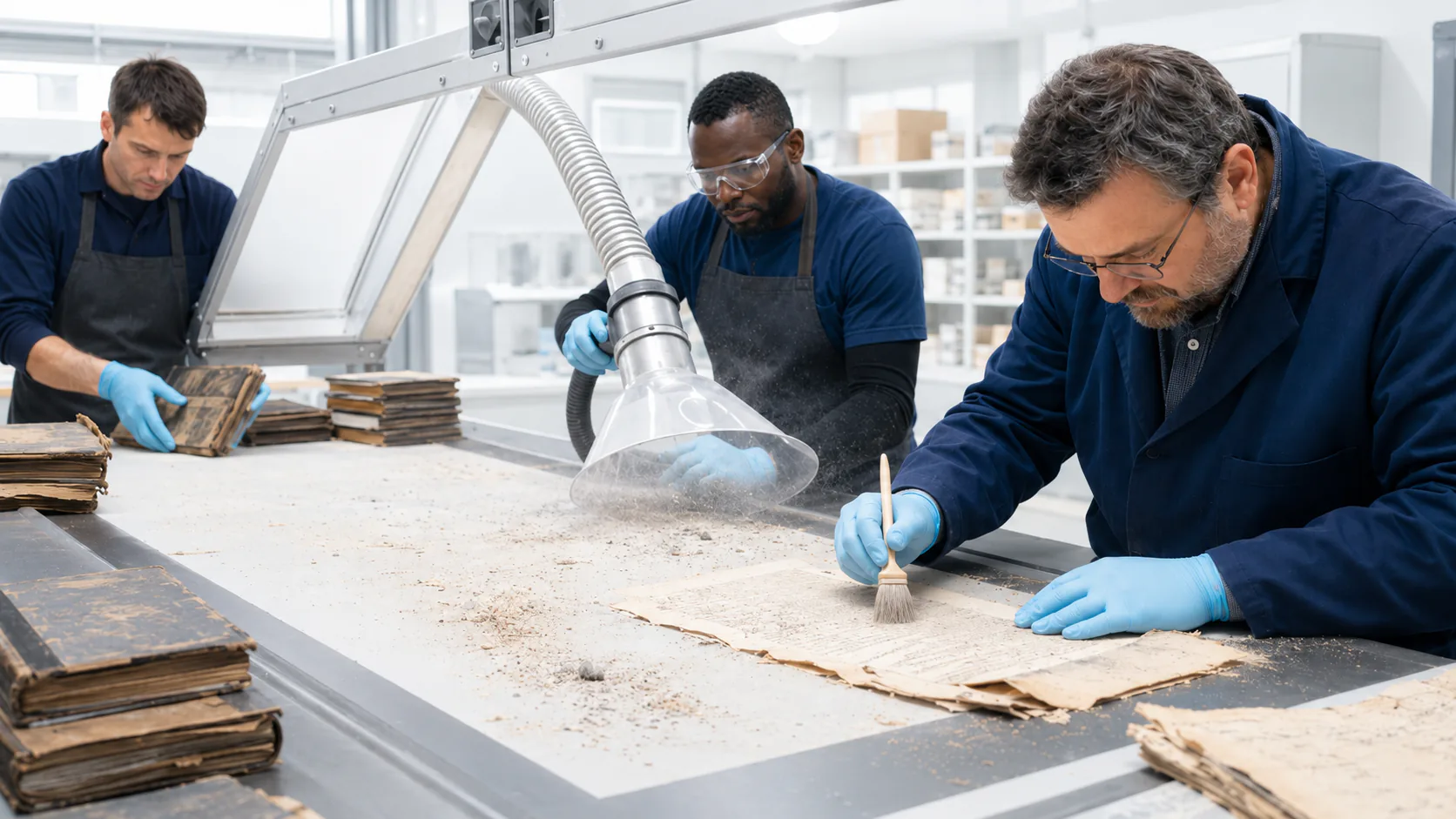
1. Why Dust Matters in Archives
Dust is more than an appearance problem.
Deposited particulate matter can:
- abrade fragile paper surfaces during handling;
- soil pages, bindings and enclosures;
- carry chemically active pollutants;
- provide nutrients or harbourage for some pests and microorganisms;
- transfer contamination from boxes to documents and work surfaces;
- reduce the ability to inspect collections for mould, insects and damage.
Research by The National Archives in the United Kingdom found that vacuuming was more effective at removing test dust than alternative dry cleaning methods and confirmed the value of folders and boxes in limiting dust deposition and transfer.
This supports a basic conservation principle:
Prevent dust entry where possible; remove accumulated dust in a controlled way; protect cleaned collections through good storage and enclosures.
2. Assess Before Cleaning
Not every dusty item should be cleaned in the same way.
Before treatment, assess:
- paper strength;
- surface friability;
- tears and losses;
- media stability;
- binding condition;
- presence of loose pigments;
- active or inactive mould;
- insect residues;
- water or fire damage;
- photographic or mixed-media components;
- previous conservation treatments.
A strong modern record in a stable folder may tolerate routine dry cleaning.
A brittle manuscript with flaking ink may require a conservator and a much more controlled approach.
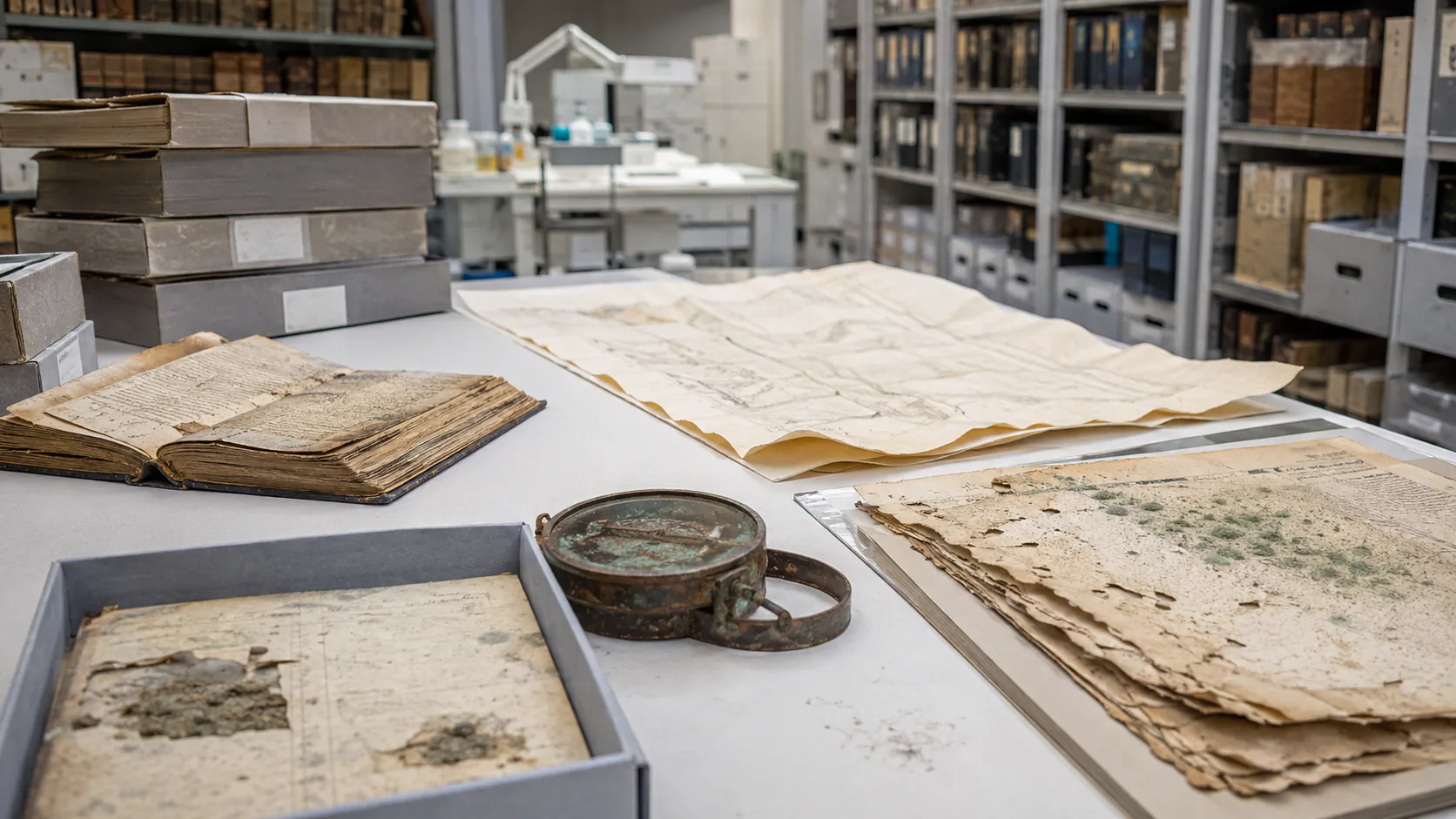
Separate dust from active mould
Dust and mould are not interchangeable problems.
Active mould may appear damp, soft, furry or smeary and usually indicates an unresolved moisture problem.
When active mould is present:
- isolate affected materials;
- stop the moisture source;
- control RH and temperature;
- consider freezing damp paper if immediate treatment is not possible;
- use appropriate occupational-health controls;
- obtain conservation or mould-remediation advice where necessary.
Cleaning should not begin simply because visible material is present on the surface.
3. Dry Surface Cleaning
For stable books and archival paper, dry methods are usually preferred for routine dust removal.
Water or cleaning chemicals should not be introduced unless the material has been assessed for a specific conservation treatment.
Common dry methods may include:
- soft brushes;
- controlled vacuuming;
- vulcanized rubber or conservation sponges for appropriate surfaces;
- specialised eraser materials for selected paper;
- low-abrasion cloths for suitable boxes or shelving.
The objective is to remove loose contamination without driving particles deeper into the object or abrading the surface.
Work from cleaner to dirtier areas
A practical workflow often begins with:
- outer enclosure;
- binding or closed volume;
- text-block edges;
- selected internal surfaces where necessary and safe;
- work surface and tools.
This reduces the chance of transferring heavy exterior dust into cleaner internal areas.
4. HEPA Vacuuming
A vacuum cleaner fitted with a suitable high-efficiency particulate air filter is widely used for collection cleaning.
The important point is not simply the presence of a vacuum motor.
Cleaning performance depends on:
- filtration;
- controllable suction;
- nozzle design;
- operator technique;
- support for the object;
- containment of removed particles.
Control suction
Full domestic vacuum power can damage fragile materials.
Use reduced, adjustable suction and keep the nozzle under operator control.
For many books and documents, a soft brush can be used to direct dust toward the vacuum nozzle without allowing the nozzle to scrape the object.
A protective screen may be placed over the nozzle or above a fragile surface to reduce the risk of small fragments being drawn into the vacuum.
Do not redistribute dust
Dry dusters that simply lift particles into the room can move contamination from one part of the collection to another.
A properly filtered extraction system captures removed dust rather than redistributing it.
This distinction becomes increasingly important during high-volume archive cleaning.
5. Cleaning Books and Bound Volumes
For stable books, exterior dust removal typically begins with the volume closed.
Particular attention may be given to:
- top edge of the text block;
- headcap and spine area;
- fore edge;
- tail edge;
- boards or cover;
- grooves and joints.
The top edge often accumulates the greatest dust load.
Work should direct contamination away from the text block rather than brushing it into the pages.
Interior cleaning
Opening a volume introduces additional handling risk.
Internal cleaning is appropriate only when:
- dust or contamination is present inside;
- the binding opens safely;
- the paper and media are stable;
- the cleaning method is suitable for the material.
Do not force a tight or damaged binding flat for cleaning.
Use supports or book cradles where necessary.
6. Loose Documents and Archival Files
Loose sheets are particularly vulnerable to:
- edge tears;
- creasing;
- loss of fragments;
- disturbance of friable media.
Documents should be supported on a clean flat surface.
Cleaning direction should avoid pushing particles into torn edges, folds or losses.
When working through an archival folder, maintain document order.
The preservation of intellectual arrangement is as important as physical cleaning.
Use temporary markers or batch-control procedures when material must leave its original enclosure.
7. Mould-Affected Books and Paper
Inactive mould residue may be removed from selected materials using controlled HEPA vacuuming and other dry methods.
However, the work environment must be considered.
Mould residues can contain spores, fragments and allergens even when growth is no longer active.
Depending on the scale and condition, controls may include:
- isolation from clean collections;
- local extraction;
- personal protective equipment;
- work in a dedicated cleaning area;
- HEPA-filtered vacuuming;
- cleaning or replacement of contaminated enclosures.
For a large outbreak, specialist advice is appropriate.
Cleaning does not solve the cause
After cleaning, investigate:
- elevated RH;
- leaks;
- condensation;
- inadequate ventilation;
- wet building materials;
- storage against damp exterior walls;
- contaminated HVAC or storage zones.
Without environmental correction, mould can return.
8. Dust Extraction and Negative-Pressure Workstations
For routine or high-volume collection cleaning, a dedicated workstation can improve both process control and staff protection.
A conservation cleaning workstation may combine:
- local negative pressure;
- downdraft or rear extraction;
- adjustable suction tools;
- HEPA filtration;
- controlled lighting;
- height-adjustable working surfaces;
- object supports;
- filter monitoring;
- safe dust collection.
The purpose is not to “suck dust off the collection as fast as possible.”
The workstation should instead create a controlled zone in which particles released by brushing or vacuuming are captured before they spread into the room.
Why negative pressure helps
A local negative-pressure zone directs contaminated air toward the filtration system.
This can reduce:
- dust migration to adjacent clean material;
- operator exposure;
- re-deposition on cleaned objects;
- contamination of the wider conservation laboratory.
Airflow should remain appropriate for fragile material. Excessive local velocity can disturb loose fragments or lightweight documents.
9. A Practical Batch-Cleaning Workflow
Large archive projects benefit from a repeatable sequence.
1. Receive and identify
Record the box, collection, shelf or batch reference.
2. Assess
Check for fragile items, active mould, wet material, pest evidence and mixed media.
Separate material that requires specialist treatment.
3. Clean the enclosure exterior
Remove loose dust before opening.
4. Clean objects
Use the least aggressive method that achieves the cleaning objective.
5. Inspect
Look for:
- mould;
- insects;
- tears;
- brittle paper;
- damaged folders;
- adhesive failure;
- detached components.
6. Rehouse
Replace dirty or unsuitable folders and boxes where required.
7. Record exceptions
Document objects requiring further conservation work.
8. Return to clean storage
Do not place cleaned material back onto dusty shelves or into contaminated enclosures.
10. Shelving, Boxes and Preventive Control
Cleaning is most effective when paired with dust mitigation.
Preventive measures may include:
- appropriate archive boxes and folders;
- closed storage cabinets where suitable;
- filtered HVAC;
- good door and window seals;
- regular shelf cleaning;
- separating loading and dirty-receiving activities from clean storage;
- housekeeping schedules based on dust load and use;
- monitoring for construction or renovation dust.
The National Archives study demonstrated that archival folders and boxes can significantly reduce dust transfer to documents.
The conservation strategy should therefore be:
Control entry → Enclose → Clean when needed → Maintain the storage environment
rather than relying on repeated object cleaning alone.
11. Verification and Quality Control
A collection cleaning project should define what “clean” means.
Possible acceptance checks include:
- visible reduction in loose surface dust;
- no new tears or abrasions;
- no loss of media or fragments;
- preserved archival order;
- clean or replaced enclosures;
- removal of contaminated disposable materials;
- correct HEPA filter maintenance;
- documented exceptions.
For high-volume workflows, periodic review of operator technique helps maintain consistency.
Cleaning is a manual conservation process even when specialised equipment is used.
Planning & Verification
Assess
Separate stable dusty material from fragile, wet, mould-active or mixed-media material.
Plan
Define cleaning method, containment, PPE, object supports, batch control and rehousing requirements.
Clean
Use controlled dry methods with filtered extraction and minimal handling.
Review
Inspect the object, enclosure and work area; record exceptions and return material only to clean storage.
Assess → Plan → Clean → Review
Frequently Asked Questions
What is the safest way to remove dust from old books?
For stable books, controlled HEPA vacuuming with a soft brush and reduced suction is widely used. Fragile bindings, flaking media or brittle paper require more cautious treatment.
Should I use a household vacuum cleaner on archives?
A domestic vacuum with uncontrolled suction can damage material and may not provide appropriate particulate filtration. Collection cleaning should use controlled suction and suitable filtration.
Can books be wiped with a damp cloth?
Routine wet wiping is generally not appropriate for books and archival paper because moisture can cause staining, distortion, media bleeding or adhesive damage. Wet methods require material-specific conservation assessment.
Does vacuuming remove mould?
HEPA vacuuming can remove loose inactive mould residues from suitable material, but it does not correct the moisture problem that caused the outbreak and does not make every mould-affected object safe to handle.
Why use a negative-pressure cleaning workstation?
Local negative pressure helps capture dust and spores released during cleaning, reducing redistribution into the room and onto adjacent collections.
How often should archives be cleaned?
There is no universal interval. Cleaning frequency should reflect dust load, building conditions, collection use, enclosure quality and monitoring data.
Should documents be removed from folders for cleaning?
Only when necessary and safe. Archival order must be maintained, and fragile documents may require individual support or conservation treatment.
Are boxes enough to prevent dust?
Good boxes and folders substantially reduce dust deposition and transfer but do not eliminate the need for clean storage and housekeeping.
Planning a Collection-Cleaning Project?
For collection-scale cleaning, the main design questions are throughput, dust containment, filtration, object handling and separation of dirty and clean workflow.
Sinoalta can support the configuration of archive cleaning workstations and project-specific cleaning areas.
Explore Cleaning & Dust Extraction Solutions →
Selected Technical References
- Wilson, H. and VanSnick, S., The National Archives (UK), The effectiveness of dust mitigation and cleaning strategies
- Northeast Document Conservation Center, Cleaning Books and Shelves
- Smithsonian Libraries and Archives, technical guidance on cleaning smoke- and dust-affected books
- National Archives (UK), guidance on vacuum cleaning archives and storage
Scope and review note: Written by Stella Wynn for Sinoalta. Sinoalta is responsible for this institutional content. Issued and most recently reviewed in August 2026. It summarizes selected conservation sources for project planning and does not replace object-specific assessment, qualified conservation advice, applicable safety requirements or project validation.
 Guide
Guide Guide
Guide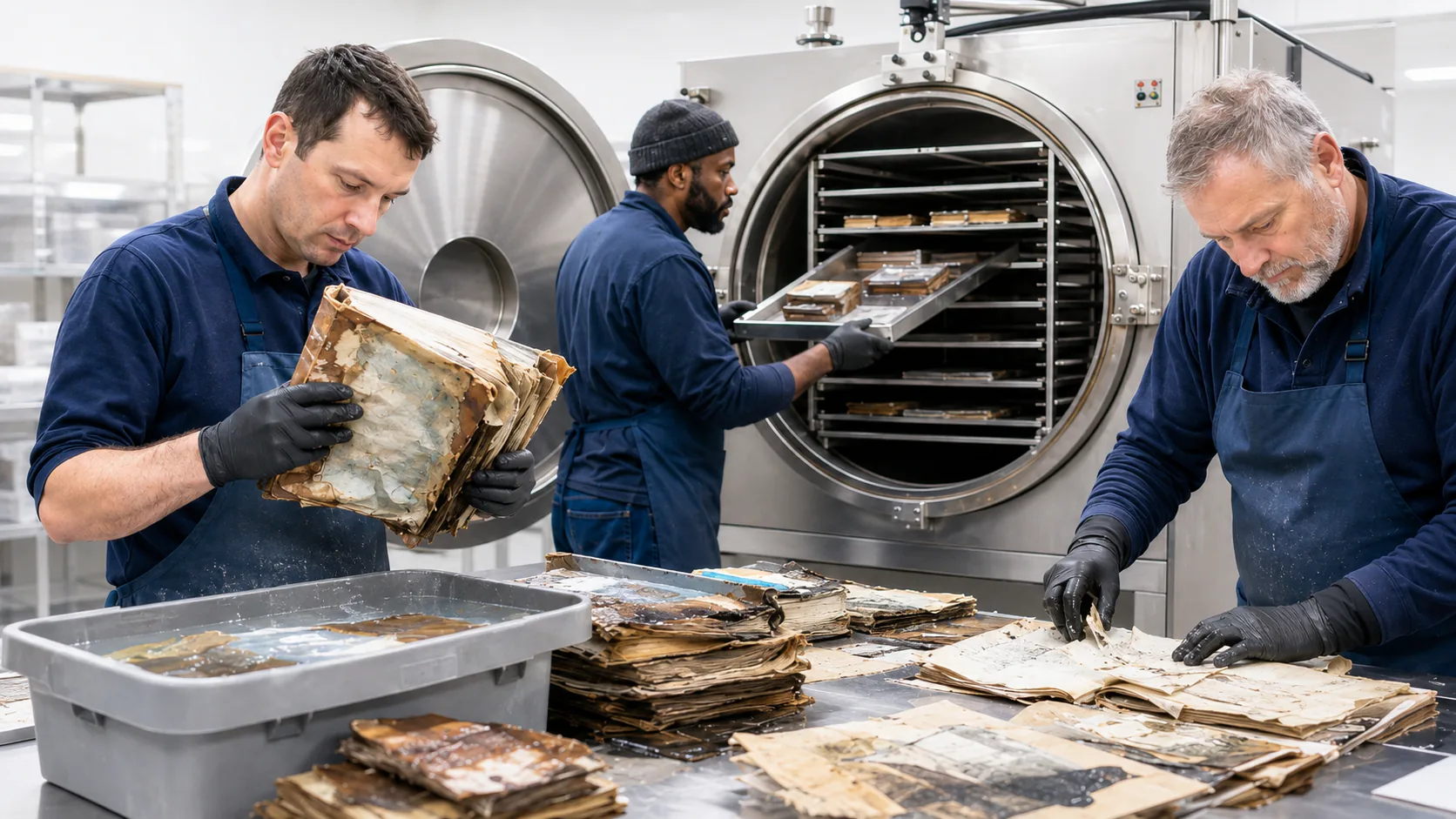 Guide
Guide