The first question after an archive, library or museum collection gets wet is not “Which drying machine should we use?”
It is:
What must be stabilised now, what can be safely air-dried, and what should be frozen before further deterioration occurs?
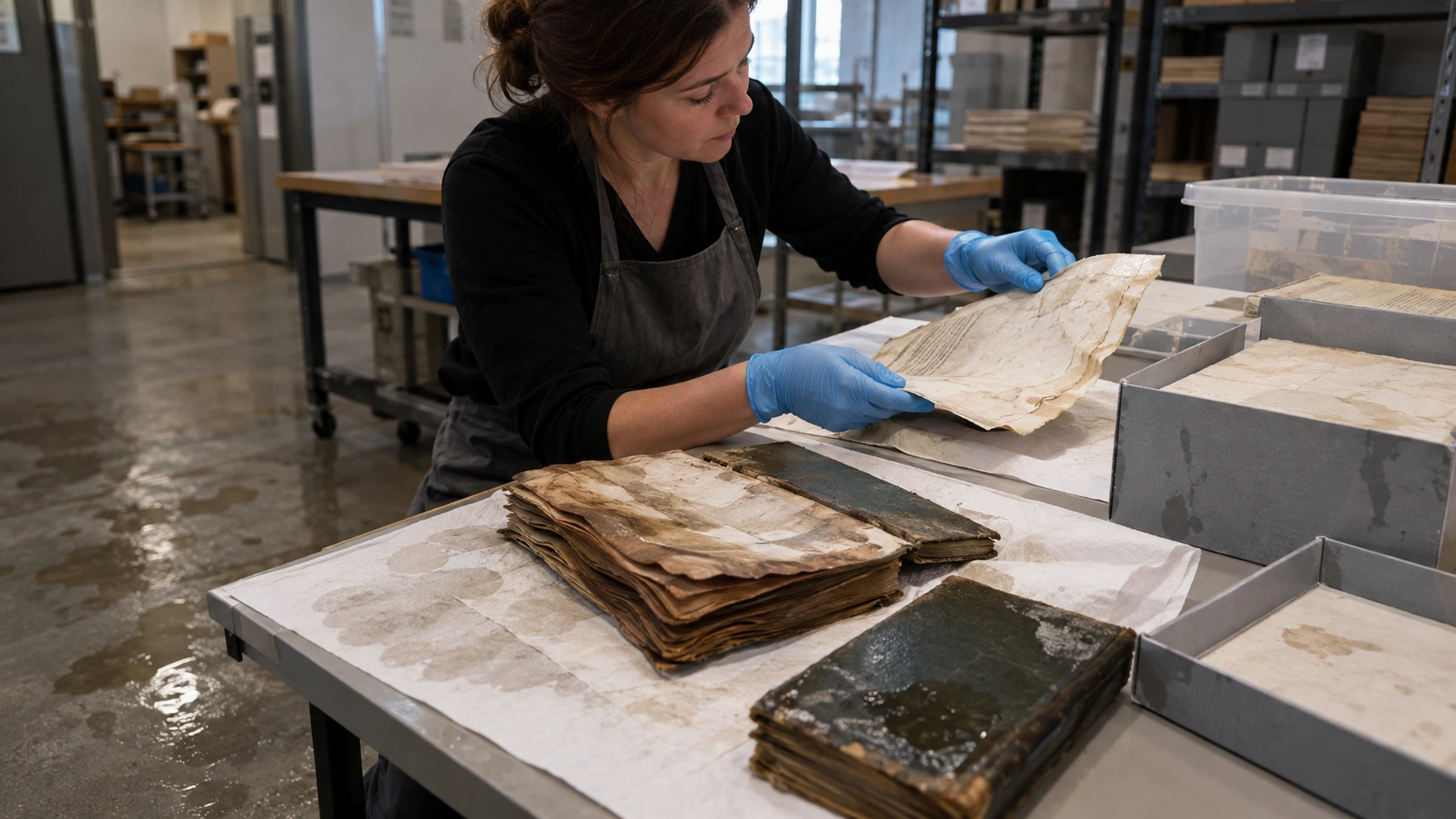
Water incidents quickly become preservation, health, logistics and documentation problems at the same time. Wet paper can distort, inks can move, coated pages can block together, bindings can swell and mould risk can increase if material remains damp.
For a small leak affecting a few damp folders, controlled air drying may be practical. For a large incident involving wet or saturated books and records, freezing can stop the recovery team from racing the clock and allow drying decisions to be made later. Vacuum freeze-drying becomes especially relevant when the volume is large or the material is unsuitable for ordinary air drying.
The following workflow is intended as a triage framework. Valuable, unusual, contaminated or highly sensitive materials should be assessed by a qualified conservator or recovery specialist.
1. Make the site safe before touching the collection
Do not enter a flooded or water-damaged storage area until site safety has been addressed.
Possible hazards include:
- live electrical systems;
- unstable shelving;
- contaminated water;
- damaged ceilings or walls;
- slippery floors;
- biological contamination;
- hidden water above cabinets or ceilings.
The water source should be stopped where possible, and electrical, structural or contamination risks should be handled by the relevant professionals.
Collection recovery begins only after staff can work safely.
2. Document the incident before moving everything
In an emergency it is easy to lose track of what was where.
Before large-scale movement, record:
- affected rooms and shelving zones;
- collection or box numbers;
- water source if known;
- approximate depth or extent of wetting;
- photographs of the area;
- time water was discovered;
- time recovery began;
- material categories and apparent wetness.
As material is packed or moved, maintain a simple box or batch inventory. NEDCC recommends recording collection identity, box numbers, material type and condition such as wet, damp or mouldy so that frozen or outsourced material can later be reconciled.
3. Stop ongoing wetting and stabilise the room
Remove standing water and reduce sources of continued wetting.
Where building systems allow, establish cool, dry conditions and continuous air movement in the recovery area. The purpose is to slow mould development and support drying—not to apply high heat directly to collection material.
The US National Archives advises avoiding high heat and harsh sunlight because rapid drying can permanently damage records.
Do not aim fans directly at fragile wet documents. In drying areas, air movement should support evaporation without scattering pages, debris or mould spores.
4. Triage by wetness, material and quantity
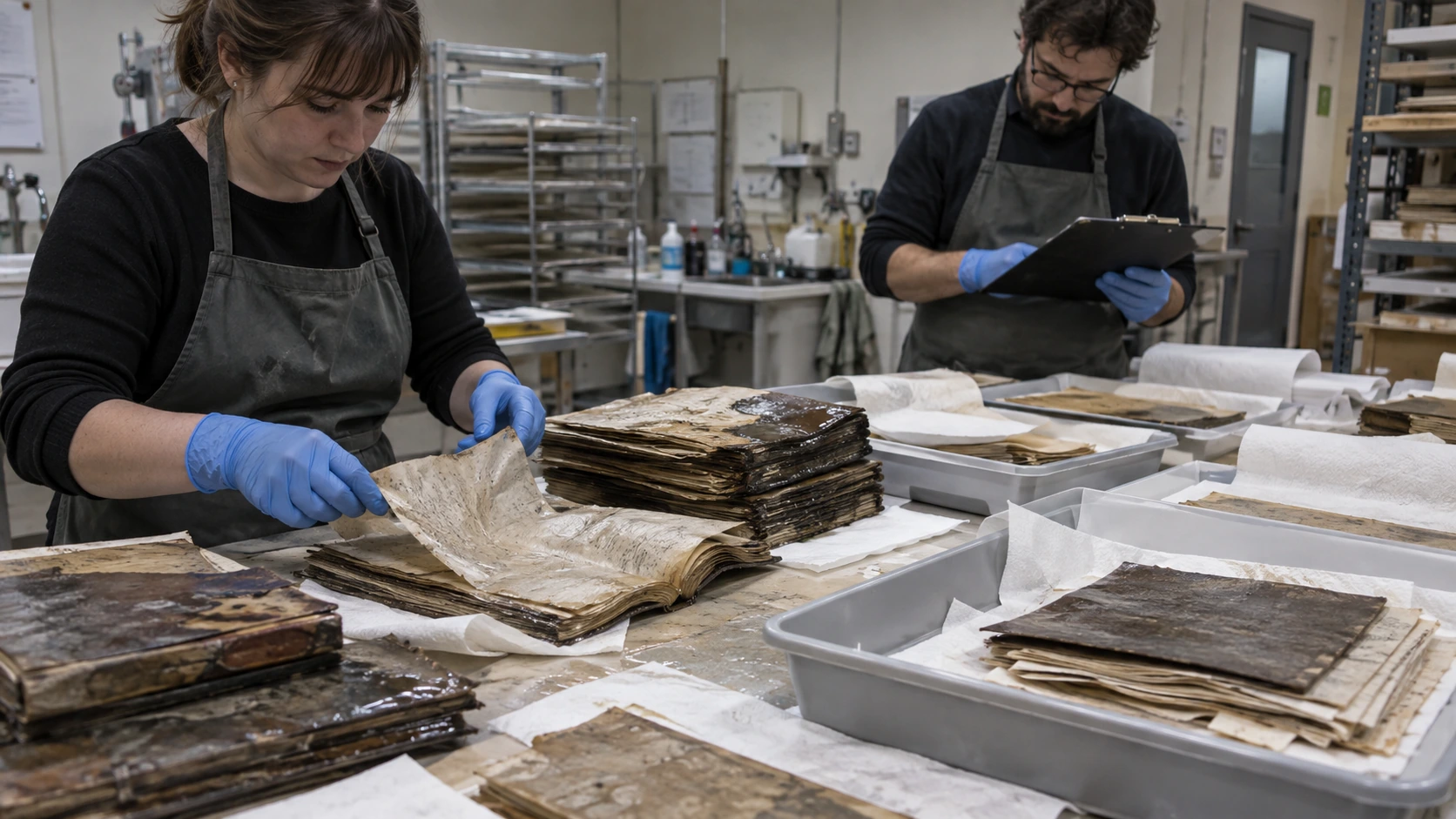
A useful first division is:
- damp: cool or slightly moist but not visibly wet;
- slightly wet: local wet areas, limited water penetration;
- wet: substantial water through pages or folders;
- saturated: thoroughly soaked, heavy, often deformed or stuck together.
Then separate by material type:
- ordinary uncoated paper;
- coated paper;
- books and bindings;
- photographs;
- parchment or vellum;
- magnetic or optical media;
- drawings or documents with water-sensitive media;
- mixed or composite objects.
Finally, estimate scale.
A method that is reasonable for 20 damp books may be impossible for 2,000 wet volumes.
5. Small quantities of damp material may be air-dried
NARA notes that many records respond well to simple air drying when quantities are small and minor physical distortion is acceptable. NEDCC similarly describes air drying as most appropriate for books that are damp or only slightly wet.
Air drying requires:
- a clean, secure space;
- controlled temperature and humidity where possible;
- continuous but gentle air movement;
- absorbent materials;
- enough tables, racks or floor area;
- enough staff to turn, interleave or monitor materials as needed.
Air drying is labour-intensive. It becomes less practical when the incident scale exceeds the available space and staff.
Do not confuse “possible to air-dry” with “best to air-dry”
A small batch of damp records may be straightforward. A saturated bound volume, a coated-paper book or a box of water-sensitive media may require a different route even if the quantity is small.
6. If the quantity cannot be handled quickly, freeze it
This is one of the most important emergency decisions.
The US National Archives states that quantities too large to handle within the first 48 hours should be frozen for later air drying or professional drying.
Freezing is therefore a stabilisation step.
It can:
- stop liquid water movement;
- slow biological activity;
- prevent staff from rushing into uncontrolled drying;
- allow time to organise funding, space and vendors;
- preserve the collection in a manageable batch sequence.
Freezing is not the same as drying. The material still contains water and will require an appropriate drying method later.
7. Pack for freezing with identification intact
Packing should protect the material while preserving order.
NEDCC recommends practices such as:
- packing books flat or spine-down;
- maintaining shelf or box order where possible;
- labelling boxes clearly;
- recording condition and contents;
- avoiding overly tight packing;
- using appropriate interleaving for coated papers or bleeding colourants where needed.
The exact packing method depends on object type and condition. Oversized sheets, fragile bindings and unusual formats may require specialist support.
8. Coated paper requires special attention
Coated paper can become one of the most time-critical materials in a water incident because wet coated surfaces may adhere to each other as they dry.
NEDCC states that books containing coated paper should generally be frozen while still wet and then vacuum freeze-dried rather than simply air-dried after freezing.
If freezing is impossible, wet coated sheets may need to be separated while still wet using specialist handling methods. This can be extremely labour-intensive and carries a high risk of blocking and surface loss.
Do not wait for a coated-paper volume to begin drying in a compressed stack before deciding what to do.
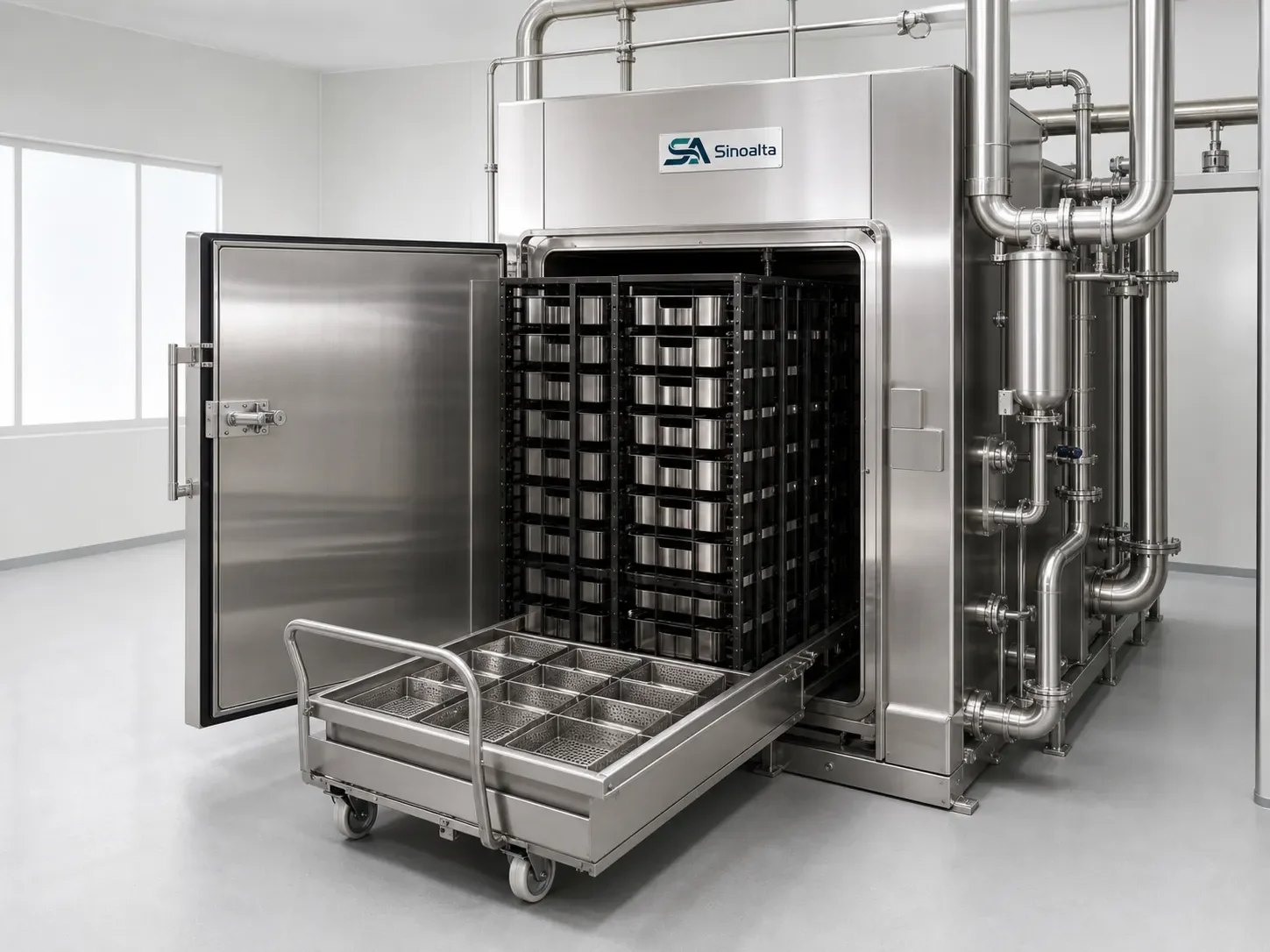
9. Vacuum freeze-drying is most useful for large or difficult batches
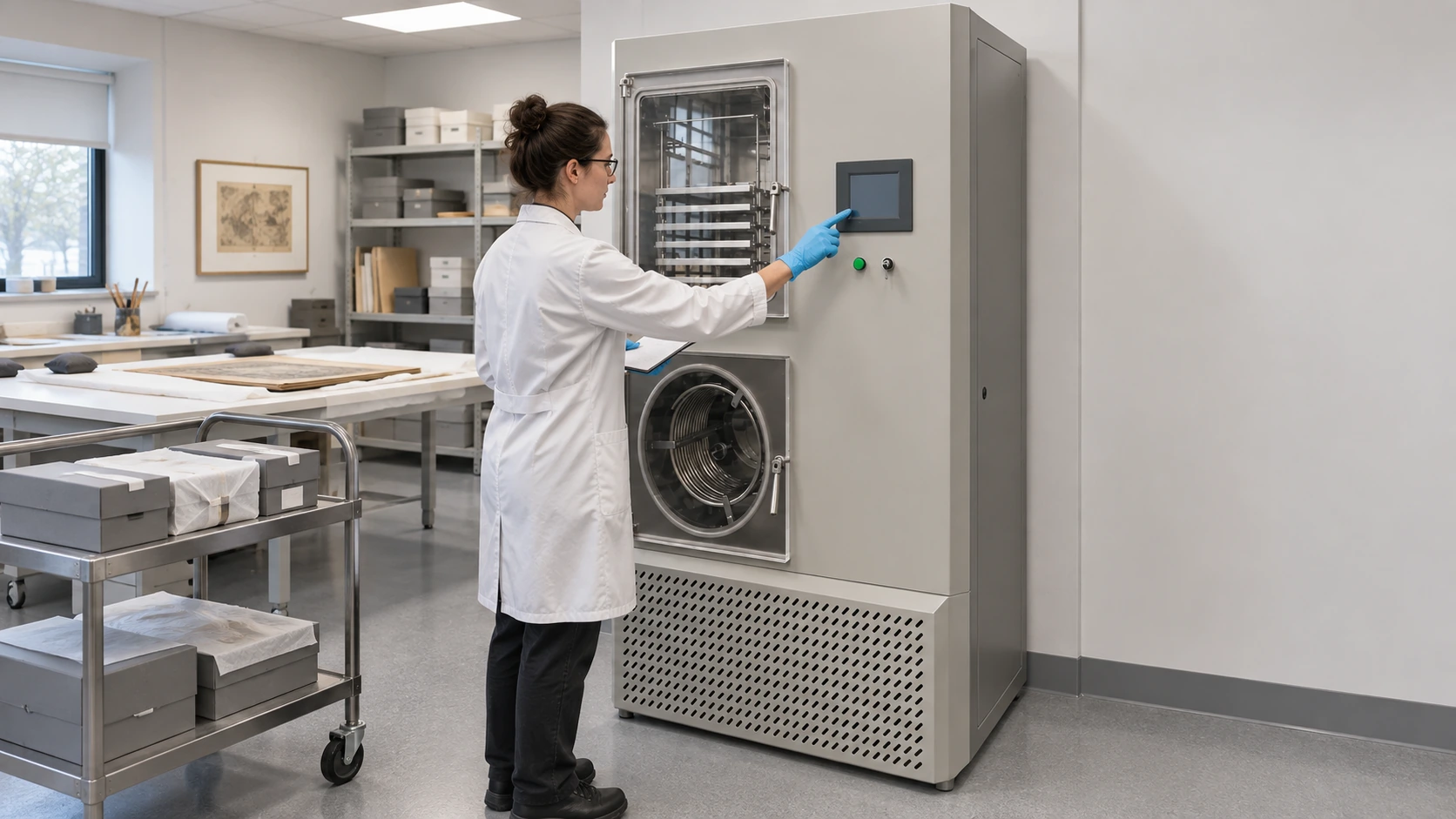
Vacuum freeze-drying removes water from already-frozen material by sublimation: ice changes to vapour without first becoming liquid.
That makes it particularly useful for:
- large numbers of wet books and records;
- saturated paper collections;
- coated paper;
- material with water-sensitive inks or colourants;
- projects where returning frozen material to a liquid-water state would create further distortion or blocking.
NEDCC describes vacuum freeze-drying as well suited to large numbers of wet books and records and to materials with water-sensitive inks and coated paper.
The practical process is:
Freeze → inventory and load → reduce chamber pressure → control heat input → sublimate ice → remove water vapour → verify drying → condition and inspect
Freeze-drying is not automatically necessary for every incident. It should be selected according to material, scale, urgency and desired outcome.
10. Do not assume every wet collection item can be frozen
Some materials require special assessment.
NEDCC advises against freezing certain media such as audio and video tapes, computer tapes, CDs, DVDs and some photographic processes. NARA likewise notes that photographs, metal, plate glass and some furniture may be exceptions.
Therefore, create a special-material stream during triage rather than sending everything in the room to one freezer.
This stream may include:
- photographs;
- audiovisual media;
- parchment;
- paintings and mixed-media works;
- magnetic media;
- objects with soluble or friable surfaces;
- composite materials;
- rare or exceptionally valuable items.
A conservator should review these materials as early as possible.
11. Separate contaminated water incidents from clean-water recovery
Water from a leaking supply pipe is not the same as sewage, flood water or water contaminated with chemicals.
Contaminated incidents may introduce:
- pathogens;
- oils or fuels;
- sewage residues;
- pesticides;
- building debris;
- mould and other biological hazards.
Worker protection, cleaning requirements and the decision to retain or discard some low-value materials can change substantially.
Do not send contaminated material into a normal drying workflow without identifying the hazard and informing any external recovery vendor.
12. Decide early whether you need a recovery vendor
Large incidents become logistics projects quickly.
A commercial recovery vendor may provide:
- freezer transport;
- large-volume freezing;
- vacuum freeze-drying;
- controlled drying;
- inventory support;
- collection cleaning;
- temporary storage.
Before committing material, confirm:
- how boxes will be identified and tracked;
- treatment method;
- expected loading format;
- whether different collection types will be separated;
- cleaning scope;
- post-drying moisture endpoint;
- handling of mould or contaminated water;
- return packaging;
- treatment documentation;
- cost basis and schedule.
NEDCC specifically recommends clear communication with drying vendors about costs, handling and expectations from the beginning.
13. Use a decision table, not one drying rule
| Situation | First-line decision to evaluate |
|---|---|
| A few damp folders | Controlled air drying may be practical |
| Small number of slightly wet books | Air drying may be practical with sufficient space and staff |
| Hundreds of wet records | Freeze to stabilise, then select drying route |
| Saturated books | Freeze; vacuum freeze-drying is often appropriate |
| Coated-paper books | Freeze while wet; evaluate vacuum freeze-drying |
| Water-sensitive inks or colourants | Freeze promptly and seek specialist drying advice |
| Special media / photographs | Separate for specialist assessment |
| Material cannot be processed within ~48 hours | Freeze if material is compatible |
This table is a triage tool, not a universal treatment specification.
14. A practical first-48-hours sequence
0–4 hours
- make the site safe;
- stop the water;
- photograph and document;
- assess scale and material types;
- establish recovery zones.
4–12 hours
- remove standing water;
- move unaffected collections out of danger;
- begin air drying small, suitable quantities;
- identify material that should be frozen;
- contact freezer or recovery vendors if scale is large.
12–24 hours
- continue packing and inventory;
- prioritise coated paper and sensitive media;
- establish cool, dry airflow in active drying areas;
- freeze batches that cannot be processed promptly;
- monitor for mould.
24–48 hours
- complete stabilisation of the remaining wet material;
- confirm drying route for frozen batches;
- separate special media for expert review;
- document all outsourced material;
- plan cleaning, rehousing and post-drying inspection.
The exact sequence will change with the incident, but the principle remains the same: do not leave large quantities of wet collection material waiting for a drying decision.
15. After drying: recovery is not finished
Dry material may still need:
- surface cleaning;
- mould assessment;
- flattening or reshaping;
- rebinding;
- rehousing;
- replacement boxes and folders;
- condition documentation;
- environmental monitoring;
- review of the building failure that caused the incident.
The recovery project is complete only when the collection has returned to stable storage and the original water risk has been addressed.
Frequently asked questions
Should wet books always be freeze-dried?
No. Small quantities of damp or slightly wet books may be air-dried successfully. Freeze-drying becomes more relevant for large quantities, saturated material, coated paper or material that would be at greater risk during ordinary thawing and air drying.
Why is the first 48 hours important?
NARA recommends freezing quantities too large to handle within the first 48 hours. The period is a practical emergency threshold because prolonged wetness increases the difficulty of recovery and the risk of mould and material distortion.
Is freezing the same as drying?
No. Freezing stabilises wet material and buys time. The water remains in the collection until the material is later air-dried, vacuum freeze-dried or treated by another suitable drying process.
Can coated paper be air-dried?
Wet coated paper is highly prone to blocking. NEDCC recommends freezing wet coated-paper books and using vacuum freeze-drying rather than air drying them after freezing.
What information should be sent to a freeze-drying vendor?
Provide material type, quantity, wetness, packing format, presence of coated paper or sensitive media, contamination status, box inventory, desired documentation and any special handling requirements.
Related Sinoalta resources
- Freeze-Drying Water-Damaged Books & Archives: https://sinoalta.com/resources/technical-guides/freeze-drying-water-damaged-books/
- Freeze-Drying vs Controlled Low-Temperature Drying: https://sinoalta.com/resources/blog/freeze-drying-vs-low-temperature-drying-books-archives/
- Water-Damaged Books & Archives Recovery: https://sinoalta.com/solutions/water-damaged-books-archives-recovery/
- Archive Freeze Dryer: https://sinoalta.com/products/archive-freeze-dryer-for-water-damaged-books-documents/
Sources and further reading
- US National Archives, Wet Records: https://www.archives.gov/preservation/holdings-maintenance/wet-records
- Northeast Document Conservation Center, Emergency Salvage of Wet Books and Records: https://www.nedcc.org/free-resources/preservation-leaflets/3.-emergency-management/3.6-emergency-salvage-of-wet-books-and-records
- Northeast Document Conservation Center, Freezing and Drying Wet Books and Records: https://www.nedcc.org/free-resources/preservation-leaflets/3.-emergency-management/3.12-freezing-and-drying-wet-books-and-records
- Canadian Conservation Institute, Framework for Preserving Heritage Collections: https://www.canada.ca/en/conservation-institute/services/preventive-conservation/framework-preserving-heritage-collections.html