1. Why Acidic Paper Is a Preservation Problem
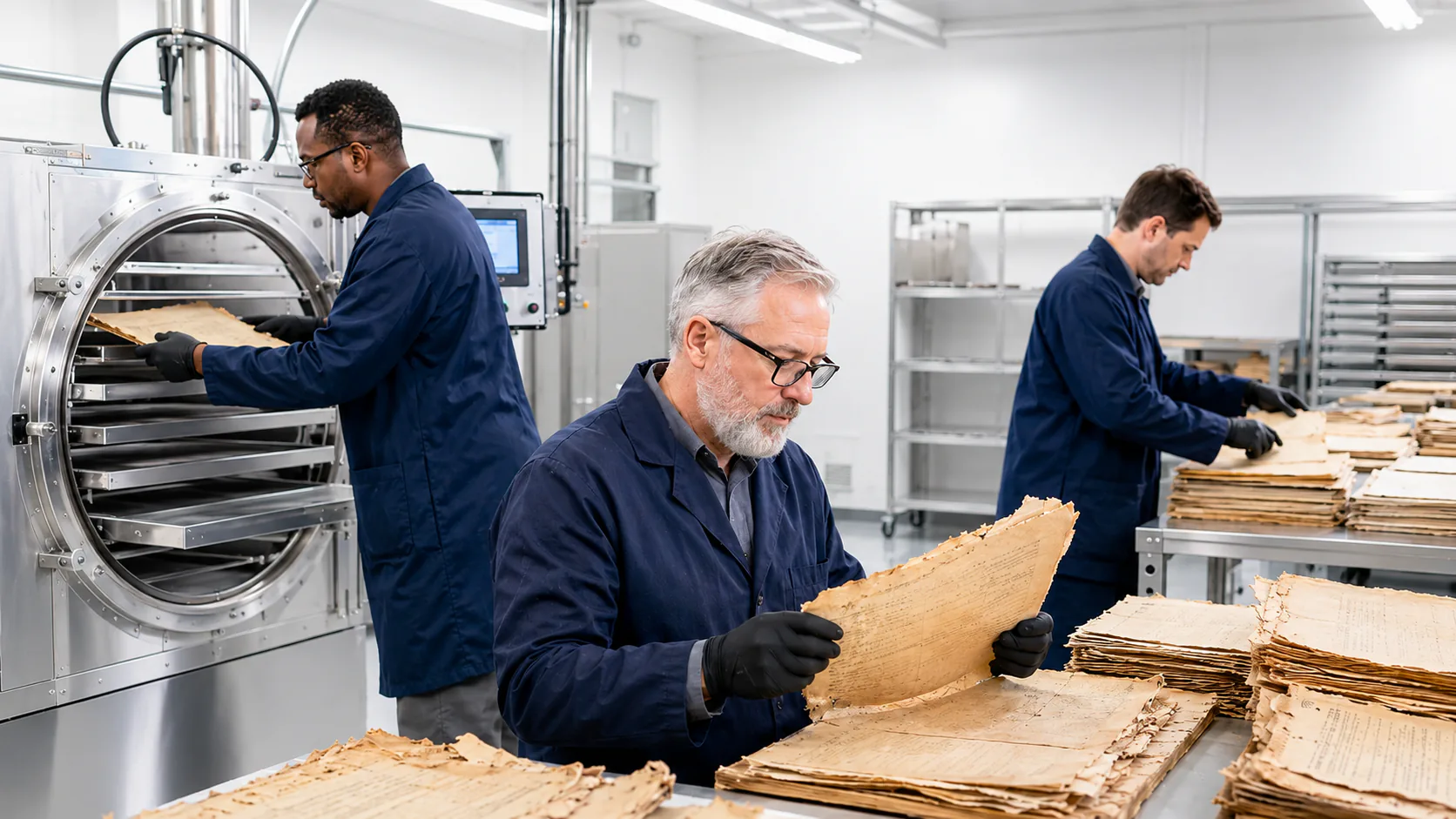
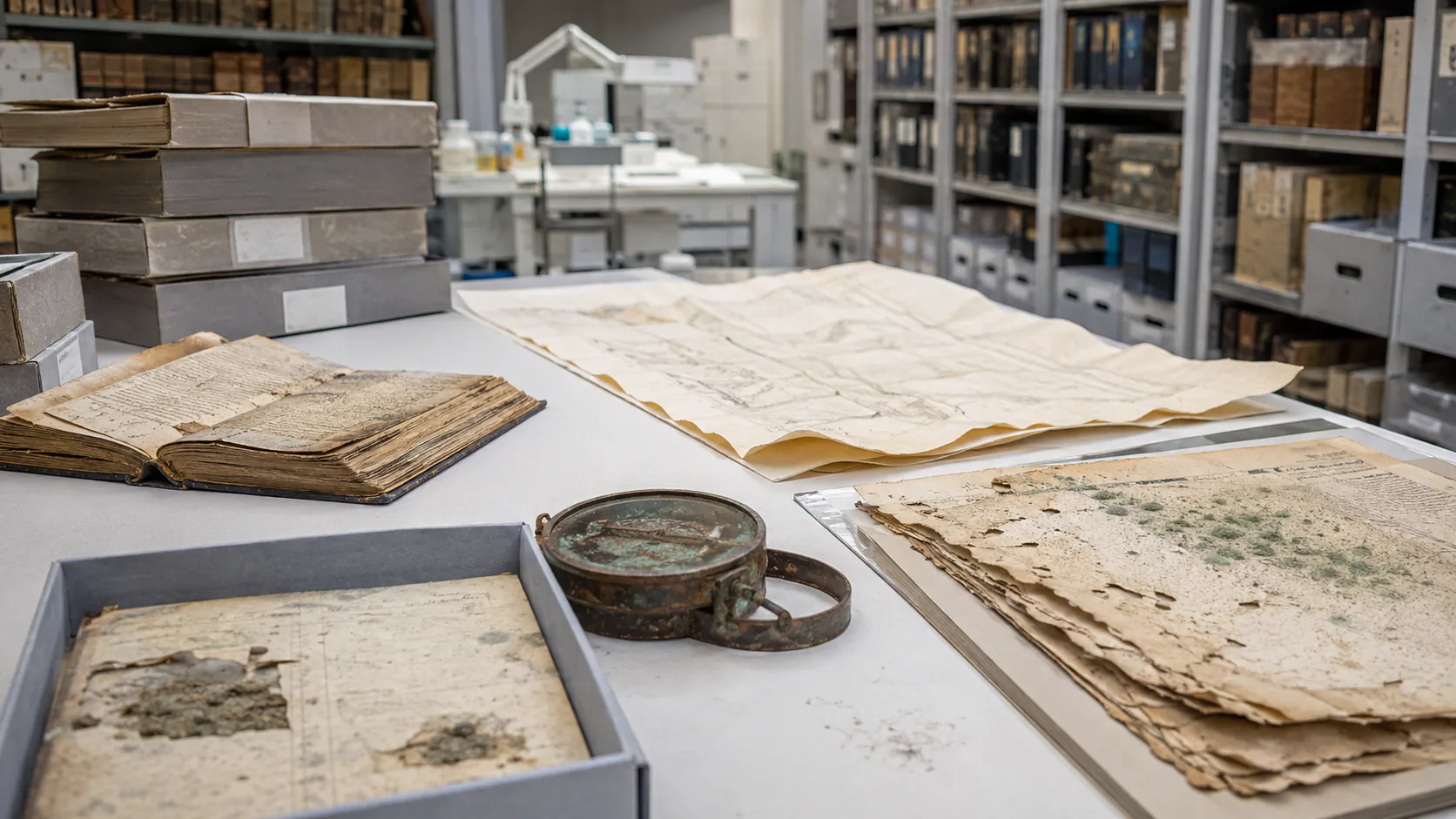
Many nineteenth- and twentieth-century books and records were produced from papers that contain acidic components or that become increasingly acidic during ageing.
Acidity can accelerate hydrolytic degradation of cellulose.
Over time, affected paper may become:
- yellowed;
- weak;
- brittle;
- prone to tearing;
- difficult to handle.
The rate of deterioration is influenced by:
- paper composition;
- lignin and sizing;
- acidity;
- temperature;
- relative humidity;
- pollutants;
- storage history.
This is why mass deacidification should be viewed as one element of a preservation programme rather than as a single cure for all paper deterioration.
2. What Deacidification Does
The basic conservation objective is to reduce the effect of acids within paper and, in many processes, introduce an alkaline reserve that can neutralise future acidic by-products.
In simplified terms:
Acidic paper → Neutralisation / alkaline treatment → Reduced acid-catalysed degradation
The Library of Congress has conducted one of the best-known large-scale mass deacidification programmes and has treated millions of books and selected manuscript materials.
This history demonstrates that mass deacidification is a genuine preservation strategy for appropriate material.
It does not mean every paper collection should be treated.
3. What Deacidification Does Not Do
One of the most important professional distinctions is:
Deacidification can slow future acidic degradation, but it cannot recreate mechanical strength that the paper has already lost.
NARA specifically emphasises this point when discussing mass deacidification for archives.
If a sheet is already extremely brittle and fragmenting, increasing alkalinity does not rebuild broken cellulose chains.
Such material may require:
- conservation repair;
- strengthening;
- supported handling;
- reformatting or digitisation;
- improved housing;
- reduced use.
This makes candidate selection critical.
4. Good Candidates for Mass Deacidification
Mass treatment is generally most useful for material that is:
- genuinely acidic;
- still mechanically strong enough to withstand handling and processing;
- expected to remain valuable and accessible for a long period;
- compatible with the selected treatment chemistry;
- sufficiently homogeneous to justify batch processing.
The Library of Congress programme specifically prioritised structurally sound books on acidic paper and excluded some categories that were already alkaline, overly brittle or otherwise unsuitable.
Material already on permanent or alkaline paper
If a book is already alkaline or manufactured on permanent paper, deacidification may provide little additional benefit.
Severely brittle paper
If the paper has already lost much of its strength, deacidification alone is not the solution.
Material scheduled for replacement or reformatting
An institution may decide that deacidification is not cost-effective for:
- duplicates;
- short-retention material;
- items already scheduled for digitisation or microfilming;
- material available in a more stable replacement format.
Preservation decisions should consider value and use, not only chemistry.
5. Why “Mass” Deacidification Is Different From Individual Treatment
A conservator can deacidify an individual paper object under closely controlled conditions.
Mass deacidification is designed for large numbers of books or documents.
That changes the problem.
The process must handle:
- variable paper;
- different inks;
- bindings;
- adhesives;
- inserts;
- labels;
- coated materials;
- unexpected mixed media.
It must also manage:
- tracking;
- batch identity;
- loading;
- treatment uniformity;
- post-treatment inspection;
- institutional access.
The engineering challenge is therefore not simply “make paper alkaline.”
It is:
Treat a large collection efficiently without creating unacceptable chemical, physical or intellectual-control risks.
6. Main Process Categories
Mass deacidification technologies have used several broad approaches.
Aqueous treatment
Water-based alkaline treatment can be effective for suitable paper.
Advantages may include:
- good penetration;
- washing away some soluble acidic products;
- introduction of alkaline reserve.
Limitations include:
- paper swelling;
- distortion;
- water-sensitive inks;
- bindings that cannot be immersed;
- soluble media.
For this reason, aqueous treatment is often more straightforward for suitable loose sheets than for intact bound volumes.
Nonaqueous or liquid-phase treatment
Solvent-based or dispersion systems were developed partly to reduce the swelling associated with water.
Modern commercial processes may deposit alkaline materials such as magnesium compounds within the paper.
Each chemistry has its own:
- penetration behaviour;
- alkaline reserve;
- solvent requirements;
- appearance effects;
- process compatibility.
Vapour- or gas-phase approaches
Various vapour-phase systems have also been researched historically.
The important point for a technical guide is not to imply that every process is equivalent.
Each mass-deacidification technology needs its own performance and compatibility data.
7. Alkaline Reserve
Deacidification is not only about raising the measured pH at the moment of treatment.
Many processes aim to leave an alkaline reserve in the paper.
This reserve can help neutralise acidic compounds that form later.
A quality-control programme may therefore evaluate:
- post-treatment pH;
- distribution of alkaline agent;
- alkaline reserve;
- penetration;
- ageing performance.
A high surface pH by itself does not prove that a paper collection has received a uniform or durable treatment.
8. Screening for Unsuitable Material
Screening is one of the most important parts of mass-deacidification planning.
Possible concerns include:
- water-soluble inks;
- unstable dyes;
- photographs;
- blueprints or other reproduction processes;
- thermal papers;
- pressure-sensitive materials;
- coated papers;
- certain plastics;
- damaged bindings;
- degraded adhesives;
- metal fasteners;
- inserted mixed media.
The exact exclusion list depends on the selected process.
Why archives can be more difficult than libraries
NARA has highlighted a major difference between library and archival collections.
A published book is usually a defined physical item.
An archival box may contain:
- correspondence;
- photographs;
- microfilm;
- blueprints;
- thermal copies;
- fasteners;
- labels;
- mixed media.
Screening can therefore become labour intensive.
The institution must decide whether the preservation benefit justifies the handling and risk.
9. Maintaining Intellectual Control
For archival material, physical order can carry meaning.
If folders and records are removed for treatment, the project must prevent:
- misfiling;
- loss of sequence;
- separation from labels;
- detachment of related inserts.
A mass-treatment workflow should therefore define:
- batch IDs;
- box and folder references;
- barcoding or tracking where appropriate;
- chain of custody;
- loading order;
- return verification.
This is a preservation requirement, not just an administrative detail.
10. Material Compatibility and Appearance
A deacidification process should be evaluated for more than pH.
Possible treatment effects may include:
- colour change;
- surface deposits;
- altered paper feel;
- changes in sizing;
- interaction with inks;
- adhesive softening or embrittlement;
- binding distortion;
- odour;
- residue.
A responsible programme uses representative testing and clear acceptance criteria.
For high-value or unusual material, individual conservation assessment may be more appropriate than mass treatment.
11. Quality-Control Criteria
A mass-deacidification programme may use several categories of evidence.
Chemical
- pH;
- alkaline reserve;
- treatment-agent distribution.
Physical
- paper strength;
- fold endurance or tensile behaviour where relevant;
- dimensional change;
- binding condition.
Optical
- colour difference;
- staining;
- surface deposits;
- changes to inks or media.
Process
- batch identity;
- treatment time;
- chemical consumption;
- operating conditions;
- rejected items;
- deviations.
Ageing performance
Laboratory evaluation may use accelerated ageing to compare treated and untreated papers.
Accelerated ageing is a comparative research tool; it is not a literal prediction of the exact number of calendar years a book will survive.
12. Mass Deacidification Versus Paper Strengthening
Acid neutralisation and mechanical strengthening are different objectives.
A paper can be:
- acidic but still strong;
- neutral but already weak;
- both acidic and weak.
This distinction should guide treatment.
For strong acidic paper: deacidification may slow future deterioration.
For brittle weak paper: repair, reinforcement, reformatting or restricted handling may be more urgent.
Some research processes attempt to combine deacidification and strengthening, but such systems should be evaluated on their own evidence.
13. Environment Still Matters After Treatment
A treated book returned to a hot, humid or polluted environment will continue to age.
NARA’s preservation planning has historically prioritised:
- suitable storage environment;
- good housings;
- protection of heavily used material;
- treatment where justified.
This is a useful principle.
Mass deacidification should complement:
- temperature/RH management;
- clean storage;
- good boxes and enclosures;
- safe handling;
- digitisation or reformatting where appropriate.
It should not substitute for them.
14. Planning a Mass-Deacidification Programme
Step 1 — Define the collection problem
Estimate:
- quantity of acidic material;
- publication or record dates;
- paper condition;
- brittleness;
- use level;
- long-term value.
Step 2 — Define selection criteria
Identify:
- eligible material;
- exclusions;
- priority subjects or record groups;
- treatment scale.
Step 3 — Evaluate the process
Review:
- chemistry;
- alkaline reserve;
- media compatibility;
- binding compatibility;
- throughput;
- handling requirements;
- documentation.
Step 4 — Pilot
Treat representative low-risk samples before full-scale implementation.
Step 5 — Establish QA
Define pre- and post-treatment checks.
Step 6 — Integrate with storage
Return treated items to an environment designed to slow future deterioration.
Planning & Verification
Assess
Determine acidity, strength, value and media compatibility.
Select
Create clear inclusion and exclusion criteria.
Treat
Apply a controlled, documented mass-deacidification process.
Verify
Check chemical performance, physical condition and batch records.
Assess → Select → Treat → Verify
Frequently Asked Questions
What is mass deacidification?
Mass deacidification is the treatment of large quantities of acidic paper or books to neutralise acids and usually deposit an alkaline reserve that slows future acid-catalysed degradation.
Does deacidification make brittle paper strong again?
No. It can slow future acidic deterioration, but it does not rebuild cellulose chains or restore mechanical strength already lost.
Which books are good candidates?
Structurally sound books on acidic paper are generally better candidates than already alkaline, coated, highly brittle or compositionally incompatible material.
Does every acidic book need deacidification?
No. Selection should consider value, expected use, condition, availability of replacement copies, storage environment and treatment compatibility.
What is alkaline reserve?
It is alkaline material remaining in the paper after treatment that can help neutralise acids formed during future ageing.
Is mass deacidification safe for inks?
Compatibility depends on the specific process and media. Water-soluble, reactive or unusual inks may require exclusion or testing.
Can archival records be mass deacidified?
Yes, selected archival paper may benefit, but mixed media and the need to maintain intellectual order make screening and workflow more complex than for homogeneous library books.
Is coated paper deacidified?
Some coated papers may be low-priority or unsuitable depending on the process because coatings, chemistry and treatment response differ from uncoated paper.
Does deacidification replace climate control?
No. Temperature, RH, pollution and handling continue to affect treated paper.
Planning a Paper-Preservation Programme?
Mass deacidification is most effective when the institution has clear selection criteria and combines treatment with good storage, handling and documentation.
Sinoalta can support system configuration for project-specific paper-treatment workflows.
Explore Deacidification Solutions →
Selected Technical References
- Library of Congress, Mass Deacidification Program
- Library of Congress, Mass Deacidification: A Selective Bibliography
- National Archives and Records Administration, Mass Deacidification: Considerations for Archives
- Library of Congress technical evaluations of mass-deacidification processes
Scope and review note: Written by Stella Wynn for Sinoalta. Sinoalta is responsible for this institutional content. Issued and most recently reviewed in August 2026. It summarizes selected conservation sources for project planning and does not replace object-specific assessment, qualified conservation advice, applicable safety requirements or project validation.
 Guide
Guide Guide
Guide Guide
Guide