“Please quote one temperature-and-humidity control system” is not a complete controlled-environment specification.
Museum and archive equipment can control very different things: relative humidity, temperature, oxygen concentration, particles, pollutants, pressure, airflow or combinations of these variables. A cabinet, display case, treatment chamber, workstation and controlled room also operate very differently even when they share the same sensor type.
A useful RFQ therefore translates a preservation requirement into measurable technical and operational requirements.
The sequence should be:
Material and risk → controlled variable → enclosure boundary → operating workflow → performance → monitoring → utilities → acceptance
This checklist is designed for conservators, museum engineers, project consultants and procurement teams preparing a request for quotation.
1. Define what is being protected
Before specifying any equipment, describe the collection or material.
Include:
- material type;
- object or sample dimensions;
- quantity;
- current condition;
- storage, display or treatment duration;
- handling frequency;
- known sensitivity;
- whether several material types share the same space.
This is not an administrative detail. CCI’s risk-based preventive-conservation framework emphasises that different collections respond differently to water, pests, pollutants, incorrect temperature and incorrect RH. A requirement that is appropriate for one material may be unnecessary or even unsuitable for another.
Avoid starting with a copied setpoint such as “22°C and 50% RH” unless that value has already been justified for the specific collection or project.
2. State the preservation objective in plain language
Write one or two sentences explaining what the system must achieve.
Good examples:
- reduce RH fluctuation around a humidity-sensitive metal collection;
- maintain a stable display-case microclimate when gallery RH varies seasonally;
- provide a low-oxygen atmosphere for documented insect treatment;
- remove dust from archive materials while containing airborne particles;
- maintain a controlled low-humidity enclosure for long-term storage;
- recover water-damaged books using a controlled freeze-drying process.
Weak examples:
- “museum-grade”;
- “high precision”;
- “intelligent system”;
- “advanced sterilisation”;
- “constant temperature and humidity.”
Marketing language is not measurable. Preservation objectives are.
3. Identify the variable that actually needs control
A controlled environment can involve one or several variables.
Relative humidity
Specify only when material sensitivity or project requirements justify it. CCI notes that different collections have different RH sensitivities and that there is no single universally correct RH for all materials.
Temperature
Temperature may affect material degradation, RH behaviour, visitor comfort and treatment processes. Decide whether temperature must be actively controlled or only monitored.
Oxygen concentration
Relevant to anoxic treatment or low-oxygen display/storage applications. Define the measurement range and process acceptance method rather than simply asking for a nitrogen supply.
Particles and dust
Relevant to cleaning workstations, storage interfaces and controlled processing areas. Define containment and filtration requirements.
Gaseous pollutants
Relevant to some sealed display or storage environments. Define target pollutants and whether mitigation uses material selection, ventilation, sorbents or active filtration.
Pressure and airflow
Relevant to negative-pressure cleaning enclosures, positive-pressure display systems, clean environments and some treatment chambers.
The RFQ should distinguish control variables from monitoring variables. A system may monitor CO₂ or PM2.5 without actively controlling them.
4. Define the environmental boundary
The same target can be applied at very different scales.
Choose the boundary intentionally:
- object enclosure;
- box or bag;
- storage cabinet;
- display case;
- treatment chamber;
- conservation workstation;
- storage room;
- laboratory;
- room-in-room system.
Ask:
- What volume is being controlled?
- How often is the boundary opened?
- How large are the access doors?
- Does a person enter the controlled space?
- Is the system continuous or batch-based?
- Does the equipment need to serve one enclosure or several?
A cabinet-level solution may be more efficient than conditioning an entire room when only a small collection needs specialised conditions. Conversely, hundreds of frequently accessed cabinets may be less practical than room-level environmental control.
5. Specify operating conditions around the equipment
Suppliers need to know the environment outside the controlled boundary.
Provide, where available:
- room temperature range;
- room RH range;
- seasonal variation;
- altitude if relevant to process equipment;
- dust load or pollution concerns;
- heat sources;
- frequency of door opening;
- object loading pattern;
- maximum batch or storage load;
- local ventilation conditions.
A control system designed for a stable conditioned gallery faces a different load from one installed in a hot, humid and intermittently conditioned space.
Do not expect the supplier to infer site conditions from country name alone.
6. Convert “high precision” into measurable performance
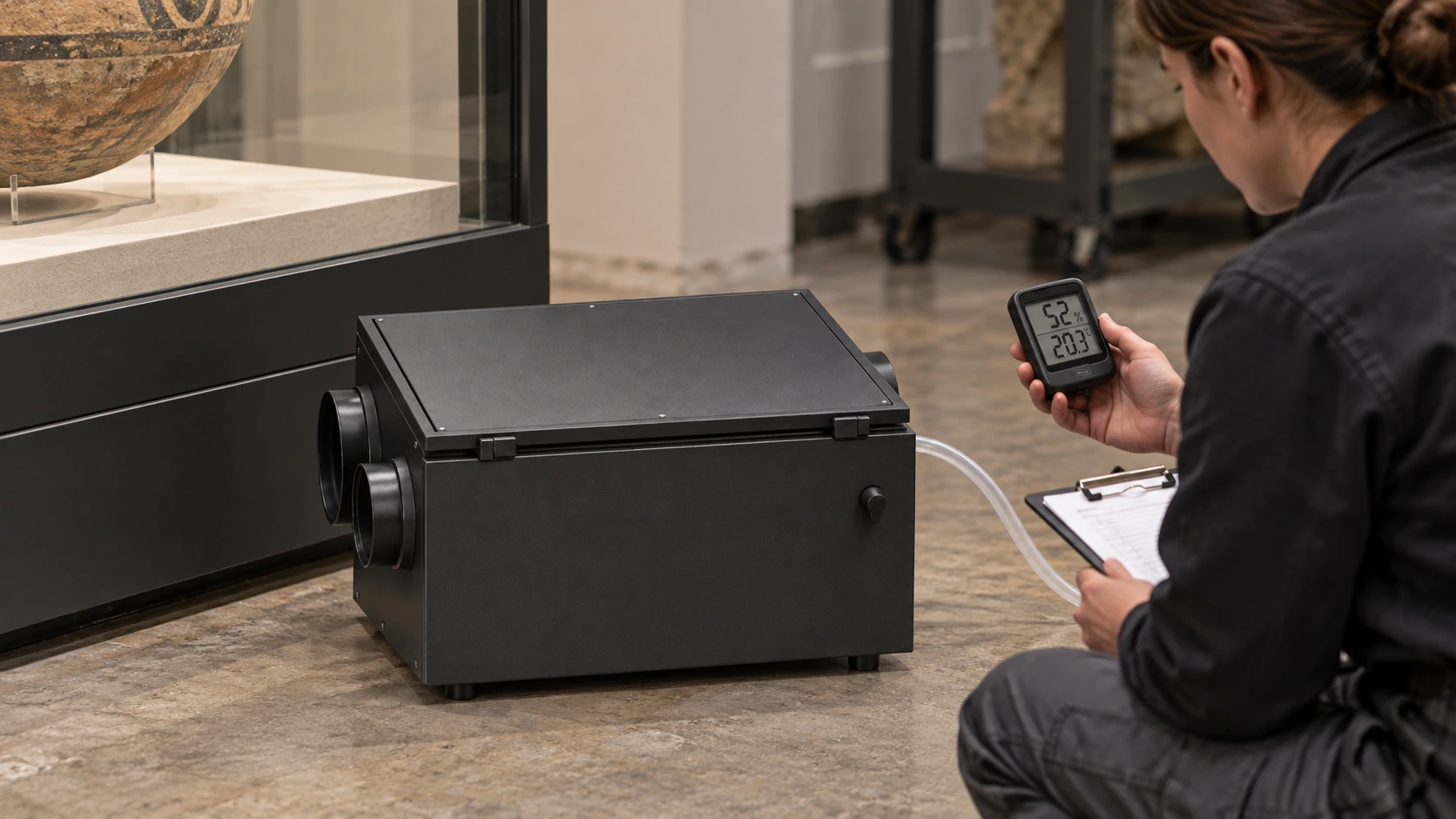
For every controlled variable, specify the fields below as appropriate.
| Performance field | Example of what to define |
|---|---|
| Control range | allowable adjustable range |
| Operating target | project-defined setpoint or band |
| Sensor range | full measurement range |
| Sensor accuracy | stated tolerance under defined conditions |
| Resolution | displayed/logged increment |
| Stability | acceptable variation under defined load |
| Recovery | expected behaviour after access or loading |
| Alarm | high/low thresholds and fault states |
| Data interval | logging frequency |
The acceptance criteria should use the same terms as the RFQ.
For example, do not specify “±2% RH precision” in the tender and then test only whether the touchscreen displays a number. Define how performance will be verified and under what conditions.
7. Separate sensor accuracy from control performance
This is a common procurement error.
A sensor with high stated accuracy does not guarantee the entire enclosure stays within the same band.
System performance is influenced by:
- sensor location;
- air mixing;
- enclosure leakage;
- control algorithm;
- load;
- door opening;
- room conditions;
- humidification/dehumidification capacity;
- thermal gradients.
The RFQ should therefore distinguish:
sensor specification from environmental performance specification.
If the project requires mapping several locations inside a large case or room, state that separately.
8. Define access and recovery conditions
Many systems perform well while closed and empty but behave differently in real operation.
Ask suppliers to state assumptions for:
- door-opening duration;
- access frequency;
- object load;
- initial object temperature/RH;
- recovery after access;
- simultaneous access to multiple compartments;
- maintenance opening.
If recovery time matters, define how it will be tested. Avoid an undefined promise such as “rapid recovery.”
9. Specify monitoring, alarms and records
A professional controlled-environment system often needs more than a local display.
Decide whether the project requires:
- continuous temperature/RH logging;
- oxygen or gas logging;
- pressure logging;
- particle or pollutant monitoring;
- alarm history;
- exportable reports;
- CSV/PDF export;
- remote access;
- RS485/Modbus or another building-management interface;
- user permissions;
- time-stamped operator actions;
- calibration reminders.
For treatment systems, define batch records. For storage and display systems, define trend records and alarm behaviour.
10. Define alarms as actions, not just lights
An alarm is useful only if staff know what it means.
Possible alarms include:
- RH high/low;
- temperature high/low;
- oxygen above treatment limit;
- sensor failure;
- door open;
- low water level;
- gas-supply fault;
- compressor or fan fault;
- power interruption;
- communication failure.
For each critical alarm, decide:
- what triggers it;
- where it appears;
- whether it is logged;
- whether remote notification is required;
- what safe state the equipment enters.
11. Include the environmental-control method in the RFQ only when justified
Procurement teams sometimes over-specify the engineering solution before suppliers have reviewed the preservation requirement.
For example, an RFQ may demand compressor cooling, desiccant dehumidification or a particular humidifier type even when the project only needs a performance outcome.
Where possible, separate:
Mandatory performance
What the collection needs.
Preferred method
What the institution believes is appropriate but is open to alternatives.
Mandatory architecture
What truly cannot change because of existing infrastructure, compatibility, safety or standardisation.
This preserves competitive design flexibility while keeping the conservation outcome fixed.
12. Define materials in contact with the controlled environment
For cabinets, cases and chambers, ask for information on:
- structural materials;
- internal liners;
- coatings;
- adhesives;
- gaskets;
- insulation;
- filters;
- trays and shelves;
- water-contact components where humidification is used.
In sealed environments, material emissions can accumulate. CCI’s display-case guidance notes that very tight enclosures can trap pollutants generated inside, so enclosure material selection should be part of the environmental design.
For sensitive projects, ask suppliers to identify internal materials and provide supporting documentation where required.
13. Specify utilities before quotation
Provide the site utility standard rather than asking the supplier to “make it compatible.”
Electrical
- voltage;
- frequency;
- phase;
- plug or hard-wiring requirement;
- available circuit capacity;
- local electrical compliance requirements.
Gas
- nitrogen, compressed air or other gas availability;
- pressure and connection standard;
- cylinder/bulk/on-site generation preference;
- exhaust or vent route.
Water and drainage
- water quality;
- automatic supply or manual refill;
- drain point;
- condensate handling.
Ventilation
- room air changes;
- extract availability;
- local safety requirements for gases or contaminated processes.
Network
- Ethernet/Wi-Fi availability;
- cybersecurity restrictions;
- BMS connection;
- local data-storage preference.
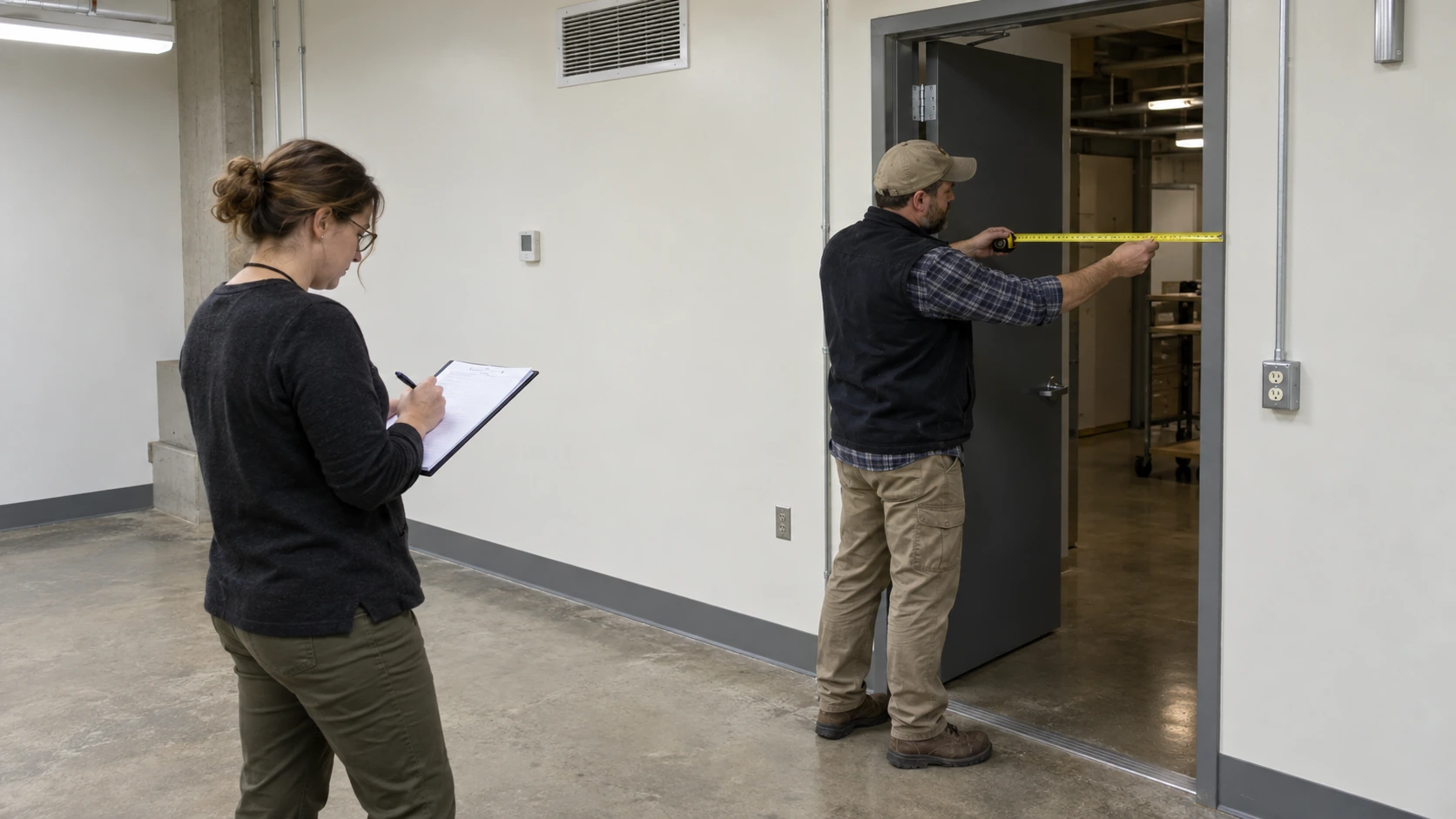
14. Include delivery and installation constraints
For large museum equipment, site access can be as important as technical performance.
Send:
- installation-floor plan;
- doorway dimensions;
- lift dimensions and capacity;
- corridor width and turning space;
- loading dock information;
- floor loading limits;
- ceiling height;
- final maintenance clearance;
- crane or forklift availability.
Ask the supplier for:
- packed dimensions;
- shipping weight;
- installed weight;
- largest single component;
- on-site assembly requirement;
- anchoring requirement.
This helps prevent a technically correct system from arriving at a building where it cannot reach the installation room.
15. Define FAT, SAT and acceptance before ordering
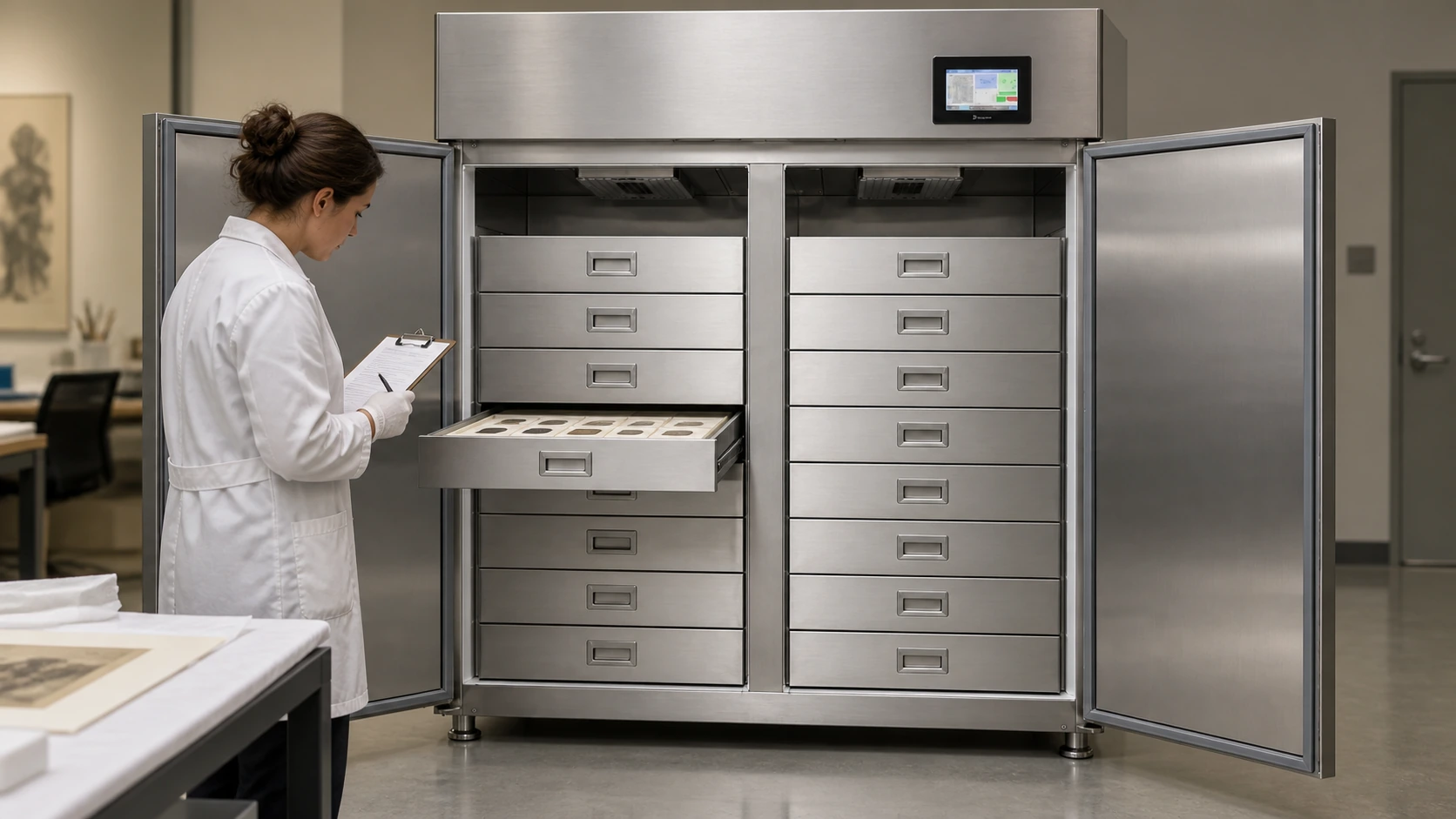
Acceptance should be written into the procurement plan.
Factory Acceptance Test (FAT)
Depending on project scope, FAT may include:
- visual and dimensional inspection;
- electrical function;
- sensor check;
- alarm test;
- control sequence;
- data logging;
- safety interlocks;
- basic environmental performance under factory conditions.
Site Acceptance Test (SAT)
SAT may include:
- installation inspection;
- utilities check;
- sensor calibration/verification;
- real room-condition test;
- recovery after access;
- alarm notification;
- remote connection;
- operator training;
- documentation handover.
Do not assume FAT performance automatically proves site performance. The installation environment can change system load substantially.
16. Ask for calibration and maintenance information
Long-term performance depends on serviceability.
Request:
- recommended sensor calibration interval;
- calibration method;
- replaceable filters;
- water-treatment consumables;
- seals and gaskets;
- compressor/fan maintenance where applicable;
- gas analyser service;
- spare-parts list;
- expected response time for remote support;
- local-service options;
- software update policy.
CCI’s preservation framework stresses long-term reliability and maintainability rather than pursuing narrow environmental control without regard to sustainability and operation.
17. Define documentation deliverables
The equipment package may need:
- operation manual;
- maintenance manual;
- wiring diagram;
- plumbing/gas diagram;
- sensor certificates;
- calibration records;
- spare-parts list;
- FAT report;
- SAT report;
- training record;
- warranty statement;
- treatment-report template;
- compliance documents required by the project.
Specify the required document language at RFQ stage.
18. Separate project compliance from marketing certificates
Do not ask only “Does the machine have CE?” or “Is it ISO?” without defining the market and applicable product legislation.
Compliance requirements depend on:
- destination country;
- electrical design;
- pressure equipment, if any;
- gas system;
- machinery configuration;
- wireless functions;
- local installation rules;
- institutional tender requirements.
The RFQ should identify the required regulatory framework and supporting documents. Where the institution requires third-party inspection, define the scope and acceptance criteria before production.
19. Controlled-environment equipment RFQ template
A. Application
- [ ] protected material/collection
- [ ] quantity and dimensions
- [ ] preservation risk
- [ ] storage/display/treatment duration
- [ ] access frequency
B. Controlled boundary
- [ ] cabinet
- [ ] display case
- [ ] chamber
- [ ] workstation
- [ ] room/room-in-room
- [ ] internal usable volume
C. Environmental variables
- [ ] RH control
- [ ] temperature control
- [ ] oxygen control
- [ ] pressure/airflow
- [ ] particles/dust
- [ ] pollutants
- [ ] monitoring only vs active control
D. Performance
- [ ] control range
- [ ] sensor range/accuracy
- [ ] stability requirement
- [ ] recovery test
- [ ] alarm thresholds
- [ ] logging interval
E. Controls and data
- [ ] local display
- [ ] data export
- [ ] remote monitoring
- [ ] BMS/RS485/Modbus
- [ ] user permissions
- [ ] batch report if applicable
F. Site and utilities
- [ ] voltage/frequency/phase
- [ ] compressed air
- [ ] nitrogen/gas
- [ ] water/drainage
- [ ] ventilation
- [ ] network
- [ ] room ambient conditions
G. Logistics
- [ ] doorway/lift dimensions
- [ ] floor load
- [ ] packed dimensions
- [ ] installation access
- [ ] commissioning
H. Acceptance and documentation
- [ ] FAT
- [ ] SAT
- [ ] third-party inspection
- [ ] calibration documents
- [ ] manuals
- [ ] training
- [ ] warranty/service
- [ ] applicable compliance documents
20. How to compare supplier quotations
Do not rank quotations only by equipment price.
Create a comparison table with at least these columns:
| Category | Supplier A | Supplier B | Supplier C |
|---|---|---|---|
| Preservation requirement met | |||
| Environmental performance | |||
| Monitoring/data | |||
| Utilities | |||
| Installation scope | |||
| Acceptance testing | |||
| Compliance documents | |||
| Training | |||
| Consumables | |||
| Service/spares | |||
| Total project cost |
This makes hidden exclusions visible and reduces the risk of selecting the lowest base price only to add essential functions later.
Final procurement principle
Controlled-environment equipment should be specified by the risk it must control and the performance that can be verified.
A strong RFQ does not say:
“We need a museum-grade intelligent constant-temperature-and-humidity machine.”
It says:
“We need to protect this material, inside this boundary, from these environmental risks, under these operating conditions, with these measurable acceptance criteria.”
That language produces better engineering discussions, more comparable quotations and a clearer path from preservation need to equipment acceptance.
Frequently asked questions
What information should be included in a museum environmental-control RFQ?
Include the protected material, main risk, controlled volume, required environmental variables, room conditions, access frequency, performance criteria, monitoring, utilities, delivery constraints, acceptance testing and documentation.
Should a museum specify a universal temperature and RH target?
No. Targets should be based on the collection, its condition, risk assessment and project requirements. Mixed collections may not have one ideal RH value.
What is the difference between sensor accuracy and environmental stability?
Sensor accuracy describes the measurement device. Environmental stability describes how the entire controlled space behaves. A highly accurate sensor does not guarantee stable conditions if airflow, leakage, control capacity or access are poorly managed.
Should FAT and SAT both be required?
For complex or high-value systems, both can be useful. FAT verifies equipment before shipment; SAT verifies installed performance under site conditions. The exact test scope should be defined in the contract.
Can third-party inspection be included in the RFQ?
Yes. Define the inspection body or qualification requirement, inspection stage, test scope, acceptance criteria and who bears the cost. This is clearer than requesting an undefined “third-party certificate.”
Related Sinoalta resources
- Material Risks & Controlled Environment Selection: https://sinoalta.com/resources/blog/material-risks-controlled-environment-selection/
- Product Systems: https://sinoalta.com/products/
- Technical Guides: https://sinoalta.com/resources/guides/
- Submit a Technical & Commercial RFQ: https://sinoalta.com/contact/
Sources and further reading
- Canadian Conservation Institute, Framework for Preserving Heritage Collections: https://www.canada.ca/en/conservation-institute/services/preventive-conservation/framework-preserving-heritage-collections.html
- Canadian Conservation Institute, Incorrect relative humidity: https://www.canada.ca/en/conservation-institute/services/agents-deterioration/humidity.html
- Canadian Conservation Institute, Basic requirements of preventive conservation: https://www.canada.ca/en/conservation-institute/services/preventive-conservation/guidelines-collections/basic-requirements-preventive-conservation.html
- Canadian Conservation Institute, Airtightness Measurement of Display Cases and Other Enclosures: https://www.canada.ca/en/conservation-institute/services/conservation-preservation-publications/technical-bulletins/airtightness-measurement-display-cases.html
- Canadian Conservation Institute, Products Used in Preventive Conservation: https://www.canada.ca/en/conservation-institute/services/conservation-preservation-publications/technical-bulletins/products-used-preventive-conservation.html