1. Why “Museum Standard Conditions” Need Context
For many years, collection environments were often reduced to a simple rule such as “50% RH at a fixed room temperature.”
Current conservation guidance is more nuanced.
The U.S. National Park Service notes that strict universal standards cannot be set because museum collections vary greatly in material composition and because institutions operate in very different climates and building types.
The Canadian Conservation Institute’s current Climate Guidelines similarly use a risk-management framework rather than treating one narrow setpoint as appropriate for every museum, archive or library.
A professional storage specification should therefore answer five questions:
- What materials are being stored?
- Which deterioration mechanisms matter most?
- What environmental history has the collection already experienced?
- What can the building and mechanical system maintain reliably?
- What control level is justified by preservation benefit, cost and sustainability?
The objective is reliable risk reduction—not numerical precision for its own sake.
2. The Current ASHRAE / CCI Climate-Control Framework
The “Museums, Galleries, Archives, and Libraries” chapter of the ASHRAE Handbook has become an important reference for engineers and heritage professionals.
CCI adopted the ASHRAE framework for its climate-control advice.
The framework uses several types of control, including AA, A1, A2, B and C.
These are not product ratings. They describe how tightly a building or room controls temperature and RH.
ASHRAE AA
AA represents precision climate control.
Current CCI presentation of ASHRAE 2023 guidance describes, for general permanent collections in suitable purpose-built facilities:
- a historic annual RH average as the preferred baseline;
- long-term RH outer limits broadly within 35% to 65%;
- short-term RH fluctuation plus space gradients limited to approximately ±5%;
- no seasonal RH change;
- tight temperature control.
AA is demanding and energy intensive.
It may be justified for highly vulnerable collections or specific institutional requirements, but it should not automatically be specified for every store.
ASHRAE A1 and A2
A1 and A2 allow greater seasonal or short-term variation while still providing precision control suitable for many major institutions.
CCI notes an important modern shift:
the framework now places greater emphasis on the collection’s historic annual average rather than defaulting automatically to 50% RH.
This supports a more realistic relationship between preservation risk, local climate and building operation.
ASHRAE B
Type B allows wider seasonal variation than A-level control.
For many permanent collections, this may provide an appropriate balance between preservation and energy demand, especially when highly vulnerable materials are given separate microclimates.
ASHRAE C
Type C focuses on preventing major RH and temperature extremes rather than maintaining precision control.
This can be relevant to historic buildings or situations where tighter control would create excessive building risk or energy demand.
The key point
The type of control should be selected because it addresses the collection’s actual risks.
It should not be chosen because a tighter number “sounds more professional.”
3. Relative Humidity: Think in Terms of Damage Mechanisms
RH can affect museum materials in several ways.
Mechanical response
Hygroscopic materials absorb and release moisture.
Examples include:
- paper;
- wood;
- leather;
- parchment;
- textiles;
- ivory;
- many adhesives.
RH changes can lead to swelling and shrinkage.
Where different materials are joined or constrained, repeated changes can contribute to:
- cracking;
- delamination;
- warping;
- splitting;
- joint failure.
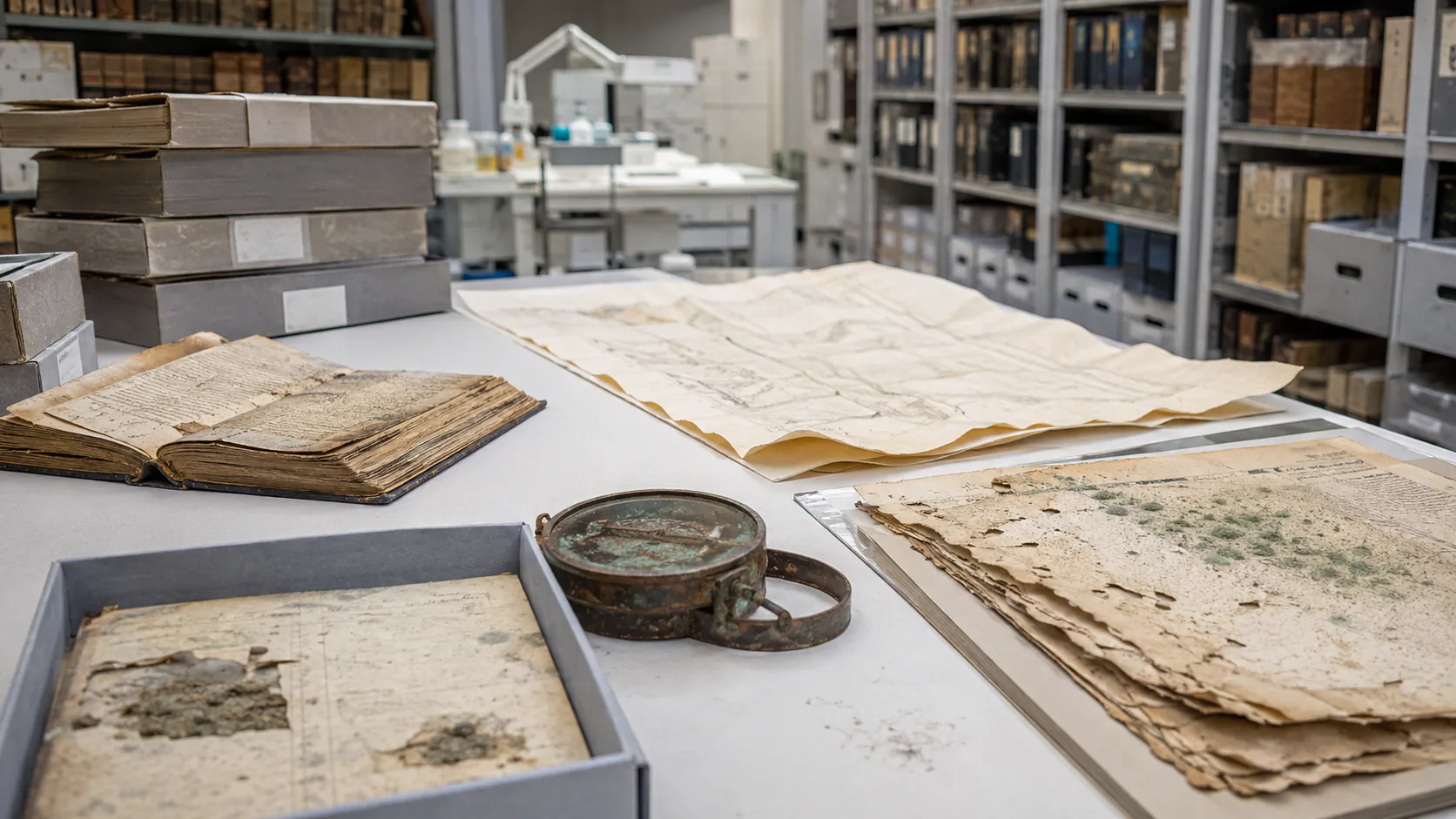
Mould risk
Persistently high RH increases the risk of mould growth.
The exact rate depends on temperature and duration, so the important issue is not simply whether RH briefly crosses a number but how high it remains and for how long.
Corrosion and salt response
Some metals and salt-contaminated materials require drier conditions than general organic collections.
Examples may include:
- unstable archaeological iron;
- chloride-contaminated metals;
- some salts and minerals;
- unstable glass.
These materials often need a dedicated dry microclimate rather than the general storage-room RH.
Desiccation
Very low RH can also be damaging.
Some organic and composite materials can shrink, crack or become brittle when excessively dry.
Therefore:
“Lower RH is always better” is not a valid museum-storage rule.
4. Temperature: Preservation and Use Must Be Balanced
Temperature affects the rate of many chemical deterioration reactions.
In general, lower temperatures slow chemical ageing.
This is particularly important for materials such as:
- acidic paper;
- photographic materials;
- magnetic and optical media;
- cellulose acetate and nitrate film;
- some plastics.
However, temperature selection is constrained by:
- staff and visitor comfort;
- building envelope performance;
- condensation risk;
- RH interaction;
- access requirements.
A cold room, cool store or freezer is therefore a special collection environment, not simply a more aggressively controlled version of a normal museum store.
Transition procedures are needed to prevent condensation when cold materials are moved into warmer, more humid air.
5. Collection-Specific Environments
A mixed collection often cannot be optimised with one room condition.
The most effective strategy may be:
General storage climate + local microclimates for vulnerable groups
General museum collections
Many mixed collections can be managed with a moderate, stable climate that avoids sustained extremes and large uncontrolled fluctuations.
Paper and books
Paper benefits from avoiding high temperature, high RH, pollutants and light.
For chemically unstable acidic paper, cooler storage can substantially extend usable life.
Metals
Unstable metals may need lower RH than paper, wood or textiles.
Archaeological iron with soluble salts can require particularly dry conditions.
Unstable glass and salt-contaminated ceramics
These may require narrower or lower RH ranges than the room around them.
Film and photographic collections
Some photographic and film materials benefit from cool, cold or frozen storage.
Their requirements should be designed according to the specific media and access pattern.
Composite objects
Composite objects may contain materials with competing environmental requirements.
The goal is therefore risk compromise, not theoretical optimisation of one component at the expense of another.
6. Microclimates and Layered Protection
A storage room does not have to provide every specialised climate by itself.
Protective layers may include:
- folders;
- archival boxes;
- sealed bags;
- storage cabinets;
- humidity-buffered cabinets;
- desiccated cabinets;
- cold-storage enclosures;
- separate rooms or vaults.
NPS guidance notes that boxes, cases and cabinets can buffer temperature and RH changes.
CCI similarly treats local enclosures as a practical way to provide a special environment within a more broadly controlled building.
Storage cabinets
Good cabinets can provide additional protection from:
- RH fluctuations;
- dust;
- light;
- pollutants;
- pests;
- water droplets and handling.
Cabinet material and construction still matter.
A poorly selected enclosure can trap harmful emissions or create inaccessible conditions.
7. Light in Collection Storage
Long-term storage normally does not require continuous illumination.
Light damage is cumulative and irreversible for many materials.
Good practice therefore includes:
- excluding daylight from dedicated stores where possible;
- switching artificial lighting off when not required;
- using low-UV lighting;
- avoiding heat-producing fixtures near sensitive objects;
- monitoring light exposure where vulnerable collections are handled or displayed within storage.
Dark storage is a simple and highly effective preservation measure for light-sensitive objects.
8. Dust and Airborne Pollutants
A storage environment should address more than temperature and RH.
Potential airborne risks include:
- coarse dust;
- fine particles;
- ozone;
- nitrogen dioxide;
- sulfur compounds;
- organic acids;
- emissions from storage or building materials.
CCI identifies ozone as a pollutant capable of affecting organic colourants and paper.
Pollutant control may involve:
- source avoidance;
- building sealing;
- particulate filtration;
- gas-phase filtration where justified;
- suitable storage materials;
- boxes and cabinets;
- reduced exposure to loading docks, traffic and renovation work.
The required level should reflect outdoor air quality, collection vulnerability and the degree of enclosure already provided.
9. Pest Management Is Part of Storage Environmental Control
Good storage design supports IPM.
Risk reduction includes:
- sealed building penetrations;
- housekeeping;
- food exclusion;
- monitoring traps;
- clean receiving areas;
- quarantine procedures;
- storage that allows inspection;
- elimination of moisture and debris.
Environmental management alone will not prevent every insect infestation.
It should be integrated with the institution’s IPM programme.
10. Water, Fire and Physical Location
The “environment” also includes hazards that may not appear on a temperature/RH graph.
Collection stores should be assessed for:
- roof leaks;
- plumbing;
- floor drains;
- flood level;
- exterior walls;
- fire protection;
- emergency access;
- loading routes;
- sprinkler and detection systems;
- storage above floor level.
CCI recommends locating storage away from high-risk public and exterior areas where possible.
Facility planning should therefore combine preventive conservation with building risk management.
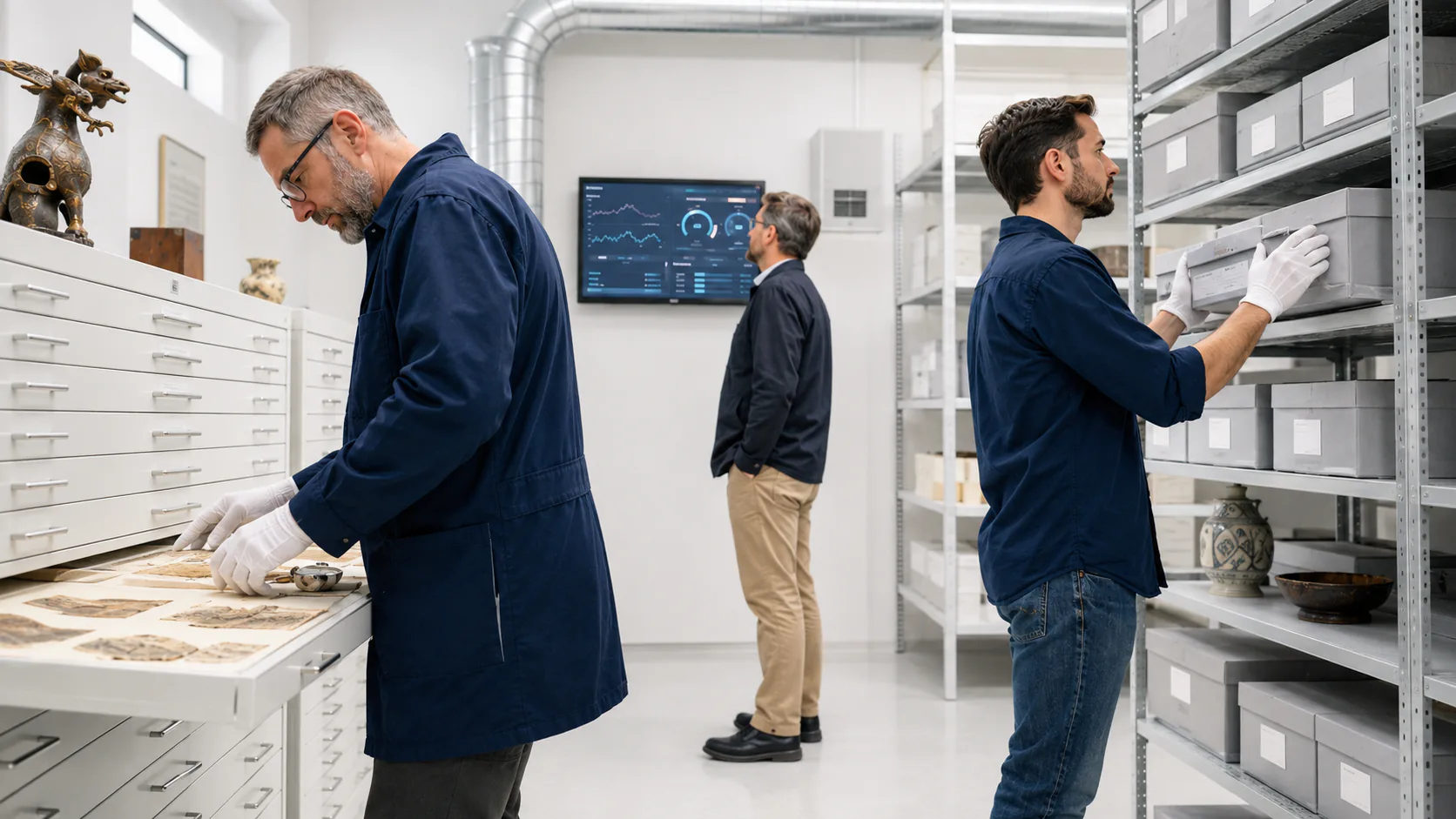
11. Environmental Monitoring
A storage specification is only useful if actual conditions are measured.
Monitoring normally includes:
- temperature;
- RH;
- time-stamped data;
- sensor location;
- calibration;
- periodic review.
Where to place sensors
Avoid assuming that one sensor represents the entire store.
Potential gradients can occur:
- near exterior walls;
- close to HVAC outlets;
- at floor or ceiling level;
- inside cabinets;
- in densely packed shelving;
- near doors.
A monitoring plan should identify representative locations and known risk areas.
Data interval
The sampling interval should be short enough to reveal daily cycles and short-term excursions.
CCI facility-assessment guidance uses continuous records rather than isolated spot measurements when evidence of environmental performance is required.
Review patterns, not only averages
Useful analysis includes:
- annual average;
- seasonal change;
- short-term fluctuation;
- extreme events;
- duration outside the target range;
- gradients between locations;
- equipment failure or shutdown.
A store can have an acceptable annual average while still experiencing damaging local events.
12. Reliability Matters More Than an Unrealistic Setpoint
CCI’s current facility guidance makes an important practical point:
a condition that is slightly less precise but maintained reliably can be preferable to very tight control that fails repeatedly.
This has direct implications for engineering.
An HVAC design should account for:
- local weather extremes;
- building insulation;
- vapour control;
- occupancy;
- heat loads;
- maintenance capability;
- backup systems;
- sensor and control accuracy.
Overly aggressive humidification in a cold climate can also create condensation inside historic building fabric.
Collection and building risks must therefore be considered together.
13. Sustainability and Climate Control
Current CCI Climate Guidelines explicitly incorporate sustainability.
This does not mean abandoning environmental control.
It means asking:
- Which risks are actually being reduced?
- Which collections truly need precision control?
- Can vulnerable objects use local microclimates?
- Can seasonal temperature adjustment reduce energy demand?
- Is the system maintainable for decades?
- Does the building envelope support the requested climate?
A storage specification should be preservation-led and resource-aware.
14. Writing a Storage Environmental Specification
A defensible specification should include more than one line saying “temperature 20°C, RH 50%.”
It may define:
Collection scope
What objects and materials will be stored?
Control type
Which ASHRAE / institutional control level is targeted?
Baseline
What annual temperature and RH baseline is appropriate?
Allowed variation
What short-term and seasonal change is acceptable?
Special microclimates
Which collections require dry, cool, cold, frozen or individually buffered storage?
Monitoring
How will performance be measured and reviewed?
Pollutants and filtration
What particulate or gas-control level is justified?
Light
How will daylight and unnecessary artificial exposure be prevented?
Operational requirements
How often are stores accessed? What are the door-opening, occupancy and loading patterns?
Commissioning
How will the actual environmental performance be demonstrated before collections are moved in?
Planning & Verification
Assess
Identify collection materials, deterioration risks, historic climate and facility constraints.
Specify
Select an appropriate control type and special microclimates.
Monitor
Measure actual temperature, RH and relevant pollutants throughout the year.
Review
Compare preservation benefit, system performance, energy use and new collection requirements.
Assess → Specify → Monitor → Review
Frequently Asked Questions
What temperature and RH should museum storage use?
There is no single universal setpoint. Current guidance recommends selecting conditions according to collection sensitivity, historic climate, building capability and the level of environmental control that can be maintained reliably.
Is 50% RH still the museum standard?
It is no longer appropriate to treat 50% RH as a universal rule. Modern ASHRAE/CCI guidance places greater emphasis on historic annual averages, risk, allowed fluctuation and collection-specific requirements.
What are ASHRAE AA, A1, A2, B and C?
They are types of climate control describing different levels of precision, seasonal adjustment and acceptable fluctuation for museums, galleries, archives and libraries.
Do all collections belong in the same store?
No. Metals, unstable glass, film, photographs or other sensitive materials may require dedicated microclimates that differ from general mixed-collection storage.
Is stable RH more important than exact RH?
Both the average condition and the size and duration of fluctuations matter. Reliable control that avoids damaging extremes is generally more useful than an unrealistic narrow setpoint that frequently fails.
Should museum storage have windows?
Dedicated collection storage generally benefits from excluding daylight and limiting exterior exposure. Building design should also consider water, temperature gradients and security.
Do storage cabinets help control the environment?
Yes. Well-designed cabinets and boxes can buffer RH changes and reduce exposure to dust, light, pollutants and pests.
How often should storage conditions be monitored?
Monitoring should be continuous enough to reveal daily and seasonal patterns, and data should be reviewed on a defined schedule. The appropriate interval depends on the facility and monitoring objective.
Can a historic building maintain museum conditions?
Sometimes, but the climate specification must account for the building envelope. Aggressive humidification or cooling can damage historic fabric through condensation, so building and collection risks must be assessed together.
Planning a Collection Storage Project?
A good store begins with the preservation requirement, not the storage furniture.
Sinoalta can support project teams in integrating collection cabinets, environmental-control systems, monitoring and specialised microclimates into a storage workflow.
Explore Museum Storage Systems →
Selected Technical References
- Canadian Conservation Institute, Climate Guidelines
- Canadian Conservation Institute, ASHRAE Types of Control
- Canadian Conservation Institute, Design Considerations for Preventive Conservation in New Heritage Collection Facilities
- U.S. National Park Service, Museum Handbook, Part I — Chapter 4: Museum Collections Environment
- Canadian Conservation Institute, General Precautions for Storage Areas
Scope and review note: Written by Stella Wynn for Sinoalta. Sinoalta is responsible for this institutional content. Issued and most recently reviewed in August 2026. It summarizes selected conservation sources for project planning and does not replace object-specific assessment, qualified conservation advice, applicable safety requirements or project validation.
 Guide
Guide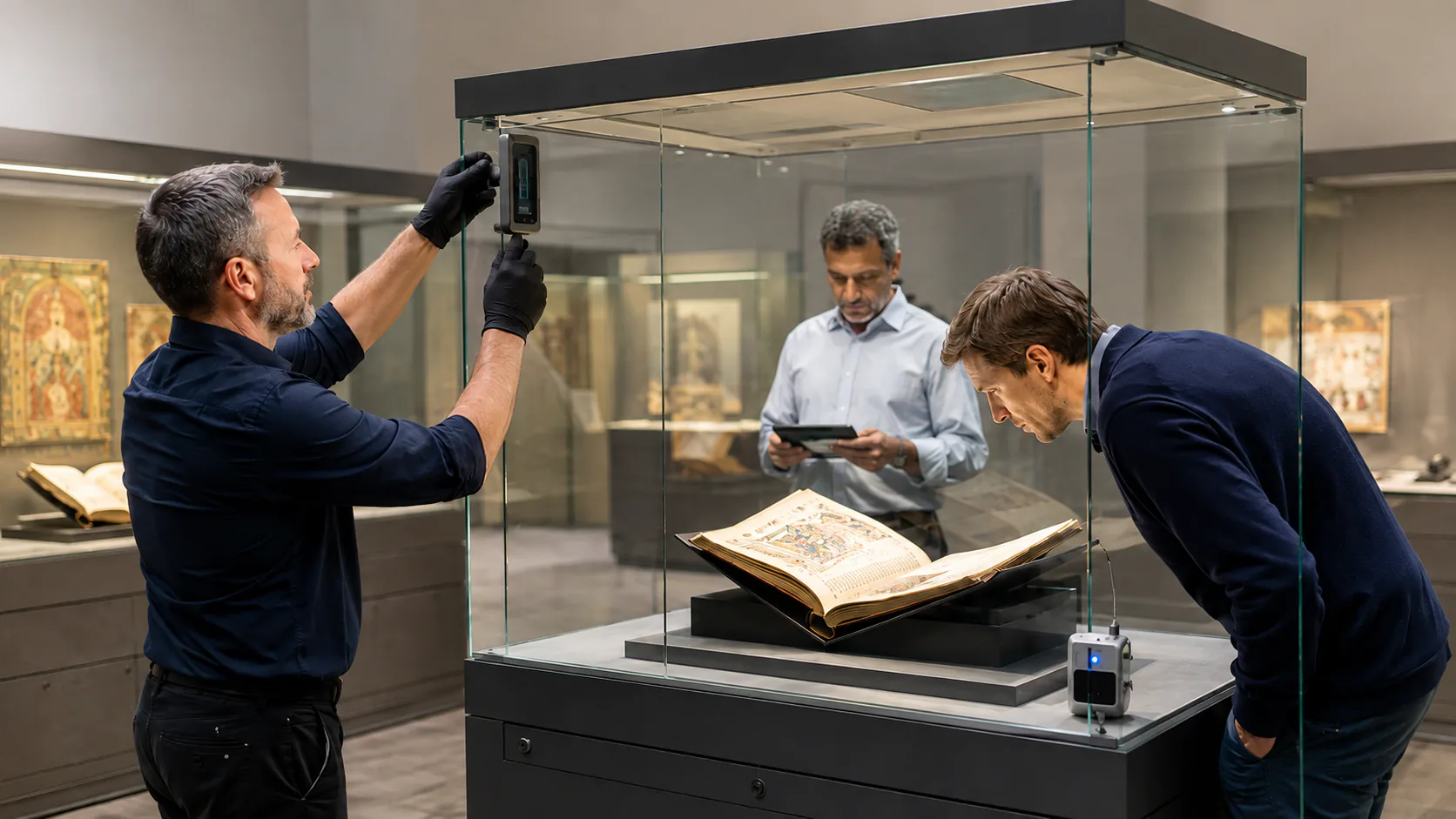 Guide
Guide Guide
Guide