
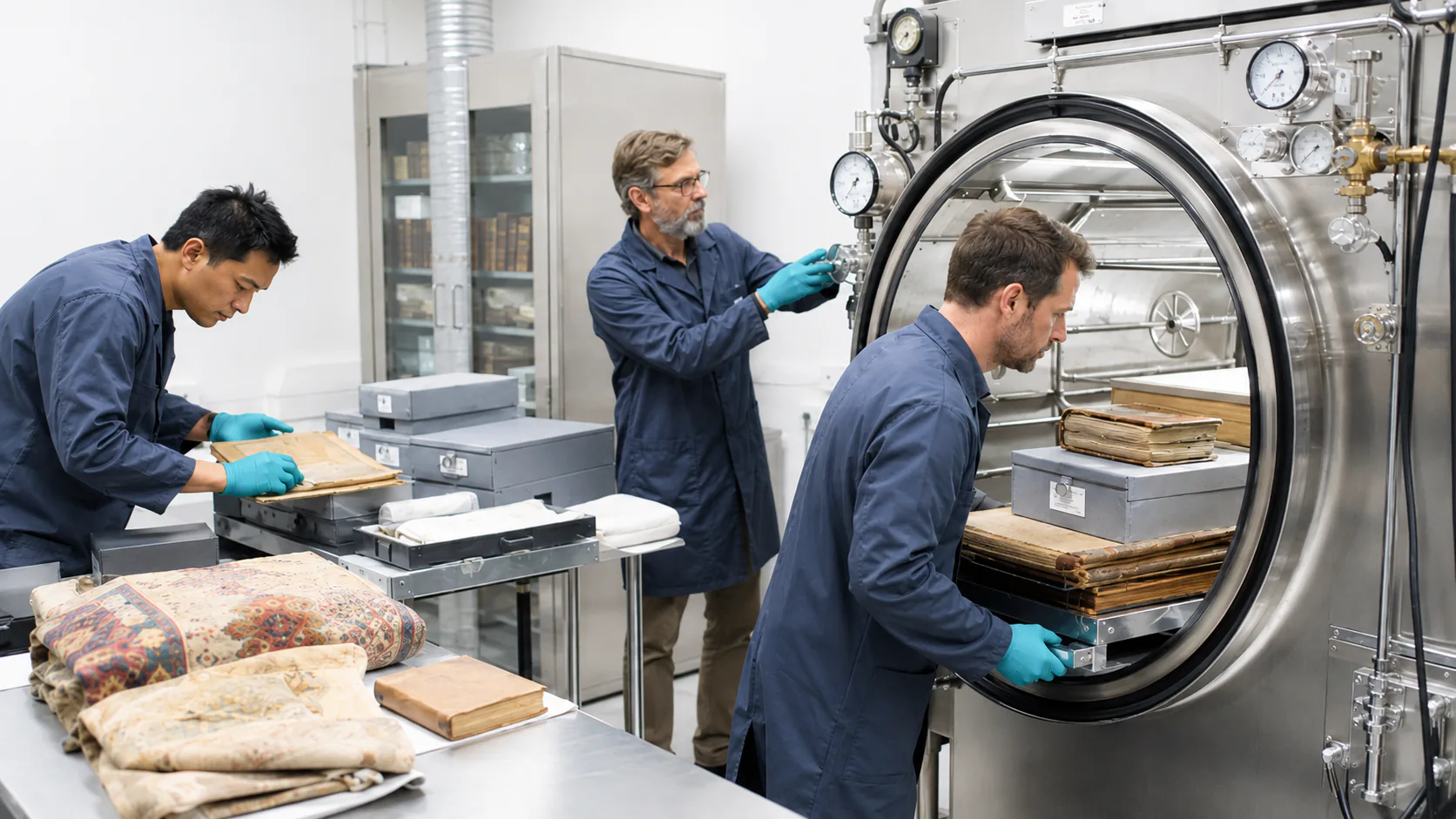
1. How Nitrogen Anoxia Controls Museum Insect Pests
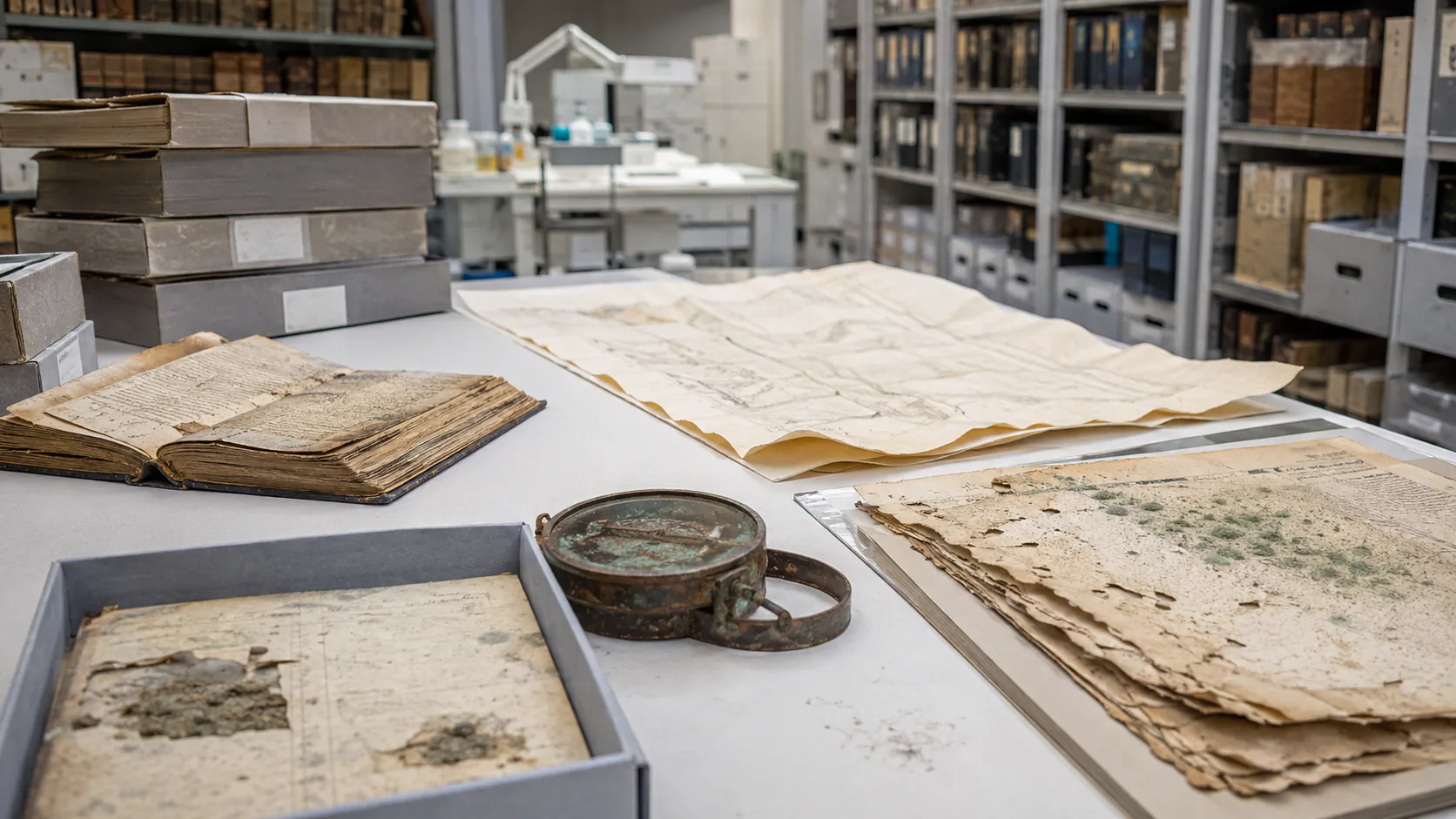
Nitrogen anoxia is a controlled-atmosphere treatment used to eradicate many insect pests affecting museum, archive and cultural-heritage collections.
The method works by replacing normal air within a sealed treatment enclosure with nitrogen until the oxygen concentration falls to a very low level. The object is then maintained under controlled low-oxygen conditions for a defined exposure period.
Nitrogen itself is not acting as a conventional toxic pesticide.
Instead, the treatment creates an atmosphere in which the target insects can no longer maintain the physiological processes required for survival.
For this reason, nitrogen anoxia should be understood as:
Atmosphere control → Oxygen reduction → Controlled exposure → Pest mortality
rather than simply as “nitrogen fumigation.”
Anoxia is a pest-disinfestation method
The primary conservation application discussed in this guide is insect disinfestation.
It should not automatically be described as sterilization, microbial disinfection or mould remediation.
Different biological risks require different treatment objectives and validation methods.
Nitrogen anoxia is therefore most appropriately considered when an active insect infestation has been identified and the affected object or collection is suitable for controlled low-oxygen treatment.
Anoxia is not the same as vacuum treatment
Nitrogen anoxia does not depend on high vacuum to kill insects.
Some engineered treatment systems may use evacuation or partial air removal to accelerate gas replacement, but the primary lethal condition remains the controlled low-oxygen atmosphere.
A treatment process should therefore be evaluated according to the oxygen conditions actually achieved and maintained rather than simply according to whether a vacuum pump is present.
2. The Four Critical Treatment Parameters
Successful anoxia depends on several interacting variables.
The four most important are:
Oxygen Level
Establish and maintain the validated low-oxygen atmosphere.
Temperature
Pest response to anoxia is strongly temperature-dependent.
Relative Humidity
Moisture conditions should remain compatible with the materials being treated.
Exposure Time
Duration must reflect the pest, life stage and actual treatment conditions.
These parameters should be treated as a system rather than as independent settings.
Oxygen Concentration
Normal atmospheric air contains approximately 21% oxygen.
During nitrogen anoxia, this concentration is reduced dramatically by replacing air with nitrogen and preventing significant oxygen ingress into the treatment enclosure.
For museum insect-pest treatment, oxygen concentrations below approximately 0.1% O₂ are widely referenced in professional conservation literature as a common control condition.
However, reaching a particular oxygen concentration once does not by itself demonstrate successful treatment.
The required atmosphere must be:
- achieved throughout the treatment enclosure;
- maintained for the required exposure period;
- verified by suitable oxygen measurement;
- considered together with temperature, pest species and treatment duration.
A rise in oxygen concentration caused by leakage, insufficient nitrogen supply or poor enclosure sealing may compromise the treatment.
Temperature
Temperature has a major influence on insect response to low oxygen.
In general, moderately warm room-temperature conditions support more effective anoxic pest treatment than cool conditions because insect metabolism decreases as temperature falls.
This leads to an important practical principle:
Lower temperature does not automatically make nitrogen anoxia more effective.
An object treated in a cool environment may require a longer exposure period than the same target pest treated under suitable warmer conditions.
Temperature should therefore be monitored and incorporated into the treatment protocol rather than treated simply as a background environmental condition.
Relative Humidity
Relative humidity is important both for treatment performance and for collection safety.
Nitrogen supplied from cylinders or generation systems may be substantially drier than the environment surrounding the objects.
If very dry nitrogen is continuously passed through a treatment enclosure, moisture-sensitive materials may gradually lose moisture.
This is particularly relevant to dynamic or continuous-flow systems.
Depending on the object and treatment configuration, the nitrogen stream or enclosure atmosphere may therefore require humidity conditioning.
The objective is not to establish one universal RH value for all objects. Instead, the treatment environment should avoid unnecessary moisture change while maintaining conditions appropriate for the materials being treated.
Paper, parchment, leather, wood, textiles and composite objects can respond differently to moisture variation.
Material assessment should therefore precede treatment planning.
Exposure Time
Treatment time cannot be determined independently from the other process variables.
The required duration may depend on:
- target insect species;
- insect life stage;
- oxygen concentration;
- temperature;
- relative humidity;
- object configuration;
- enclosure performance;
- loading density;
- validated treatment protocol.
For this reason, there is no scientifically responsible universal statement such as:
“All museum insects are eliminated after 48 hours.”
Treatment duration should instead be selected from validated protocols or documented experience relevant to the target pest and operating conditions.
3. Understanding Treatment Duration
One of the most common questions about nitrogen anoxia is:
How long does the treatment take?
The correct answer depends on the treatment conditions.
Professional conservation guidance commonly describes low-oxygen pest treatments lasting from several days to multiple weeks, depending particularly on insect species, temperature and oxygen concentration.
Some pests and life stages are more tolerant than others.
Wood-boring insects, for example, can require longer exposure than more susceptible museum pests.
Eggs may also respond differently from larvae or adults.
Why temperature changes treatment time
Because insect metabolism generally slows under cooler conditions, oxygen deprivation can act more slowly.
A protocol developed under warm room-temperature conditions therefore cannot automatically be transferred to a substantially cooler treatment environment without reassessment.
Why the target pest matters
Anoxia should not be managed simply by selecting a chamber setting and waiting for a fixed number of hours.
The correct sequence is:
Identify pest → Determine treatment conditions → Establish target atmosphere → Maintain exposure → Verify completion
Where the target species is uncertain, treatment planning should use an appropriately conservative protocol rather than assuming the response of a more susceptible pest.
4. Treatment Enclosures and Nitrogen Supply
Anoxia can be applied at very different scales.
The basic engineering challenge remains the same:
Create an enclosure capable of reaching and maintaining the required low-oxygen atmosphere for the complete exposure period.
The appropriate solution depends on object size, treatment frequency, collection throughput and institutional workflow.
Oxygen-Barrier Bags
Small objects or occasional treatments may be placed within specially selected oxygen-barrier film.
Nitrogen may be introduced into the enclosure, and oxygen scavengers may also be used in appropriate configurations to reduce residual oxygen and compensate for limited oxygen ingress.
Advantages can include:
- relatively low equipment requirements;
- flexibility for small objects;
- convenient treatment of individual items.
However, performance depends heavily on:
- barrier-film quality;
- sealing technique;
- pinhole control;
- oxygen ingress;
- correct scavenger capacity where used;
- reliable oxygen measurement.
A visually closed bag should not automatically be assumed to be sufficiently airtight.
Flexible Treatment Tents
Larger objects or batches may require reusable flexible enclosures.
These can provide significantly greater treatment volume than individual bags while retaining some flexibility in object size.
Their engineering performance is determined by factors such as:
- barrier-film permeability;
- seam integrity;
- enclosure volume;
- purge strategy;
- nitrogen consumption;
- leakage rate.
Large flexible enclosures therefore require more process planning than simply scaling up a small bag.
Rigid Treatment Chambers
Institutions carrying out routine treatments may use rigid chambers or cabinets.
A purpose-designed chamber can support more repeatable control of:
- nitrogen introduction;
- oxygen measurement;
- temperature and humidity monitoring;
- treatment records;
- chamber access;
- gas exhaust;
- safety interlocks.
Rigid systems may be particularly useful where objects are treated regularly or where repeatability and documentation are important operational requirements.
Walk-In and Large-Volume Systems
Oversized objects or high-throughput institutional programmes may require walk-in chambers or project-specific treatment enclosures.
At this scale, engineering considerations become increasingly important.
These may include:
- chamber airtightness;
- gas-distribution uniformity;
- nitrogen-generation capacity;
- purge time;
- treatment volume;
- monitoring-point location;
- environmental conditioning;
- exhaust handling;
- operator safety.
The largest chamber is not automatically the best solution.
System capacity should reflect the actual treatment workflow and typical object sizes.
5. Static and Dynamic Anoxia
Nitrogen anoxia systems can be operated using different gas-management strategies.
Understanding this distinction is useful when comparing treatment configurations.
Static or Sealed Treatment
In a predominantly static process, the enclosure is brought to the required low-oxygen condition and then sealed or maintained with minimal additional gas exchange.
A simplified sequence may be:
Load → Seal → Purge → Reach Target O₂ → Maintain → Monitor → Complete
This approach places particularly high importance on enclosure airtightness.
If oxygen enters faster than the system can compensate, the target treatment condition may not be maintained.
Dynamic or Controlled-Flow Treatment
In a dynamic process, nitrogen is supplied continuously or intermittently to establish and maintain the required atmosphere.
A simplified sequence may be:
Load → Purge → Establish Low O₂ → Controlled Nitrogen Supply → Monitor → Adjust → Complete
Dynamic systems can provide more active atmosphere control, particularly for large enclosures.
However, continuous gas flow introduces additional considerations.
Very dry nitrogen can remove moisture from hygroscopic collection materials, so humidity management may become necessary.
Nitrogen consumption and exhaust handling also become part of system design.
Neither operating strategy is inherently superior in every application.
The correct approach depends on:
- enclosure performance;
- collection materials;
- treatment volume;
- required throughput;
- nitrogen availability;
- environmental-control requirements;
- institutional workflow.
6. Airtightness and Oxygen Ingress
Airtightness is not merely a construction-quality feature.
It is a fundamental process-control requirement.
If ambient air leaks into the treatment enclosure:
Air ingress → O₂ concentration rises → Treatment conditions change → Validity may be compromised
Poor airtightness can also increase nitrogen consumption because additional gas must be supplied to compensate for oxygen entering the chamber.
For this reason, anoxia system evaluation should consider:
- door and access seals;
- film permeability where flexible enclosures are used;
- seam integrity;
- service penetrations;
- valve connections;
- sensor ports;
- chamber leakage behaviour.
Where appropriate, enclosure performance should be tested rather than assumed.
Stable oxygen control depends on both the nitrogen supply system and the physical integrity of the treatment enclosure.
7. Material Compatibility
One reason nitrogen anoxia has become established within museum pest management is its compatibility with a broad range of collection materials.
It does not require routine exposure to conventional pesticide residues and can avoid the thermal stresses associated with high-temperature treatment or freezing.
Objects treated by anoxia may include materials such as:
- books and paper;
- textiles;
- leather;
- wood;
- natural-history materials;
- ethnographic objects;
- composite organic collections.
However, this should never be converted into a universal claim that:
“Nitrogen is safe for every museum object.”
Review the complete object
Assessment should consider:
- substrate materials;
- pigments and dyes;
- coatings;
- adhesives;
- metals;
- previous conservation treatments;
- condition and fragility;
- composite construction.
A single museum object may contain many materials with different responses.
Sensitive colorants and reactive materials
Very low oxygen environments can influence the chemical state of certain sensitive colorants or materials.
Reported concerns are particularly relevant to some unusual pigments and to prolonged anoxic storage.
Short-duration pest treatment is not equivalent to long-term oxygen-free storage, but objects containing unusual or poorly characterized materials should still be reviewed before treatment.
Where material response is uncertain, a conservator should determine whether additional assessment or testing is necessary.
8. Temporary Pest Treatment Is Not Long-Term Anoxic Storage
Nitrogen environments are used in conservation for more than one purpose.
These uses should not be confused.
Pest-Control Anoxia
A temporary treatment designed to eradicate susceptible insect pests.
The object enters a low-oxygen environment for a defined period and is then returned to normal collection conditions.
Long-Term Oxygen-Free Display or Storage
A preservation strategy in which an object may remain within a low-oxygen enclosure for extended periods.
This introduces different considerations involving:
- long-term material response;
- colorants;
- oxidation processes;
- enclosure design;
- display lighting;
- humidity control;
- continuous monitoring.
This Technical Guide addresses temporary insect pest treatment.
Treatment protocols should therefore be evaluated according to the objective of disinfestation rather than automatically applying requirements from long-term anoxic storage.
9. Process Monitoring and Verification
A nitrogen treatment should be documented as a controlled process rather than treated as a simple timer-based operation.
A typical workflow can be structured as follows.
Assess
Identify the pest risk, collection materials, object condition and treatment objective.
Prepare
Select the enclosure, determine the treatment protocol and establish monitoring requirements.
Load and Seal
Position objects so that gas circulation and monitoring are not unnecessarily obstructed.
Verify enclosure closure and critical connections.
Reduce Oxygen
Introduce nitrogen or operate the selected atmosphere-control process until the specified low-oxygen condition is reached.
Confirm Target Conditions
Record:
- oxygen concentration;
- temperature;
- relative humidity where required;
- time at which validated exposure conditions begin.
The exposure period should begin according to the treatment protocol—not simply when the chamber door is closed.
Maintain and Monitor
Verify that the required conditions remain within the defined operating range.
Depending on the system, monitoring may be continuous or conducted according to a documented schedule.
Unexpected oxygen increases should be investigated.
Complete Treatment
Confirm that the required exposure conditions and duration have been achieved.
Return to Normal Atmosphere
Re-aerate or ventilate the treatment enclosure using a controlled procedure.
Inspect and Document
Inspect treated objects and retain treatment records.
Where the object forms part of an IPM programme, follow-up monitoring should confirm that the infestation has been controlled and that the original pest source has been addressed.
10. What Should Be Recorded?
Useful treatment records may include:
- project or batch identification;
- object or collection reference;
- suspected or identified pest;
- treatment enclosure;
- nitrogen source;
- starting oxygen concentration;
- target oxygen concentration;
- oxygen readings during exposure;
- temperature;
- relative humidity where relevant;
- exposure start and completion times;
- deviations or alarms;
- corrective actions;
- post-treatment observations;
- operator identification.
Documentation provides evidence that a treatment was performed under defined conditions.
It also helps institutions improve future protocols and compare results over multiple treatment cycles.
11. Operator Safety
Nitrogen is commonly described as inert and non-toxic.
This does not mean that uncontrolled nitrogen release is harmless.
Nitrogen can displace oxygen from occupied spaces.
Because nitrogen is colourless and odourless, dangerous oxygen depletion may occur without obvious sensory warning.
Treatment installations should therefore be planned according to local occupational-safety requirements and the scale of nitrogen use.
Depending on the installation, safeguards may include:
- adequate room ventilation;
- controlled nitrogen discharge;
- room oxygen monitoring;
- warning alarms;
- access control;
- operating procedures;
- emergency procedures;
- equipment interlocks;
- safe chamber opening and re-aeration procedures.
Operators should never enter a treatment chamber or other enclosure containing an oxygen-deficient atmosphere.
Large-volume systems require particular attention because substantial quantities of nitrogen may be released during purging, operation or chamber ventilation.
Collection safety and operator safety should be treated as separate but equally necessary parts of the system design.
12. Selecting an Anoxia System
The treatment method should be matched to the institution rather than selected only by chamber size.
A useful starting point is to consider three operating scales.
Small Object / Occasional Treatment
Possible approach:
Barrier enclosure or small controlled treatment setup
Suitable where treatment demand is limited and object dimensions are relatively small.
Routine Institutional Treatment
Possible approach:
Rigid controlled-atmosphere chamber
Useful where museums, archives or conservation laboratories require repeatable batch processing, integrated monitoring and documented treatment cycles.
Large Objects / High Throughput
Possible approach:
Walk-in or project-specific controlled-atmosphere system
Suitable where object dimensions, batch volume or institutional workflow exceed conventional cabinet-scale treatment.
Selection should also consider:
- expected treatment frequency;
- object dimensions;
- chamber loading;
- required monitoring accuracy;
- nitrogen availability;
- environmental conditioning;
- installation space;
- operator workflow;
- documentation requirements.
A system that is too large may consume unnecessary nitrogen and space.
A system that is too small may create operational bottlenecks or encourage excessive loading.
Treatment capacity should therefore be selected around the actual conservation workflow.
Planning & Verification
Assess
Identify the target pest, object materials, condition and treatment constraints.
Plan
Define the atmosphere-control method, target conditions, exposure protocol, monitoring requirements and safety measures.
Monitor
Record oxygen, temperature, environmental conditions and treatment status throughout the required process.
Verify
Confirm that validated treatment conditions were maintained, document deviations and determine whether the object can be released from treatment.
Assess → Plan → Monitor → Verify
Frequently Asked Questions
What is nitrogen anoxia?
Nitrogen anoxia is a controlled-atmosphere pest treatment in which normal air is replaced with nitrogen until oxygen reaches a very low concentration. Museum objects are maintained under the defined low-oxygen conditions for a validated exposure period to eradicate susceptible insect pests.
What oxygen level is used for museum pest treatment?
Professional conservation literature commonly references oxygen concentrations below approximately 0.1% O₂ for controlled insect anoxia. The required treatment protocol must still consider pest species, temperature, exposure duration and enclosure performance.
How long does nitrogen anoxia treatment take?
There is no universal treatment time. Duration depends on the target insect, life stage, oxygen concentration, temperature and validated protocol. Professional treatments may require periods ranging from days to weeks rather than a fixed number of hours for every pest.
Does nitrogen anoxia kill insect eggs?
Validated anoxia treatments can control different insect life stages, including eggs, but susceptibility varies by species and life stage. The treatment duration should therefore account for the most tolerant stage of the target pest.
Which museum pests can be treated with nitrogen anoxia?
The method has been used against many museum insect pests, including textile pests, stored-product insects and wood-boring insects. Treatment requirements vary, and some groups—particularly certain wood borers—may require longer exposure.
Can books and paper be treated with nitrogen anoxia?
Books, paper and many other organic collection materials may be suitable for anoxic pest treatment. The complete object should nevertheless be assessed for sensitive colorants, coatings, adhesives, composite materials and previous treatments.
Is nitrogen anoxia safe for museum objects?
It is compatible with a broad range of museum materials when correctly controlled, but no treatment method should be described as universally safe. Material composition, object condition and treatment parameters should be reviewed before exposure.
Does nitrogen anoxia leave pesticide residues?
Nitrogen anoxia does not rely on conventional toxic pesticide deposition and therefore avoids the conventional pesticide residues associated with many historical fumigation treatments.
Is nitrogen anoxia the same as fumigation?
It can be described technically as a controlled-atmosphere fumigation method, but its mechanism differs from toxic chemical fumigants. Nitrogen acts by displacing oxygen rather than introducing a conventional biocidal fumigant.
Why does temperature affect treatment time?
Insect metabolism generally slows as temperature decreases. Because anoxic treatment depends on physiological response to oxygen deprivation, cooler treatment conditions can substantially increase the time required for effective control.
Why must relative humidity be monitored?
Very dry nitrogen can alter the moisture content of hygroscopic materials, particularly in continuous-flow systems. RH management helps limit unnecessary moisture change during treatment.
How is oxygen monitored during treatment?
A suitable low-range oxygen measurement system is used to determine when the target atmosphere has been established and whether it remains within the defined range throughout exposure.
What is the difference between an anoxia bag and a treatment chamber?
Both can create low-oxygen environments. Barrier bags are generally suited to smaller-scale treatment, while rigid or walk-in chambers can provide more repeatable atmosphere control, monitoring and operational capacity for routine or large-volume institutional treatment.
Is nitrogen dangerous to operators?
Nitrogen is non-toxic but can displace oxygen and create an asphyxiation hazard. Treatment rooms and systems should therefore incorporate appropriate ventilation, monitoring, procedures and safeguards according to local occupational-safety requirements.
Planning a Nitrogen Anoxia Project?
Successful pest treatment depends on more than chamber volume.
Object materials, target pests, required throughput, atmosphere control, oxygen measurement, humidity management, safety and documentation should be considered as one treatment system.
For institutions planning routine or collection-scale anoxia treatment, Sinoalta can support system configuration and treatment-workflow planning according to project requirements.
Explore Anoxic Treatment Systems →
Selected Technical References
- Charles Selwitz and Shin Maekawa, Getty Conservation Institute, Inert Gases in the Control of Museum Insect Pests
- Shin Maekawa and Kerstin Elert, Getty Conservation Institute, The Use of Oxygen-Free Environments in the Control of Museum Insect Pests
- Canadian Conservation Institute, Comparison of Treatment Methods — Controlled Atmospheres (Low Oxygen)
- U.S. National Park Service, Anoxic Microenvironments: A Treatment for Pest Control
- U.S. Occupational Safety and Health Administration, guidance on oxygen-deficient atmospheres
Scope and review note: Written by Stella Wynn for Sinoalta. Sinoalta is responsible for this institutional content. Issued and most recently reviewed in August 2026. It summarizes selected conservation sources for project planning and does not replace object-specific assessment, qualified conservation advice, applicable safety requirements or project validation.
 Guide
Guide Guide
Guide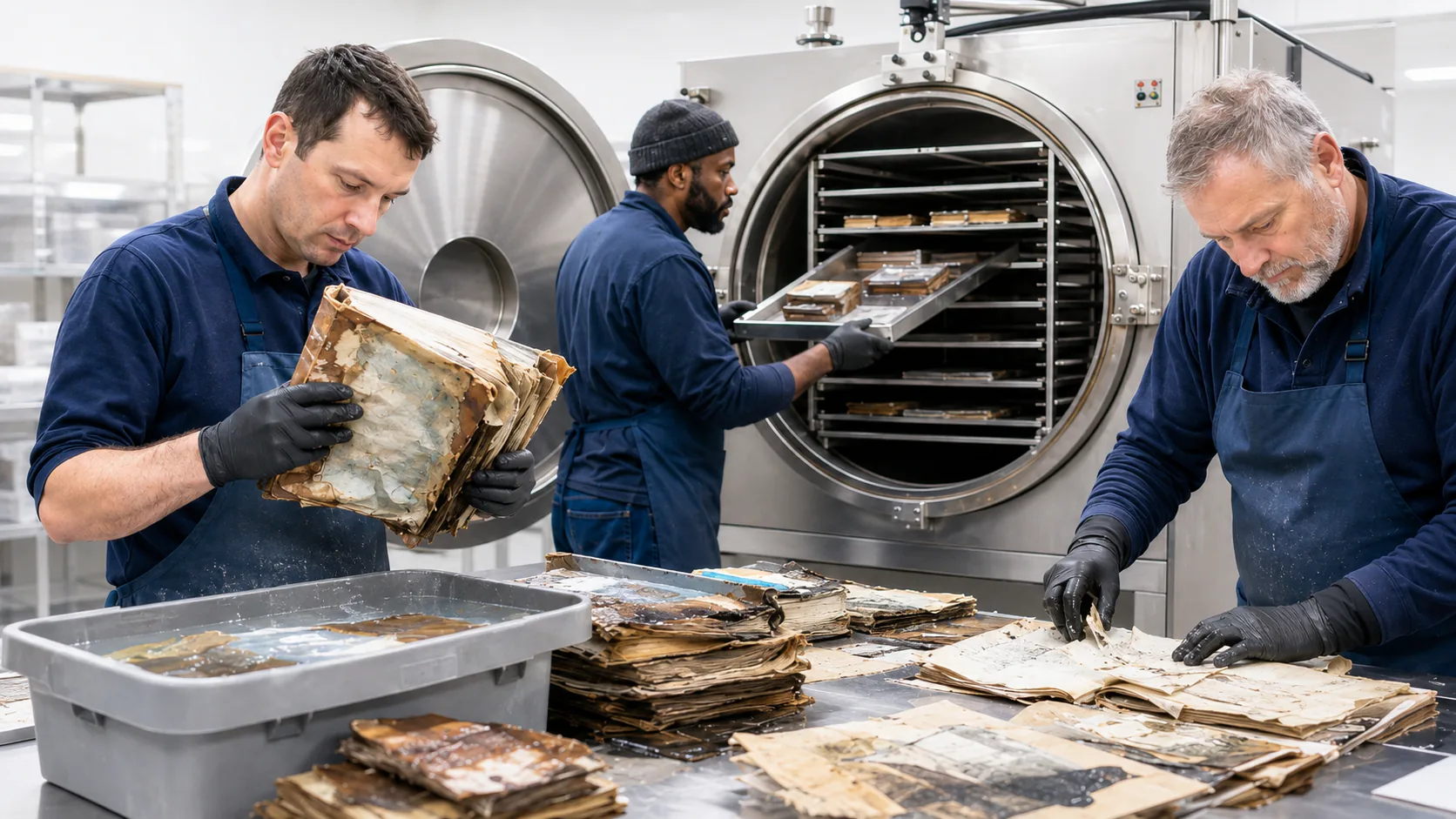 Guide
Guide