A useful quotation for museum storage cabinets begins with the collection, not with a cabinet model number.
If an RFQ says only “museum storage cabinet, 10 units,” the supplier still has to guess the storage format, collection size, load, access pattern, environmental requirement, monitoring needs, delivery constraints and installation conditions. Those assumptions create avoidable revisions later.
A stronger RFQ does not need to be a complete engineering specification. It simply needs to define the preservation objective and the operating conditions well enough for different suppliers to quote against the same requirement.
This guide sets out the information worth confirming before requesting a quotation.
1. Start with the collection, not the cabinet
The first question is not whether the cabinet should have drawers or shelves. It is what the cabinet must protect and how staff will use it.
Record the basic collection profile:
- collection type and material;
- number of objects or boxes;
- typical and maximum object dimensions;
- approximate weight of individual objects and expected shelf or drawer load;
- current condition and known vulnerabilities;
- frequency of access;
- expected storage period;
- anticipated collection growth.
This is important because different collection types need different support and handling strategies. The Canadian Conservation Institute (CCI), for example, treats storage as a collection-specific decision: paper, paintings, textiles, metals and three-dimensional objects can require different forms of enclosure, shelving, drawers or racks rather than one universal storage format.
A cabinet that is excellent for boxed archives may be inefficient for ceramics. A deep drawer unit may suit flat works on paper but create unnecessary handling for three-dimensional objects. Framed paintings may be better stored on purpose-built sliding screens or art racks than inside conventional cabinets.
A simple collection brief
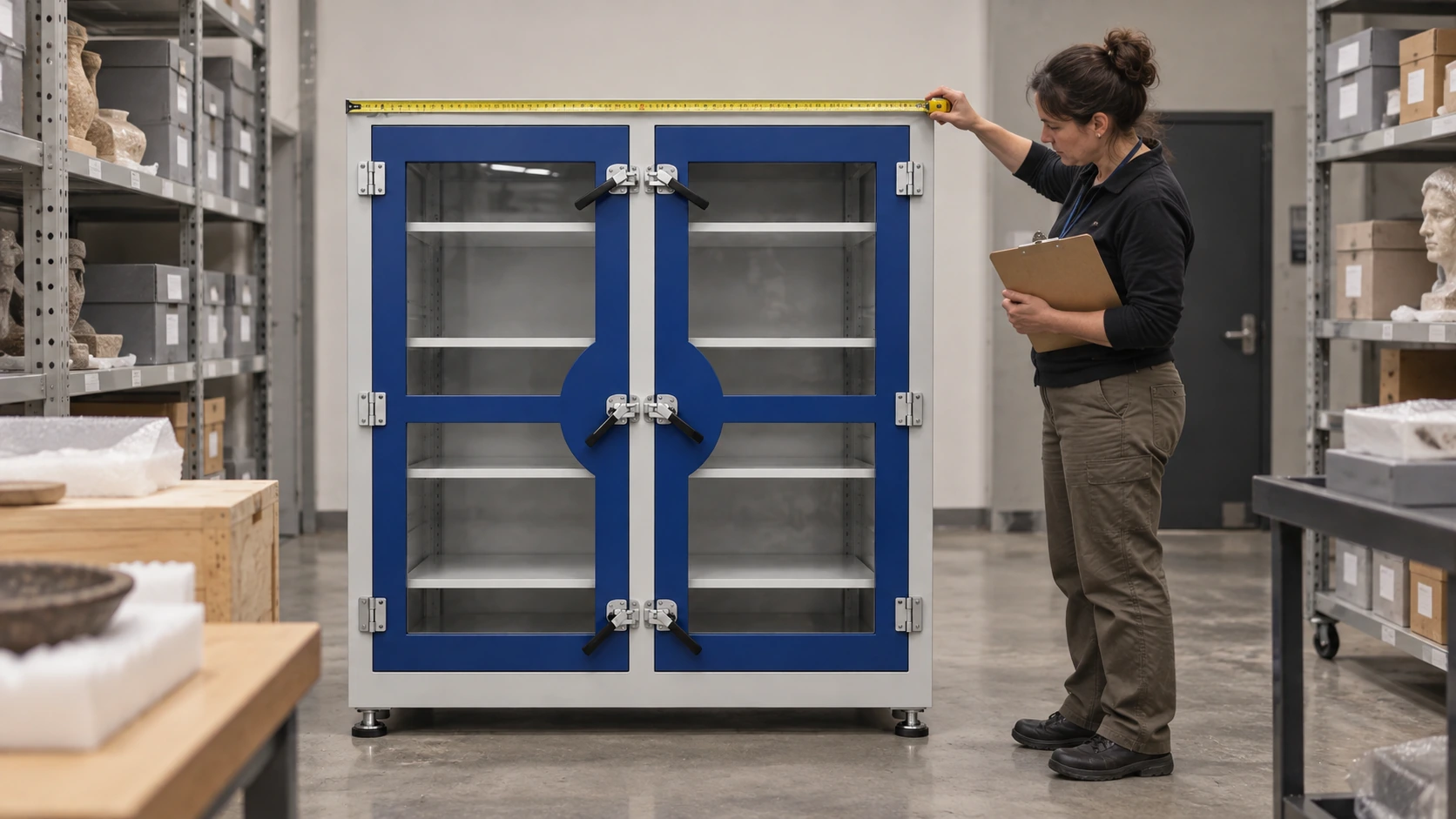
Before contacting suppliers, try to complete a one-page collection brief:
| Question | Example of useful information |
|---|---|
| What is being stored? | archival boxes, coins, bronzes, photographs, textiles |
| Largest item size? | maximum L × W × H |
| Typical item weight? | approximate range |
| How often is it accessed? | daily, weekly, occasional |
| How much growth is expected? | e.g. five-year or ten-year planning allowance |
| Main risk to reduce? | dust, handling, humidity fluctuation, pollutants, unauthorised access |
The purpose is not to turn the curator into an engineer. It is to prevent the equipment specification from becoming detached from the collection.
2. Decide what storage format is actually required
“Museum storage cabinet” can describe very different equipment. Before the RFQ is issued, identify the storage format or allow suppliers to recommend one from a clearly defined collection brief.
Common formats include:
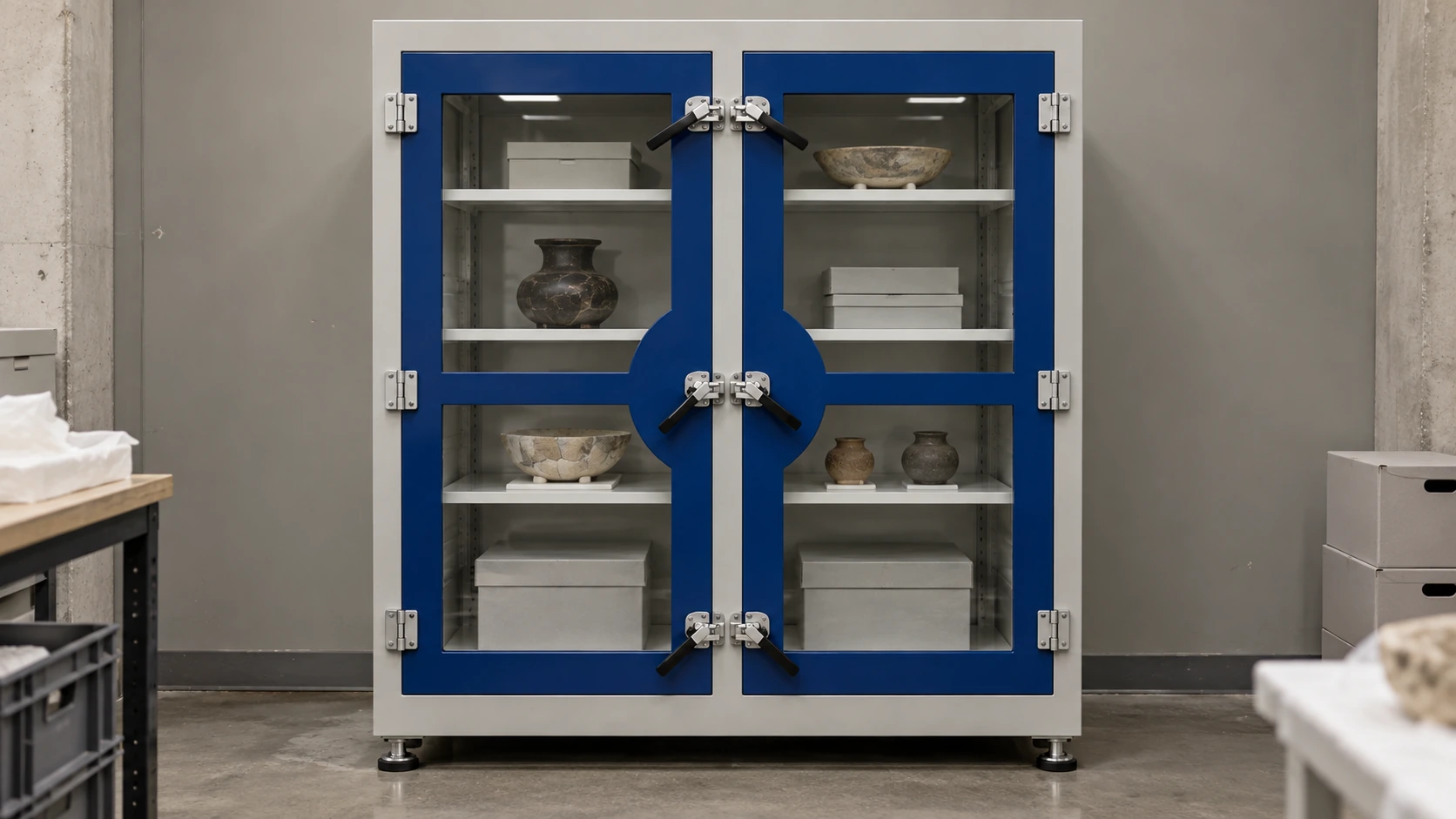
- adjustable-shelf cabinets for three-dimensional objects;
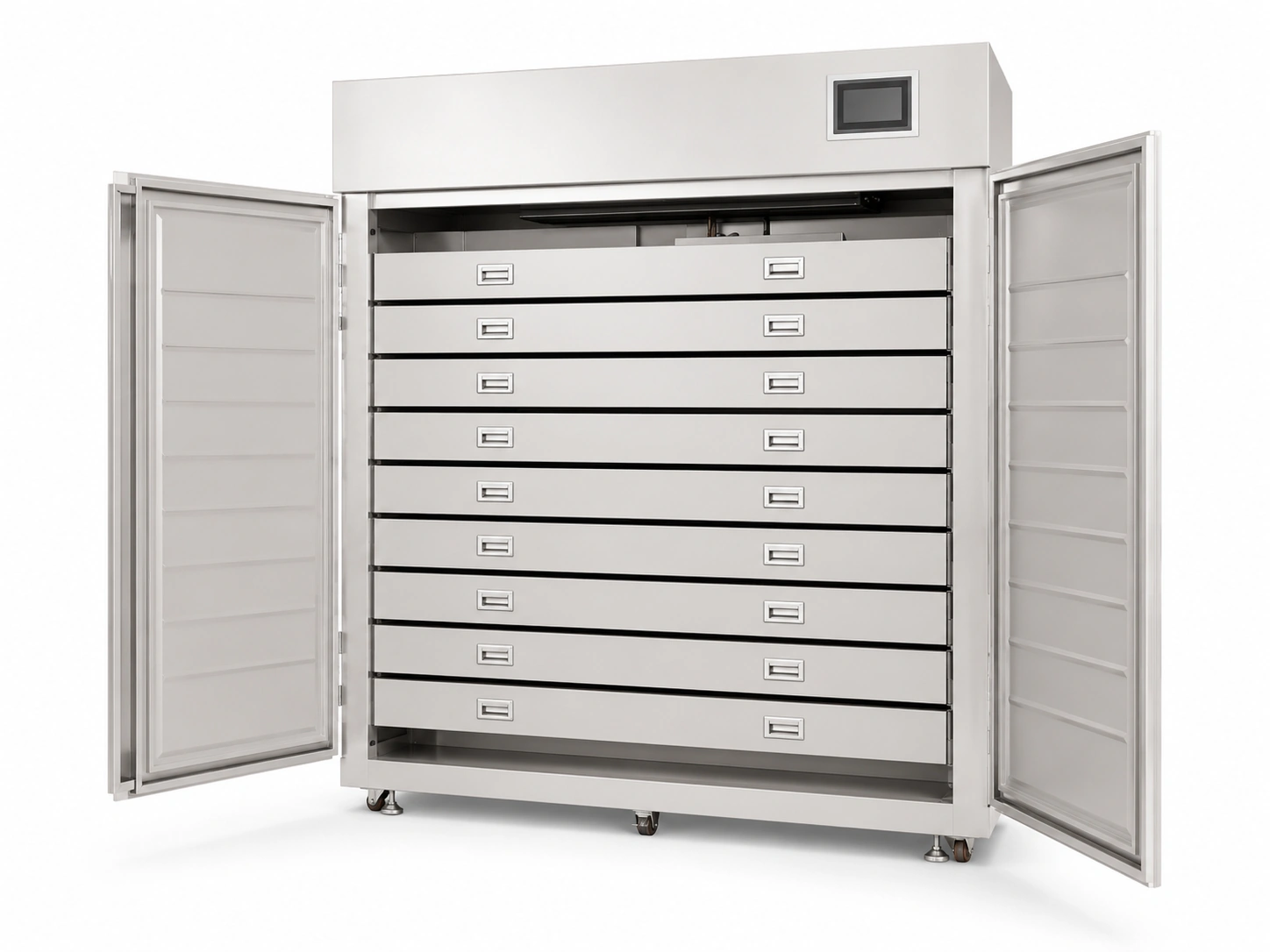
- drawer cabinets for flat or classified materials;
- map or plan cabinets for large paper-based objects;
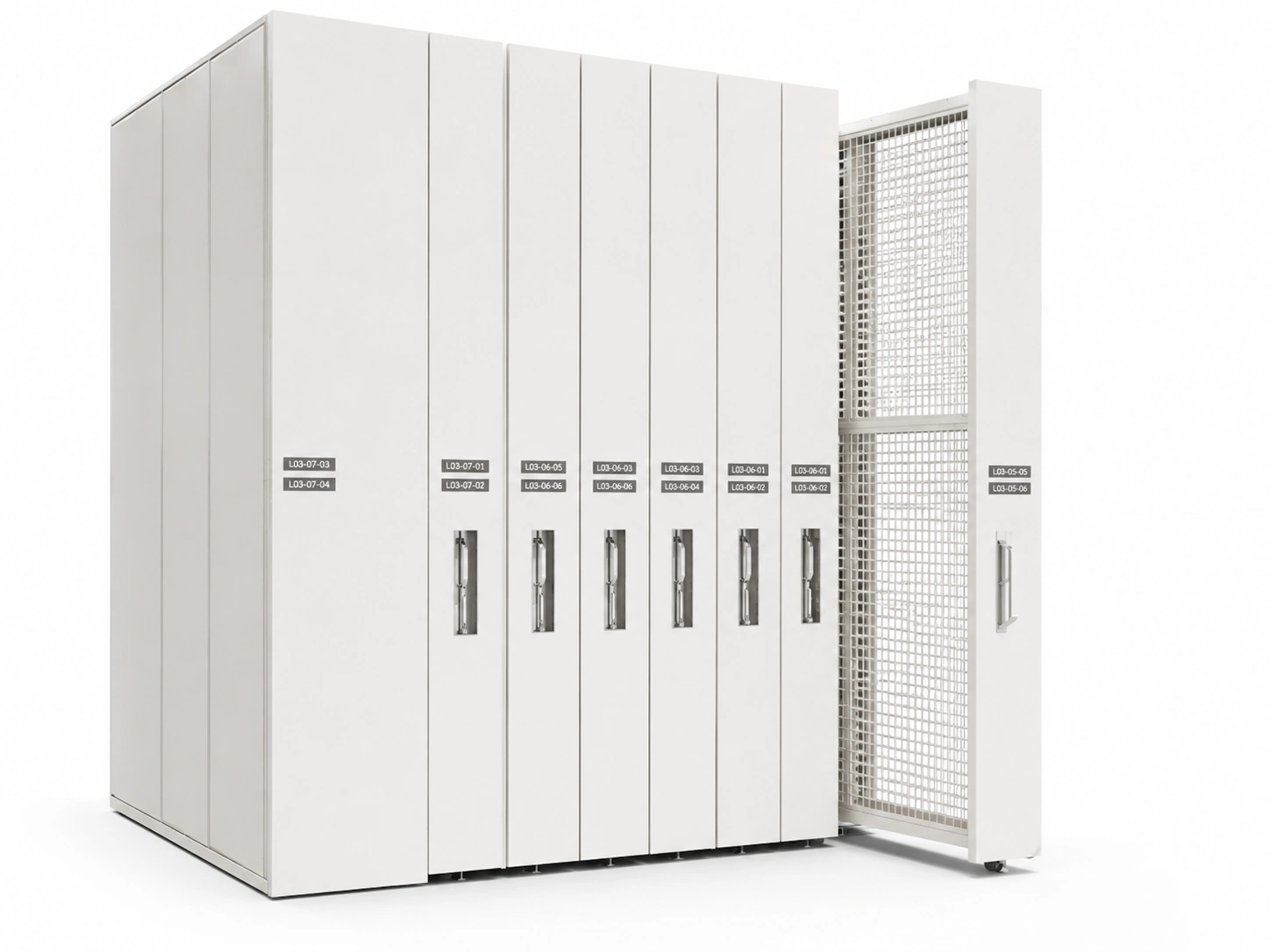
- closed shelving for boxed archives and books;
- open shelving where room-level environmental control and frequent access are more important than enclosure;
- pull-out art racks or sliding screens for framed works;
- specialised cabinets for textiles, metals or humidity-sensitive materials.
CCI guidance for paintings, for example, distinguishes slotted shelving, flat pull-out storage and sliding screens according to the physical form of the collection and handling requirements. That is a useful principle for any museum store: storage furniture should reduce unnecessary handling rather than force objects into a convenient standard cabinet.
3. Specify the internal layout
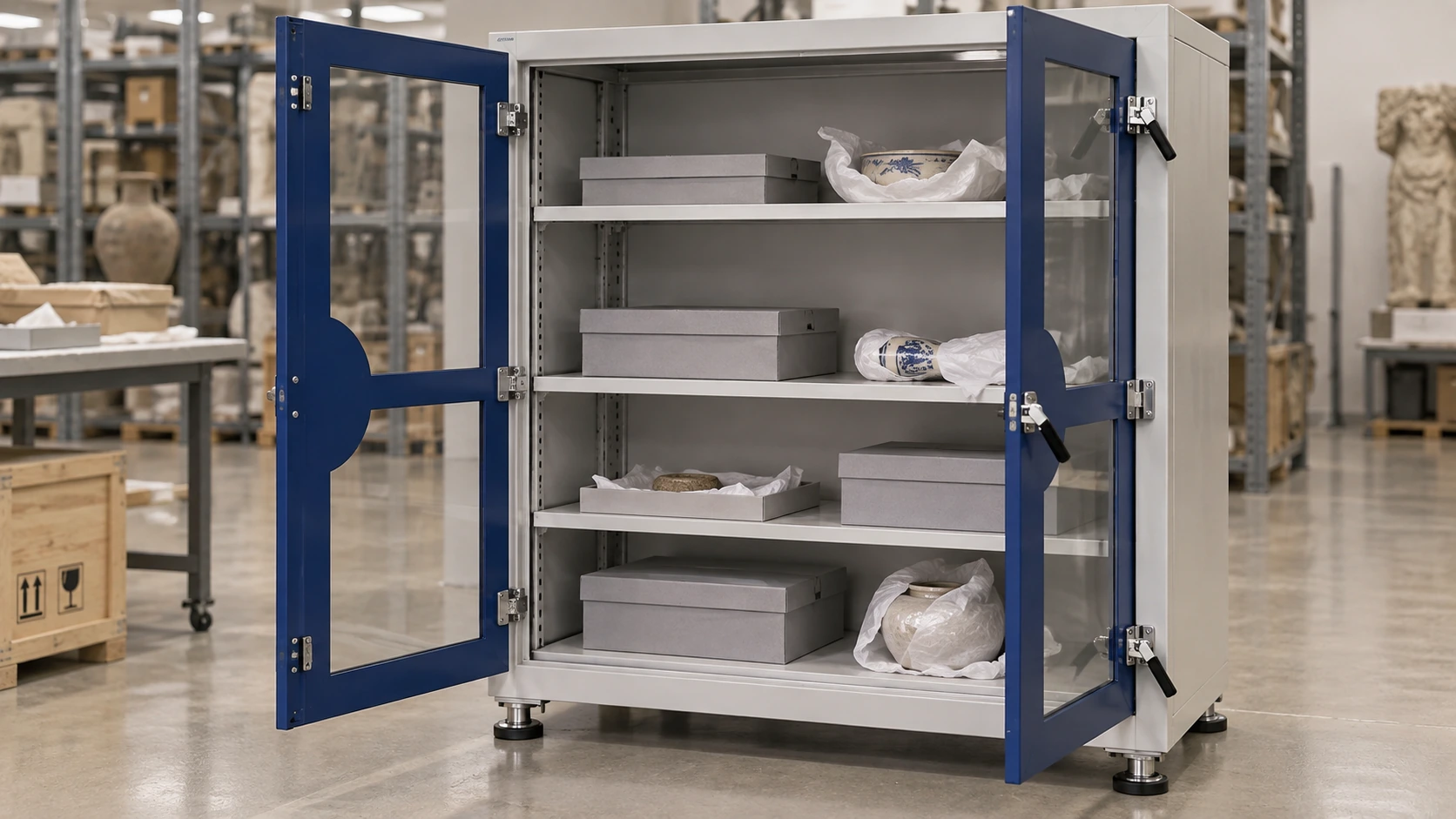
The internal arrangement often matters more to day-to-day use than the exterior cabinet dimensions.
Define, where possible:
- number of shelves or drawers;
- usable internal dimensions;
- shelf or drawer spacing;
- adjustability;
- shelf and drawer load capacity;
- whether trays need to be removable;
- whether dividers are required;
- object support or cushioning requirements;
- clearance for safe lifting and retrieval.
If the collection is still being catalogued, ask for an adjustable system rather than fixing every dimension too early.
For mixed collections, it can also be useful to divide the procurement into storage families rather than attempting to make one cabinet perform every function.
4. Define cabinet materials and finishes by preservation function
Do not specify a material simply because it sounds more “museum grade.” Ask what the material is expected to achieve.
Useful questions include:
- Is the cabinet body chemically stable for long-term collection storage?
- Are interior finishes easy to clean?
- Are coatings fully cured before use?
- Are wood or wood-based materials present inside the enclosure?
- Are shelves and drawers resistant to corrosion and routine cleaning?
- Are exposed edges smooth and safe for staff and objects?
CCI notes that chemically stable materials are important in storage and specifically identifies powder-coated metal as an appropriate option for many metal collections. CCI also warns that some wood products and coatings can release volatile compounds that may be unsuitable around sensitive objects.
The correct conclusion is not that one material is universally superior. It is that the cabinet material, coating and internal fittings should be selected with the stored material and pollutant risk in mind.
5. Decide whether environmental control belongs at room level or cabinet level
Not every museum storage cabinet needs active humidity or temperature control.
In a well-managed storage room with conditions suitable for the collection, a conventional closed cabinet may primarily provide organisation, dust protection, physical protection and some buffering from short-term environmental change.
Cabinet-level control becomes more relevant when:
- a vulnerable subset of the collection needs conditions different from the room;
- the building cannot provide sufficiently stable room conditions;
- the collection requires a lower or otherwise specialised RH range;
- the cabinet must provide a more isolated microenvironment;
- environmental data must be monitored and documented at enclosure level.
CCI guidance on preventive conservation emphasises that different collections have different sensitivities to relative humidity and that there is no single “correct RH” for every object. That is why an RFQ should not simply copy a generic temperature-and-humidity number from another project.
Instead, state:
- what material is being stored;
- what deterioration mechanism is being controlled;
- whether the target condition has already been defined by a conservator or project consultant;
- whether the requirement is room-level or cabinet-level control.
6. If the cabinet must be airtight, define why
“Airtight” is often used as a marketing adjective, but in preservation work it should describe a function.
A well-sealed enclosure can reduce exchange with the room and help limit the ingress of dust, pollutants, pests and rapid RH changes. CCI notes that enclosures such as cabinets, boxes and cases can provide strong protection when well sealed, but the appropriate level of enclosure depends on the preservation objective.
Ask:
- Is the purpose dust exclusion?
- Is the cabinet intended to buffer RH?
- Will silica gel or another sorbent be used?
- Will active humidity control be connected?
- Does the project require an air-exchange-rate test or another measurable acceptance method?
- How often will doors or drawers be opened?
The last point matters. A highly sealed cabinet that is opened repeatedly may not behave like the same cabinet in low-access storage.
Do not request an extreme airtightness value without a reason. Define the preservation function first, then the required performance.
7. Specify monitoring and records separately from control
Environmental monitoring and environmental control are related but different requirements.
Your RFQ should state whether you need:
- temperature monitoring;
- RH monitoring;
- internal and external sensors;
- local display;
- alarm thresholds;
- data logging;
- exportable records;
- remote access;
- integration with a building or collection-management system.
If the cabinet includes active control, also ask what happens after access:
- How is the system expected to recover after the door is opened?
- Is recovery performance tested under a defined load and room condition?
- What alarms indicate sensor, power or control faults?
Avoid accepting vague phrases such as “high precision” without a stated measurement range, sensor accuracy or acceptance method.
8. Include access, security and handling requirements
Preservation performance can be undermined by poor handling design.
Consider:
- lock type and access control;
- keyed or electronic locks;
- drawer stops;
- anti-tip protection;
- visibility requirements;
- labelling positions;
- ergonomic working height;
- whether heavy objects require pull-out shelves or trolleys;
- whether staff can retrieve one object without moving several others.
CCI’s preventive-conservation guidance repeatedly treats accessibility and orderly retrieval as part of good storage, because unnecessary movement increases physical risk to collections.
9. Do not forget the room and delivery route
A cabinet can meet the preservation specification and still fail the project if it cannot be delivered or safely installed.
Before quotation, provide:
- room dimensions;
- door and lift dimensions;
- corridor width and turning constraints;
- floor level;
- stair or ramp conditions;
- available power supply where active systems are used;
- floor loading limits where relevant;
- distance from walls or service zones;
- maintenance access;
- final installation location.
For large projects, ask the supplier to confirm packed dimensions and weights as well as installed dimensions.
10. Ask suppliers to separate standard equipment from project options
For easier comparison, request that quotations distinguish:
- base cabinet construction;
- shelves or drawers;
- environmental-control options;
- sensors and data logging;
- locks and security;
- internal supports;
- delivery;
- installation;
- commissioning;
- training;
- spare parts;
- warranty and service.
This avoids comparing one supplier’s complete project package against another supplier’s bare cabinet price.
Museum storage cabinet RFQ checklist
Use the following checklist before sending an enquiry.
Collection
- [ ] Collection/material type
- [ ] Quantity
- [ ] Maximum object dimensions
- [ ] Approximate object weight
- [ ] Fragility or known environmental sensitivity
- [ ] Access frequency
- [ ] Expected collection growth
Cabinet format
- [ ] Shelf, drawer, rack or mixed format
- [ ] Required usable internal dimensions
- [ ] Adjustable components
- [ ] Required shelf/drawer load
- [ ] Object-support requirements
Preservation performance
- [ ] Main risk to reduce
- [ ] Dust/pollutant protection requirement
- [ ] Airtightness requirement, if applicable
- [ ] Passive humidity buffering, if applicable
- [ ] Active RH or temperature control, if applicable
- [ ] Monitoring and data-recording requirement
Operation
- [ ] Lock/access requirement
- [ ] Opening frequency
- [ ] Labelling/documentation requirement
- [ ] Cleaning and maintenance access
Site
- [ ] Room dimensions
- [ ] Door/lift/corridor dimensions
- [ ] Floor loading constraints
- [ ] Electrical standard, if powered
- [ ] Delivery and installation scope
- [ ] Commissioning and training requirement
Final procurement principle
A museum storage cabinet should not be selected from exterior dimensions alone.
The most useful RFQ connects four things:
Collection → Risk → Storage format → Operating conditions
Once those are clear, cabinet construction, environmental control, monitoring and installation can be specified without adding unnecessary functions or overlooking critical constraints.
For institutions that are still defining the storage plan, a supplier should be able to review the collection type, available space and environmental requirement before recommending a cabinet configuration.
Frequently asked questions
What information is needed to quote museum storage cabinets?
At minimum, provide the collection type, quantity, largest object dimensions, preferred storage format, approximate load, room conditions, access frequency, required environmental control and installation location. A good supplier can help refine the specification from that starting point.
Should museum storage cabinets be airtight?
Not automatically. A well-sealed cabinet can improve protection from dust, pollutants, pests and environmental fluctuations, but the required airtightness should follow the preservation objective. Some collections are adequately protected by conventional closed cabinets inside a stable storage room; others benefit from a more controlled enclosure.
Do museum cabinets need humidity control?
Only when the collection risk and room conditions justify it. Active humidity control may be useful for sensitive collections or unstable rooms, while passive buffering or room-level control may be sufficient in other cases.
What material is best for museum storage cabinets?
There is no universal best material. The important factors are chemical stability, cleanability, corrosion resistance, structural capacity and compatibility with the stored collection. Powder-coated metal and stainless-steel configurations are common, but selection should be based on the project requirement rather than material name alone.
How much future storage capacity should a museum plan for?
There is no single percentage that fits every institution. Include a realistic allowance based on acquisition policy, collection growth, rehousing plans and the expected service life of the storage system rather than filling every cabinet to maximum capacity at installation.
Related Sinoalta resources
- Museum Collection Storage Planning: https://sinoalta.com/solutions/museum-storage/
- Museum Storage Equipment & Systems: https://sinoalta.com/products/museum-storage-systems/
- Museum Collection Storage Cabinets: https://sinoalta.com/products/museum-collection-storage-cabinets/
- Preventive Conservation & Collections Care: https://sinoalta.com/resources/preventive-conservation/
Sources and further reading
- Canadian Conservation Institute, General Precautions for Storage Areas: https://www.canada.ca/en/conservation-institute/services/conservation-preservation-publications/canadian-conservation-institute-notes/precautions-storage-areas.html
- Canadian Conservation Institute, Caring for paper objects: https://www.canada.ca/en/conservation-institute/services/preventive-conservation/guidelines-collections/paper-objects.html
- Canadian Conservation Institute, Storage and Display Guidelines for Paintings: https://www.canada.ca/en/conservation-institute/services/conservation-preservation-publications/canadian-conservation-institute-notes/storage-display-guidelines-paintings.html
- Canadian Conservation Institute, Products Used in Preventive Conservation – Technical Bulletin 32: https://www.canada.ca/en/conservation-institute/services/conservation-preservation-publications/technical-bulletins/products-used-preventive-conservation.html
- Canadian Conservation Institute, Incorrect relative humidity: https://www.canada.ca/en/conservation-institute/services/agents-deterioration/humidity.html