1. What Is a Paper Suction Table?
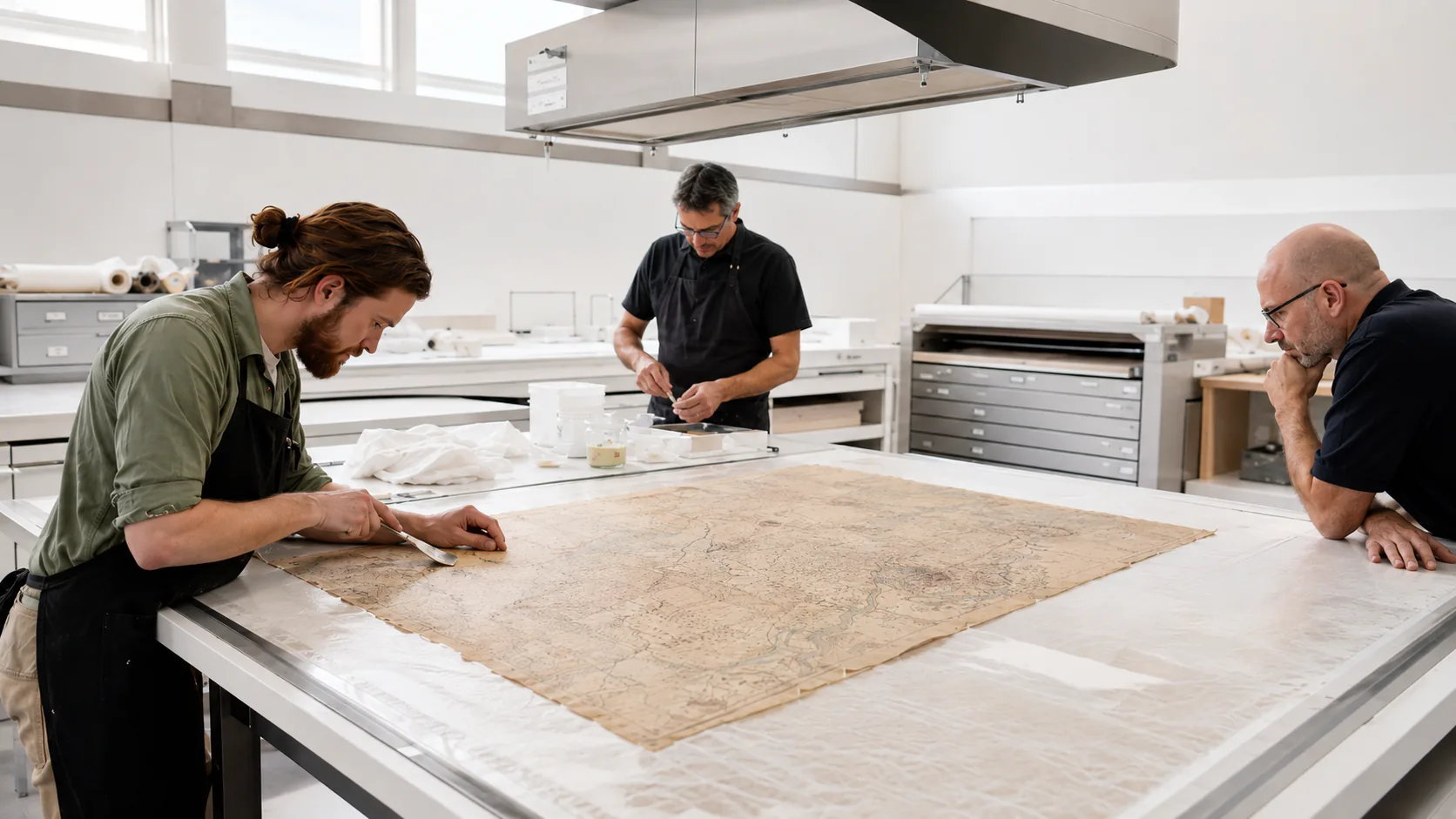
A paper suction table is a specialised conservation device that draws air downward through a porous working surface.
The object is placed over:
- blotting material;
- a screen;
- another porous support,
and suction creates a pressure differential across the sheet.
Canadian conservation training literature describes the basic effect clearly: paper and blotter are held in close contact, while solvents, dissolved dirt or treatment solutions can be drawn through the object into the absorbent layer below.
The table therefore provides controlled through-plane flow.
This can help a conservator localise treatment that might otherwise spread laterally across the sheet.
2. Why Suction Is Useful
When liquid is applied to paper without suction, it can move by capillary action in multiple directions.
This may produce:
- tide lines;
- stain migration;
- spreading of soluble degradation products;
- uncontrolled solvent movement.
Suction changes the pressure gradient.
Instead of allowing the liquid to travel primarily sideways, the table encourages movement downward through the paper and into the blotter.
This does not eliminate risk.
It gives the conservator another way to control the treatment.
3. Main Paper-Conservation Applications
Suction tables may be used for:
- local washing;
- reducing stains;
- extracting soluble degradation products;
- applying selected solvents;
- controlling bleaching or reducing agents in specialised treatments;
- humidification;
- flattening;
- drying;
- lining or attachment procedures;
- local pulp infill or leafcasting adaptations.
The exact method depends on the object and the conservator’s treatment plan.
A suction table is a platform for controlled treatment—not a single treatment method.
4. Local Washing
Local washing can be useful when an object cannot be fully immersed or when treatment is needed only in a selected area.
A basic approach may involve:
- supporting the sheet on an absorbent blotter;
- masking surrounding areas if required;
- applying water or another selected solution locally;
- using suction to pull the liquid through;
- replacing saturated blotter;
- monitoring the stain or degradation product.
This can reduce the distance that dissolved material travels laterally.
Media testing remains essential
If inks, pigments or annotations are water-sensitive, local washing can still cause movement.
Suction does not make soluble media insoluble.
The treatment should be preceded by testing and controlled application.
5. Stain Reduction
Suction can be particularly valuable when the objective is to reduce a local tide line or stain.
The conservator may use:
- water;
- buffered solutions;
- solvents;
- gels or mist application;
- another reagent appropriate to the stain.
The table can help draw solubilised material away from the treated area.
However, stain treatment is chemically complex.
The cause of the stain should be understood before selecting a reagent.
The goal is not necessarily to make the paper visually white.
It is to improve stability or appearance without unacceptable damage to cellulose or media.
6. Solvent Treatment
Some adhesives, tapes, oils or stains require organic solvents.
A suction table can help control solvent penetration and reduce lateral spreading.
This is useful, but introduces significant safety requirements.
Organic solvent treatment may create:
- vapour exposure;
- flammable atmospheres;
- dissolved adhesive migration;
- tidelines;
- changes to inks or coatings.
A table intended for solvent work should be compatible with the chemicals used and integrated with appropriate ventilation.
Local suction through the object is not automatically equivalent to safe laboratory fume extraction.
7. Drying and Flattening
Suction can support controlled drying.
By holding the paper against a flat porous surface, it may help reduce:
- cockling;
- local lifting;
- distortion.
The technique can be useful after:
- washing;
- humidification;
- local aqueous treatment.
However, excessive restraint can also create stress.
The conservator should control:
- suction level;
- moisture gradient;
- drying rate;
- edge restraint.
Very fragile or dimensionally unstable objects may require an alternative drying method.
8. Lining and Attachment
Vacuum or suction tables have also been used in lining procedures.
Suction can:
- hold layers flat;
- help remove trapped air;
- draw adhesive through porous layers in some techniques;
- support even contact during drying.
The suitability depends on:
- object media;
- adhesive;
- lining tissue;
- porosity;
- required pressure.
No single lining method is appropriate for all works on paper.
9. Local Suction and Suction Discs
Not every treatment requires a full table.
A small suction disc or masked working area can concentrate pressure beneath a limited region.
Local suction is useful when:
- a stain is small;
- the surrounding media are sensitive;
- the sheet is very large;
- treatment should avoid unnecessary wetting.
AIC and CCI literature documents local suction approaches for stain reduction and specialised treatment.
The smaller the active area, the greater the control can be—but the risk of hard treatment boundaries or tide lines must also be considered.
10. Masking the Working Area
Masking controls where air can pass through the table.
If the entire porous surface remains open, much of the airflow may bypass the object.
Masks can:
- concentrate suction;
- define the active treatment region;
- reduce unnecessary airflow;
- improve consistency.
Materials used for masking should be chemically and physically suitable for the treatment.
Sharp mask edges may create abrupt wet/dry boundaries, so treatment technique still matters.
11. Suction Level and Uniformity
There is no universal suction setting for paper conservation.
Required pressure depends on:
- paper porosity;
- object size;
- blotter;
- screen resistance;
- treatment liquid;
- whether the task is drying, washing or solvent extraction.
The table should provide adjustable control.
More suction is not automatically better.
Excessive pressure can:
- deform weak paper;
- pull fragments;
- emboss a screen pattern;
- accelerate drying too aggressively;
- move media;
- create uneven local treatment.
Uniformity across the active area can be as important as maximum pressure.
12. Surface Design
A conservation suction table should provide:
- flat support;
- even airflow;
- chemically resistant construction;
- a screen or porous layer appropriate to paper;
- access for blotter replacement;
- adjustable suction;
- cleanability.
Some designs use stainless-steel screens or perforated surfaces.
The working support should not imprint texture into damp paper.
Interleaving and blotter selection are therefore part of the treatment system.
13. Risks and Limitations
Potential risks include:
Tide lines
If a treatment boundary dries unevenly, dissolved material can concentrate at the edge.
Over-cleaning
A stain may be part of the object’s history. Aggressive reduction can produce an unnaturally clean patch.
Media movement
Soluble inks, dyes or retouching may bleed.
Paper distortion
Differential wetting can cause expansion and cockling.
Chemical damage
Bleaches, reducing agents or solvents may harm cellulose or media if poorly selected.
Mechanical loss
Strong suction can disturb weak fragments.
The suction table improves control, but professional judgment remains essential.
14. Safety
Treatment planning should consider both the object and the operator.
Depending on the process:
- provide local exhaust for solvent vapours;
- use compatible electrical equipment;
- manage flammable liquids;
- wear suitable PPE;
- prevent reagent spills entering equipment;
- define safe waste handling;
- maintain filters and pumps.
The table should be installed according to the chemicals and laboratory conditions in which it will actually be used.
15. A Typical Treatment Workflow
Assess
Identify the paper, media, stain or treatment objective.
Test
Test solubility, colour change and response in a small area.
Prepare
Select blotter, mask, suction level and reagent.
Treat
Apply liquid gradually while maintaining controlled downward flow.
Observe
Watch for tidelines, media movement, colour change or distortion.
Stop
Remove excess liquid and replace contaminated blotter.
Dry
Use controlled suction or another appropriate drying method.
Document
Record the solution, treatment area and outcome.
16. Selecting a Suction Table
Consider:
- maximum sheet size;
- required active area;
- suction adjustability;
- airflow uniformity;
- solvent compatibility;
- filtration or exhaust interface;
- work height;
- lighting;
- masking options;
- cleaning and maintenance;
- integration with other paper-conservation tasks.
A conservation laboratory may benefit more from a versatile, controllable table than from maximum suction alone.
Planning & Verification
Assess
Define the object, media and treatment objective.
Test
Confirm compatibility of liquids and suction.
Treat
Apply the method locally and incrementally.
Review
Evaluate visual, chemical and dimensional response.
Assess → Test → Treat → Review
Frequently Asked Questions
What does a suction table do?
It draws air through a porous working surface, creating pressure differential that can pull treatment liquids through paper into absorbent material below.
Can a suction table remove stains?
It can support local stain reduction by controlling liquid movement, but the correct reagent and treatment method depend on the cause of the stain and material sensitivity.
Is a suction table the same as a vacuum table?
The terms are often used interchangeably in conservation. Designs vary in pressure level, airflow and surface construction.
Can solvents be used on a suction table?
Yes, in appropriate conservation treatments, but the table and ventilation system must be chemically compatible and operator exposure must be controlled.
Does suction prevent tide lines?
It can reduce lateral movement and help control tidelines, but poor wetting and drying technique can still create them.
Can fragile paper be treated?
Sometimes, but fragile paper may require reduced suction, screens, local treatment or another method.
Is higher suction better?
No. The correct level is the minimum pressure that supports the treatment without damaging the object.
Can a suction table be used for drying?
Yes. Controlled suction can support flat drying after humidification or washing, provided the object can tolerate the restraint.
Planning a Paper Conservation Laboratory?
A suction table is most useful when the table surface, pump, extraction, lighting and adjacent wet-treatment workflow are designed together.
Sinoalta can support project-specific table size and workstation configuration.
Explore Suction Table Systems →
Selected Technical References
- Library and Archives Canada / Canadian conservation training literature on paper suction tables
- Canadian Conservation Institute research on the design and use of vacuum suction tables
- Journal of the American Institute for Conservation, Design and Construction of a Suction Table
- AIC Book and Paper Group, Demonstration of Paper Suction Table Techniques
Scope and review note: Written by Stella Wynn for Sinoalta. Sinoalta is responsible for this institutional content. Issued and most recently reviewed in August 2026. It summarizes selected conservation sources for project planning and does not replace object-specific assessment, qualified conservation advice, applicable safety requirements or project validation.
 Guide
Guide Guide
Guide Guide
Guide