There is no single “best” museum storage system.
A closed cabinet, open shelving bay, mobile rack and pull-out art screen solve different problems. The correct choice depends on the physical form of the collection, frequency of access, room environment, handling risk, floor space, dust exposure and the level of enclosure the objects need.
A good storage plan therefore asks:
What must the storage furniture protect against, and how must staff retrieve the collection?
This comparison focuses on four common formats:
- closed museum storage cabinets;
- open or static shelving;
- mobile/high-density shelving;
- pull-out racks and sliding screens for framed works.
1. Start with the collection and retrieval workflow
Before comparing hardware, record:
- material type;
- object dimensions and weights;
- boxed vs unboxed storage;
- flat, hanging or three-dimensional format;
- fragility;
- frequency of retrieval;
- number of staff required to handle objects safely;
- expected collection growth;
- room environmental conditions.
CCI storage guidance consistently ties storage design to collection characteristics and access. For paintings, for example, CCI describes different solutions for vertically stored works, flat fragile works and hanging framed collections. For paper, CCI recommends archival boxes, shelving and cabinets as additional protective layers according to format and sensitivity.
The storage format should therefore reduce handling and preserve visibility and order rather than force every object into the same furniture type.
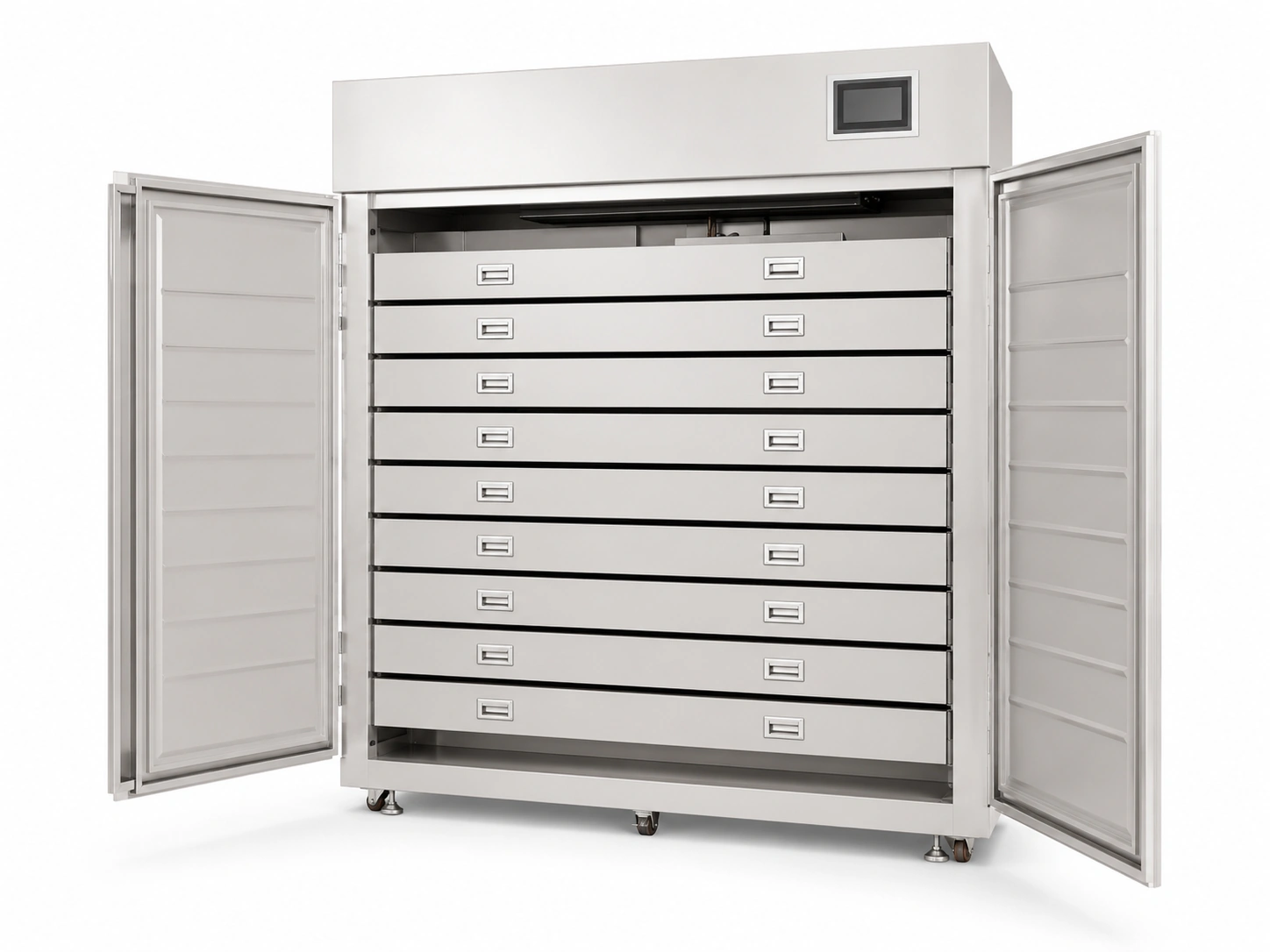
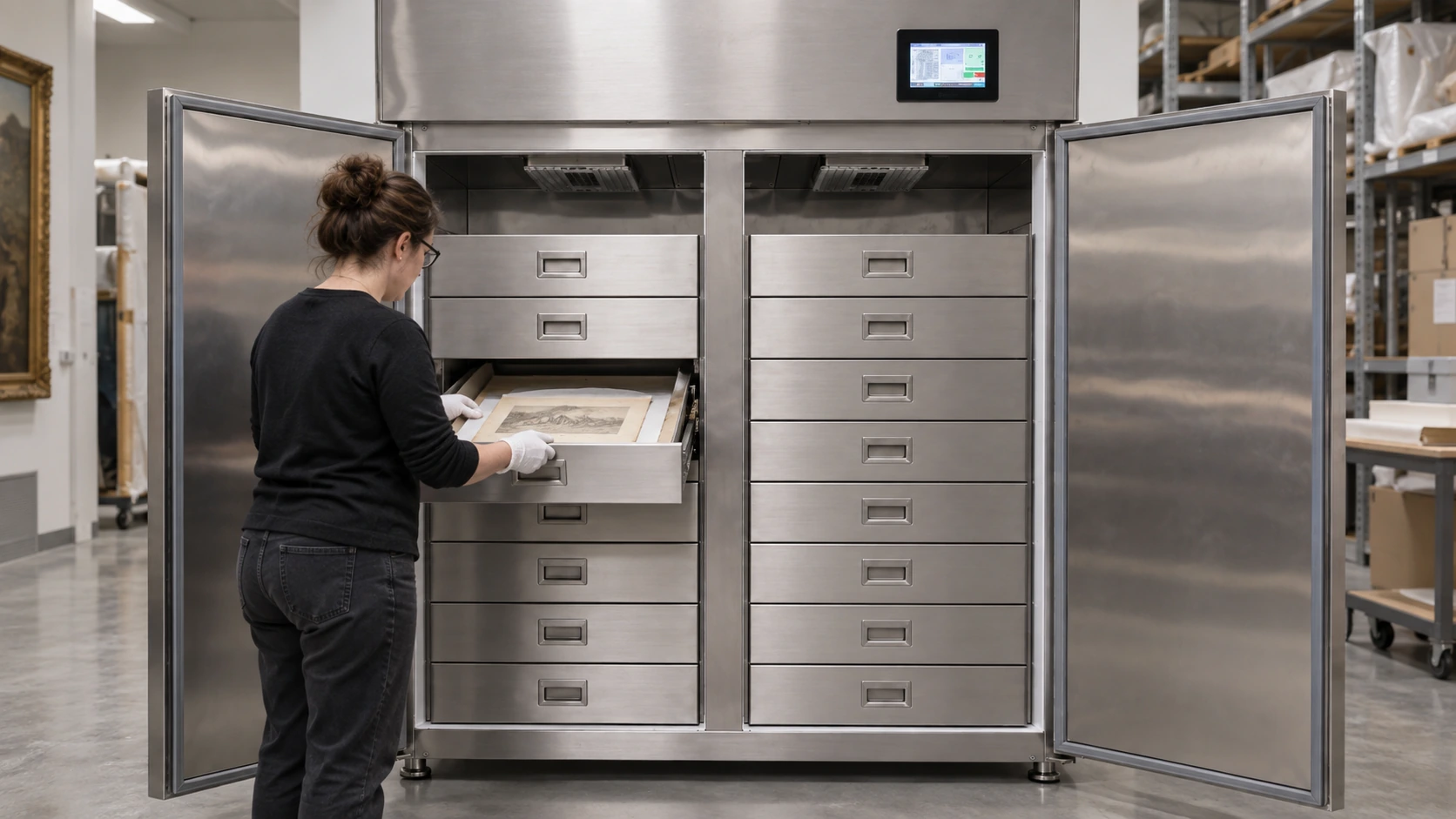
2. Closed museum storage cabinets
Closed cabinets create a second protective boundary inside the storage room.
They are often used for:
- small and medium three-dimensional objects;
- archival boxes and documents;
- photographs;
- coins and metal objects;
- works on paper;
- textiles stored flat;
- collections needing an additional dust or environmental barrier.
Strengths
Dust protection Doors and enclosed construction reduce direct deposition of room dust compared with open shelving.
Physical separation Objects can be organised into defined cabinet zones, reducing contact with unrelated storage activity.
Environmental buffering A closed enclosure can moderate short-term RH change, especially when well sealed and when objects are boxed or otherwise buffered. CCI notes that closed cabinets and well-designed enclosures can help slow RH fluctuations for paper and other sensitive materials.
Security Locks or controlled access can be integrated.
Cabinet-level control Where justified, a cabinet can incorporate passive humidity buffering, active RH control, temperature/RH monitoring or air purification.
Limitations
- less space-efficient for very large framed works;
- access can be slower if objects are densely packed;
- cabinet dimensions can constrain future acquisitions;
- active environmental options add maintenance;
- drawers and doors need adequate aisle clearance.
Best fit
Choose cabinets when enclosure itself is part of the preservation strategy and the collection can be organised within defined shelves, drawers or trays.
3. Open or static shelving
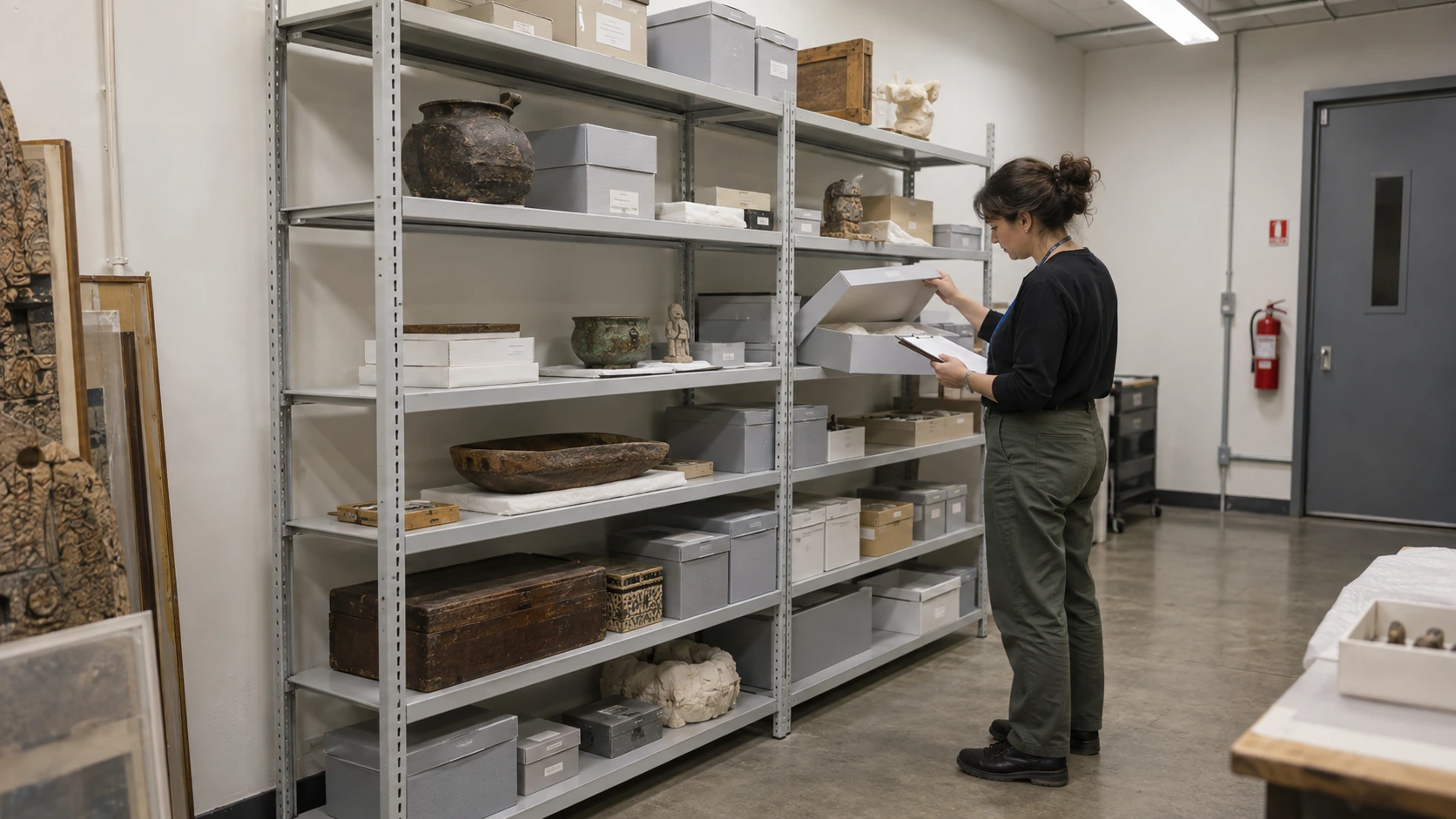
Open shelving is one of the simplest and most flexible museum storage formats.
It is commonly used for:
- boxed archives;
- robust three-dimensional objects;
- containers and trays;
- collections that require frequent visual access;
- stores where room-level environmental control is already suitable.
Strengths
Visibility and retrieval Staff can identify and retrieve containers without opening a cabinet.
Flexible dimensions Shelving can often be adjusted as collection sizes change.
Lower equipment complexity There are no cabinet seals, doors or integrated environmental systems to maintain.
Efficient use for boxed collections When objects already have appropriate boxes or containers, open shelving can support high-density organisation without adding another enclosure.
Limitations
Dust exposure Objects and containers are more exposed to airborne dust unless individually covered or boxed.
Room dependence The storage room must provide the required temperature, RH, cleanliness and pest protection because the shelving offers little environmental separation.
Water risk Overhead leaks or sprinkler discharge can affect exposed material more directly. CCI recommends keeping collections off floors and considering protection from water paths in storage design.
Security The room, rather than the individual unit, usually provides the main access barrier.
Best fit
Open shelving works best when the collection already has protective housings, the room environment is appropriate and staff need efficient access.
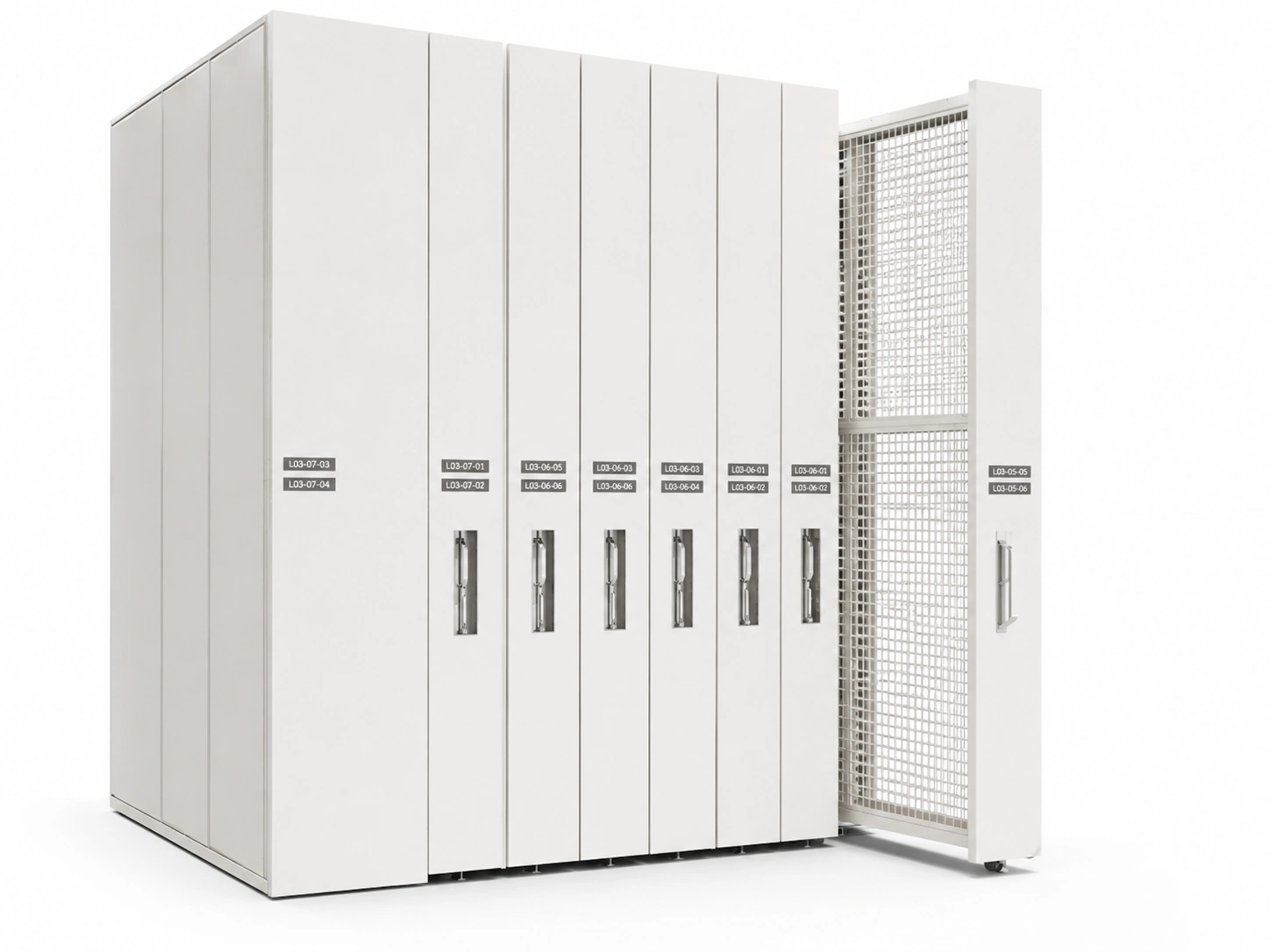
4. Mobile or high-density shelving
Mobile shelving places shelving bays on moving bases so that most permanent aisles are removed. An aisle is opened only where access is needed.
This can greatly increase storage density in rooms where floor area is limited.
Strengths
Space efficiency Reducing fixed aisles can increase usable storage capacity without expanding the room.
Good fit for regular container sizes Archival boxes, books and standardised collection containers can be arranged efficiently.
Structured organisation Dense storage can still be highly retrievable when bays, shelves and locations are clearly labelled.
Limitations
Floor load High-density systems concentrate substantial weight. Structural capacity should be reviewed before installation.
Movement risk Objects must be stable enough that rack motion does not cause sliding, vibration or impact.
Access control Only one or a limited number of aisles may be open at a time depending on the system.
Mechanical maintenance Tracks, drive mechanisms and safety systems require maintenance.
Emergency access Emergency planning should consider what happens during power loss or mechanical failure in powered systems.
Best fit
Mobile storage is most attractive when floor area is the limiting constraint and the collection can be safely standardised on shelving or in containers.
It should be treated as a room-and-structure project, not only as furniture procurement.
5. Pull-out art racks and sliding screens
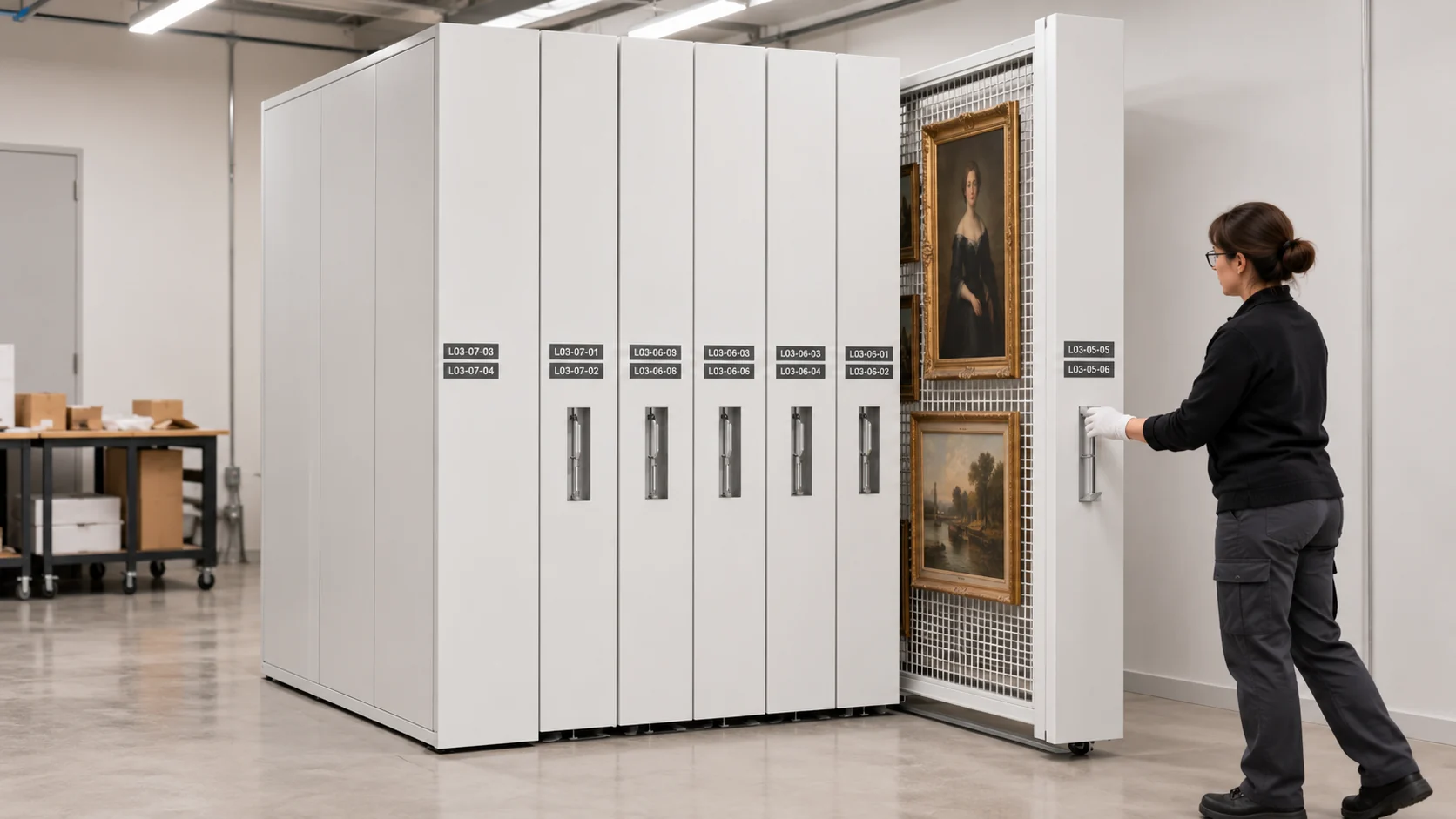
Framed paintings and other “suspendable” works require a different logic.
CCI describes sliding screens as a safe and convenient storage method for paintings because they provide efficient use of space and allow viewing and retrieval without stacking framed works directly against one another.
A pull-out rack typically uses mesh or framed panels that slide out from a fixed bank.
Strengths
High density for framed works Many paintings can be hung vertically within a relatively compact footprint.
Reduced stacking Works do not need to be repeatedly unstacked to reach the item behind them.
Visual access Pulling out one screen allows staff to inspect several works without moving each one individually.
Flexible hanging layout Different frame sizes can be arranged on the same panel where weight and spacing allow.
Limitations
- requires compatible hanging hardware;
- very heavy or fragile works may need separate support;
- installation can involve floor tracks or structural coordination;
- rack load and stability must be engineered;
- unframed or three-dimensional collections need other formats.
Best fit
Use pull-out racks or sliding screens for framed paintings, large flat artworks and other collections that are safely stored vertically by suspension.
6. Compare the systems by preservation risk
| Risk / need | Closed cabinet | Open shelving | Mobile shelving | Pull-out art racks |
|---|---|---|---|---|
| Dust exclusion | Strong | Low unless boxed | Low–moderate unless enclosed | Low–moderate |
| Cabinet-level RH control | Possible | No | Usually room-level | Usually room-level |
| Fast visual access | Moderate | Strong | Strong | Strong for framed works |
| Space density | Moderate | Moderate | Very strong | Strong |
| Security at unit level | Strong | Low | Moderate | Low–moderate |
| Large framed works | Weak | Moderate | Weak | Very strong |
| Boxed archives | Strong | Strong | Very strong | Not suitable |
| Small classified objects | Strong | Moderate | Moderate | Not suitable |
| Mechanical complexity | Low–moderate | Low | Moderate–high | Moderate |
These are general tendencies. Specific product design can move a system from one category to another.
7. Compare by collection type
Archives and books
Typical options:
- open shelving for boxed archives and frequently accessed material;
- mobile shelving where floor area is limited;
- closed cabinets for sensitive, valuable or low-access collections requiring extra dust or environmental protection.
Works on paper
Typical options:
- flat drawer cabinets;
- map cabinets;
- boxed storage on shelving;
- closed cabinets for a more buffered enclosure.
CCI’s paper guidance illustrates large flat metal cabinets as a suitable storage form for works on paper.
Coins, metals and small objects
Closed cabinets and drawers often offer the best organisation, particularly when collections require small compartments, trays or a low-dust environment. For certain metal collections, a controlled low-RH enclosure may be justified.
Ceramics and robust three-dimensional objects
Adjustable shelving or closed cabinets can both work. The decision often depends on dust risk, room conditions, access and object size.
Textiles
Flat drawer cabinets, removable trays, boxes on shelving or rolled storage may be appropriate depending on textile size and condition. CCI notes that large metal map cabinets can be useful for flat textile storage and that uncovered textiles should not simply be left exposed on open shelves.
Paintings and framed works
Pull-out racks, sliding screens or slotted shelving are generally more space-efficient than conventional cabinets for large framed works.
8. Room environment determines how much work the furniture must do
A storage unit cannot be selected independently of the room.
Ask:
- Is RH already controlled at room level?
- Is the room dusty?
- Are pests actively managed?
- Is there a water-leak risk?
- How stable is temperature?
- Are there pollutants or nearby service functions?
- Is the room secure?
If room conditions are stable and the objects are boxed, simple shelving may be sufficient.
If the building is difficult to condition or a sensitive subset needs a separate microenvironment, closed cabinets may add a useful protective layer.
9. Access frequency can reverse the “best” choice
A theoretically protective enclosure can become operationally poor if staff must open it continuously.
For high-access teaching collections, open or mobile shelving may reduce handling and retrieval time.
For rarely accessed high-value material, a closed cabinet with controlled access may be more appropriate.
For paintings, a pull-out screen can reduce handling because staff view works by moving the rack panel rather than moving every painting in front of the target object.
The safest system is often the one that minimises unnecessary handling in the real workflow.
10. Do not use storage density as the only performance metric
High-density storage is attractive, but overfilling creates new risks:
- objects become difficult to inspect;
- staff move several objects to retrieve one;
- fragile items contact each other;
- airflow around containers may be reduced;
- future acquisitions have nowhere to go;
- emergency removal becomes slower.
CCI preventive-conservation guidance emphasises orderly storage and retrieval without excessive movement of other objects. Density should therefore be balanced against safe access.
11. A practical selection sequence
Use the following order:
Step 1 — Group the collection
By material, size, weight, format and access frequency.
Step 2 — Identify the main preservation risks
Dust, physical damage, humidity, water, pollutants, pests, security.
Step 3 — Decide the enclosure level
Room only, box/container, closed cabinet, specialised microenvironment.
Step 4 — Select the storage format
Shelving, mobile shelving, cabinet, drawer, art rack.
Step 5 — Check room and structure
Aisles, floor load, delivery, fire protection, water paths, maintenance.
Step 6 — Build in growth
Do not fill the system to maximum density on day one.
12. When a mixed storage strategy is better
Many museum stores should not choose one system.
A mixed collection may use:
- mobile shelving for boxed archives;
- closed controlled cabinets for humidity-sensitive metals;
- drawer cabinets for works on paper;
- pull-out racks for paintings;
- open shelving for robust oversized objects.
This approach follows the collection instead of forcing every object into one procurement category.
Final decision matrix
| Main requirement | First system to evaluate |
|---|---|
| Maximum density for boxed archives | Mobile/high-density shelving |
| Fast access in a stable room | Open/static shelving |
| Extra dust/security/environmental enclosure | Closed cabinets |
| Flat paper or small classified objects | Drawer cabinets |
| Framed paintings | Pull-out racks/sliding screens |
| Collection needs cabinet-level RH control | Controlled storage cabinets |
| Oversized irregular objects | Custom shelving/racking based on handling plan |
Frequently asked questions
Are closed museum cabinets always better than open shelving?
No. Closed cabinets provide an extra enclosure but may be unnecessary for robust boxed collections in a well-controlled room. Open shelving can improve access and flexibility. The choice depends on collection risk and workflow.
When should a museum use mobile shelving?
Mobile shelving is useful when floor area is limited and the collection can be safely stored in regular shelving bays or containers. Floor loading, movement, emergency access and mechanical maintenance should be reviewed before installation.
What is best for storing paintings?
For many framed paintings, pull-out racks or sliding screens provide efficient vertical storage and reduce repeated stacking and handling. Fragile, oversized or unframed works may require other supports.
Do storage cabinets help stabilise humidity?
Closed cabinets can slow short-term RH change, especially when well sealed and combined with boxes or passive buffering. They do not replace room environmental control automatically, and active cabinet-level control should be used only when justified by the collection requirement.
Can one storage system serve an entire museum collection?
Usually not efficiently. Mixed collections often benefit from different storage formats for archives, paintings, textiles, metals, small objects and oversized material.
Related Sinoalta resources
- Museum Collection Storage Planning: https://sinoalta.com/solutions/museum-storage/
- Museum Storage Equipment & Systems: https://sinoalta.com/products/museum-storage-systems/
- Museum Collection Storage Cabinets: https://sinoalta.com/products/museum-collection-storage-cabinets/
- Pull-Out Art Storage Racks: https://sinoalta.com/products/pull-out-art-storage-racks/
Sources and further reading
- Canadian Conservation Institute, General Precautions for Storage Areas: https://www.canada.ca/en/conservation-institute/services/conservation-preservation-publications/canadian-conservation-institute-notes/precautions-storage-areas.html
- Canadian Conservation Institute, Storage and Display Guidelines for Paintings: https://www.canada.ca/en/conservation-institute/services/conservation-preservation-publications/canadian-conservation-institute-notes/storage-display-guidelines-paintings.html
- Canadian Conservation Institute, Caring for paper objects: https://www.canada.ca/en/conservation-institute/services/preventive-conservation/guidelines-collections/paper-objects.html
- Canadian Conservation Institute, Flat Storage for Textiles: https://www.canada.ca/en/conservation-institute/services/conservation-preservation-publications/canadian-conservation-institute-notes/flat-storage-textiles.html
- Canadian Conservation Institute, Basic requirements of preventive conservation: https://www.canada.ca/en/conservation-institute/services/preventive-conservation/guidelines-collections/basic-requirements-preventive-conservation.html