
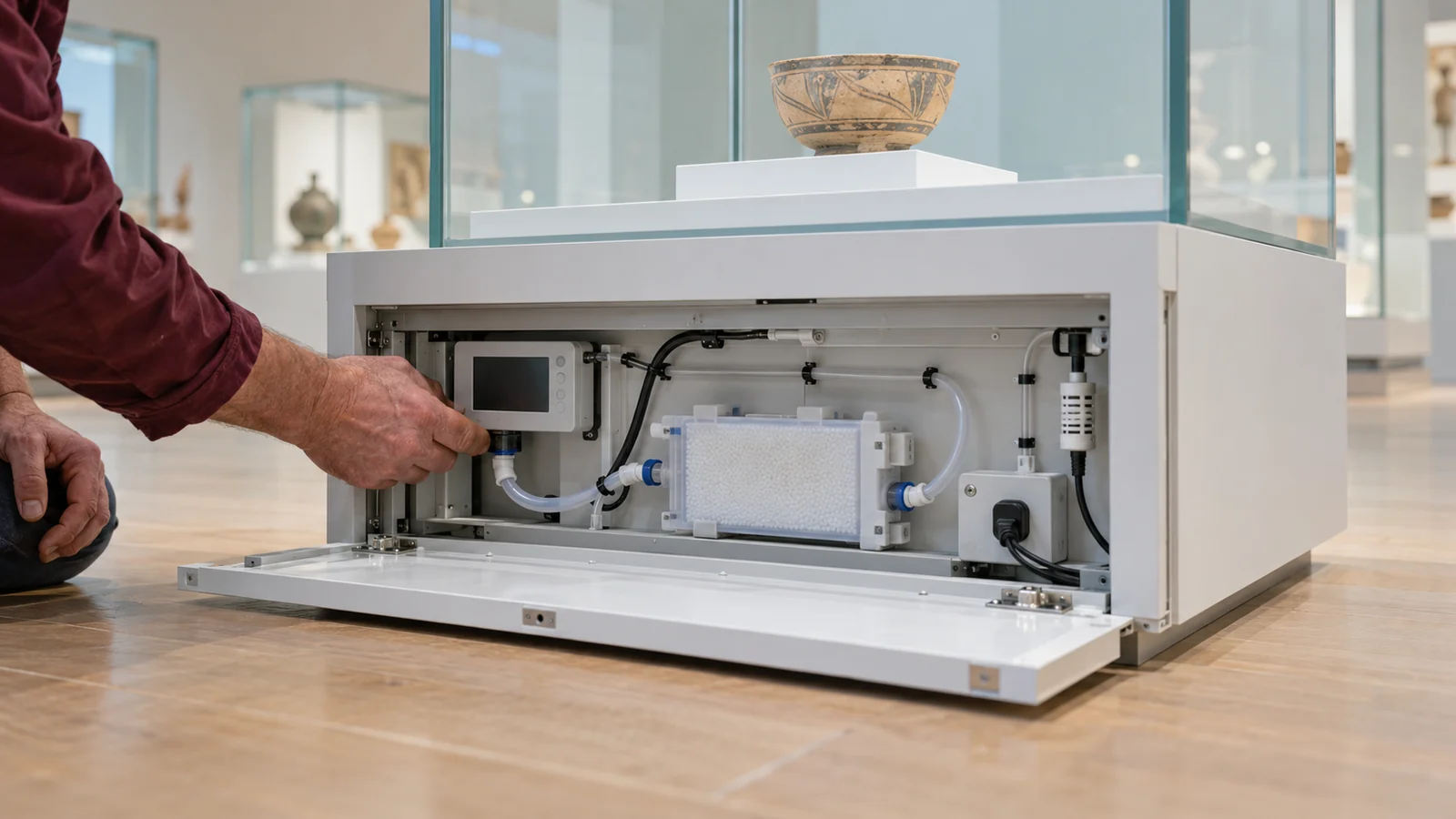
An effective microclimate equipment RFQ requires more than a target relative humidity. Suppliers also need case construction, surrounding conditions, operating hours and installation arrangements.
Providing this information early helps distinguish requirements ready for quotation from those requiring site measurement or further design.
Describe the collection and target conditions
Identify the collection, sensitivities, display period and targets established by the conservation team, including controlled variables and permissible changes. List unresolved requirements for later confirmation.
Do not copy figures from another exhibit or project without assessment. Targets should consider object condition, the existing environment and sustainable operation.
For mixed materials or loan requirements, record conflicting constraints in the conservation assessment. Procurement documents should use agreed project targets; the supplier should not unilaterally set collection requirements.
Provide case and site information
Supply internal and external dimensions, usable volume, construction, seals, opening frequency, object layout, lighting and air or pipe connections. Include any case test report and its test conditions.
Provide gallery conditions, power, equipment location, access, permitted noise and maintenance clearance. Where leakage is unknown, ask suppliers to state their quotation assumptions.
For a case in design, share proposed penetrations and equipment layouts so case and equipment suppliers can coordinate interfaces. For an existing case, check modification approvals, warranty implications and installation windows.
Specify controls and monitoring
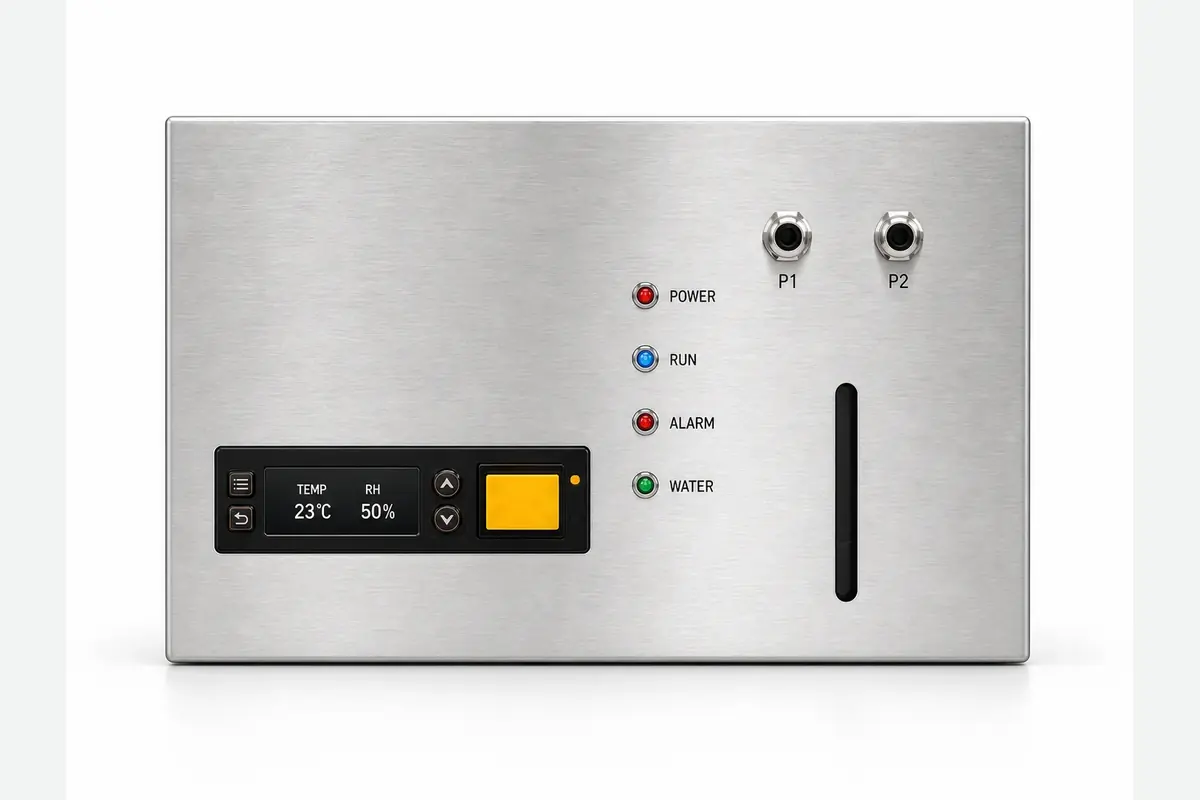
Identify measurement locations, displays, data logging, alarms, power-loss behaviour and staff response. If cases need different conditions, state whether independent measurement and control are required.
Ask about sensor calibration, consumables, filtration and cleaning. Display resolution, sensor accuracy and actual in-case control performance are different measures and should be compared separately.
Align the quoted scope
Request separate equipment, sensors, pipes, accessories, installation, commissioning, training, transport and maintenance items. State whether coordination with the case manufacturer or building systems is included.
Document responsibility for electrical work, interfaces or case modifications that may be undertaken by others, avoiding unresolved handoffs on site.
Agree project acceptance
Agree preconditions, measurement points, instruments, duration, record format and acceptance criteria. Where appropriate, test an empty case first, then assess operation after installation of the exhibit.
Performance must be tested for the specified case, target and actual environment. The same result cannot automatically be assumed for another case or operating condition.
Compare loads and interfaces
Case volume is only one selection input. Sealing, room temperature and humidity, opening frequency, lighting heat and moisture exchange with objects and internal materials can all affect operation. Give suppliers available data and ask how missing data affect selection.
Check supply and return air and sensor locations so ducts and interfaces do not obstruct display, opening or maintenance. Reserve space for drainage, heat rejection or consumables if needed, and assign responsibility.
For equipment serving several cases, ask how each is connected, measured and controlled. Different targets may require independent control; confirm capabilities for the proposed configuration through project testing.
Common buyer questions
Does every case need active control? Assess collection needs, gallery conditions, sealing and maintenance capacity. Some projects may use buffering or improve the room environment; others may require active equipment.
Does a stated case volume apply everywhere? Ask for the external conditions, case state and load behind that figure. Volume alone does not establish performance.
After acceptance, assign responsibility for reviewing data and alarms, sensor calibration, consumables and fault response. Operating records help identify changes caused by opening or maintenance.
Sources
- Canadian Conservation Institute: Incorrect Relative Humidity
- Canadian Conservation Institute: Silica Gel and Passive Control
Share case drawings, target conditions and gallery data to discuss equipment configuration and acceptance methods.
Explore related equipment → · Discuss your project →