
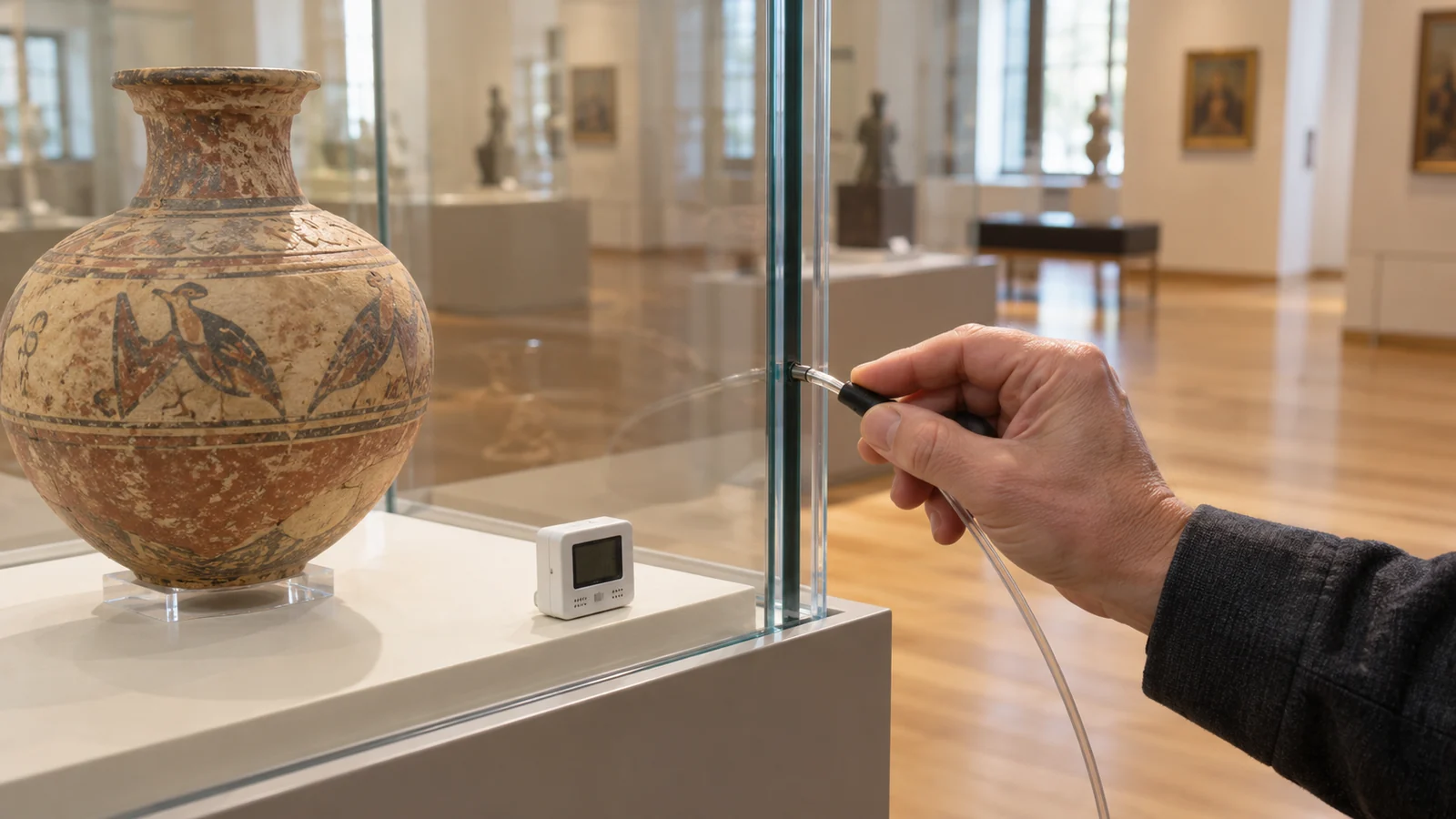
A case's airtightness affects exchange with gallery air, humidity buffering, pollutant control and maintenance. The phrase 'well sealed' is difficult to verify without measurement conditions.
Canadian Conservation Institute guidance describes measurement methods and recommends targets suited to the objects and project. No single value is appropriate for every case.
Why airtightness matters
Air exchange affects how quickly moisture and pollutants move in or out. Sealing also affects passive buffer consumption and the load on active equipment.
Airtightness is one part of protection. Internal materials, lighting heat, opening frequency and gallery conditions also matter; sealing does not automatically remove pollutants emitted inside the case.
What is air exchange rate?
Air exchange rate describes exchange between the case and its surroundings, often expressed as changes per day. A lower value generally indicates slower exchange under the test conditions, but is not a universal quality score.
Construction, pressure and temperature differences, openings and methods affect results. Compare reports with their test conditions, not just their numbers.
What should a test record?
A decay test estimates exchange from changes in a tracer over time. The tester should identify the method, instrument, calculation and applicable conditions. Require case state, volume, measurement points, environment, duration and raw data.
Consider retesting after installation, modification or seal maintenance. Whether a test represents normal operation depends on whether interfaces, lighting and openings are in the agreed state.
Write procurement and acceptance terms
Conservation, exhibition and engineering teams should set a project target based on the collection, display period, control strategy and maintenance. Specify cases, method, conditions, sample size, report and responsibility for correction and retesting.
Do not present one institution's target as a global mandatory standard or an unverified manufacturer claim as this project's result. Performance depends on the tested configuration and conditions.
- Target, case configuration and operating state
- Method, measurement points, instruments and duration
- Report, criteria, correction and retest responsibilities
Plan maintenance
Door seals, penetrations, alterations and repeated opening can change the case. Record seal inspections, opening, sensors and maintenance to help interpret environmental data.
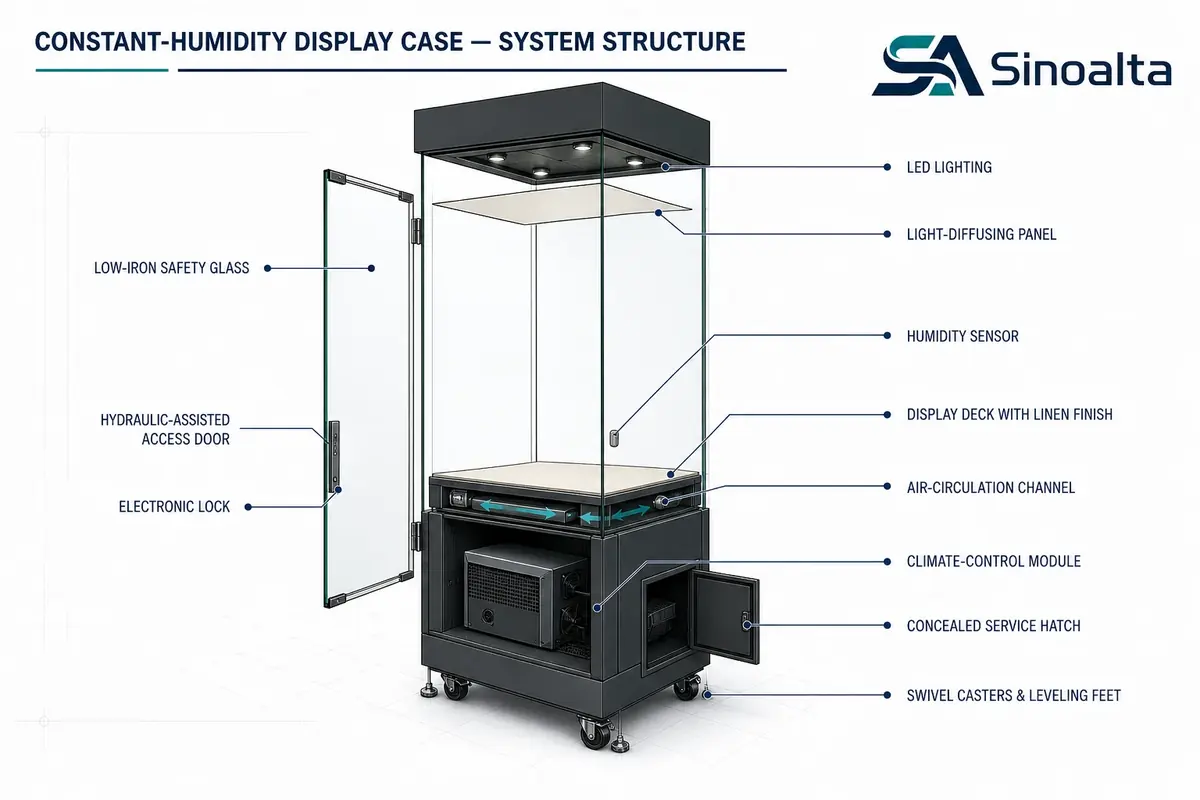
Assess active devices or buffering together with the case. Continue monitoring after installation of the exhibit under normal operation rather than relying only on one empty-case test.
Use reports in procurement
Identify the case number, structure and installed fittings, including doors, connections, lighting and controls. Empty, installed and operating conditions differ and results should be interpreted within their test scope.
Record instrument model and calibration, tracer method, sampling position, raw data and calculation. A result without the test process and applicable conditions is difficult to compare.
For a case that misses its target, locate leaks and likely causes, then agree repair, retesting and costs. Assess whether changes to connections or seals after testing require another test.
Is greater airtightness always better?
Reduced exchange can limit external air infiltration, but pollutants emitted by internal materials or objects may become harder to remove. CCI recommends assessing materials, pollutant sources and environmental control together.
Consider humidity variation, dust, pollutants, opening and display duration. Conservators should help set targets; suppliers should explain how they propose to achieve and verify them.
If every case cannot be tested within budget, the project team can define a sampling or staged approach and its limitations. Whether a sample represents other cases depends on manufacturing and installation consistency.
Sources
- Canadian Conservation Institute: Airtightness Measurement of Display Cases, Technical Bulletin 38
- Canadian Conservation Institute: Silica Gel and Passive Relative Humidity Control
Provide case drawings, environmental targets and test needs to discuss suitable control interfaces and acceptance documentation.
Explore related equipment → · Discuss your project →