A museum display case does not need active humidity control simply because the object is valuable.
The better question is whether the object’s environmental requirement can be maintained reliably with the case, the gallery and a passive buffering strategy. If it can, adding active equipment may create unnecessary cost and maintenance. If it cannot, a controlled microclimate can become the practical way to protect a sensitive object without conditioning an entire gallery to the same narrow requirement.
The decision usually depends on four variables:
- object sensitivity;
- gallery stability;
- enclosure airtightness;
- access and maintenance frequency.
This article explains how those variables interact and when active control becomes reasonable.
1. Begin with the object, not with a universal RH number
There is no single relative-humidity setpoint that is correct for every museum object.
Different materials respond differently to dampness, dryness, corrosion risk and RH fluctuation. CCI’s guidance on incorrect relative humidity explicitly notes that collections have different sensitivities and that a perfectly “correct” RH may not exist for a mixed collection.
Before discussing a microclimate generator, define:
- object material and construction;
- current condition;
- known sensitivity to humidity;
- lender or conservation requirements;
- acceptable fluctuation;
- exhibition duration.
Examples of objects that may justify closer control include humidity-sensitive metals, unstable glass, composite objects with conflicting material responses, some archaeological materials and objects covered by a formal loan specification.
The correct target should come from the collection requirement, not from the equipment catalogue.
2. Ask how stable the gallery already is
A display case is part of a larger environmental system.
If the gallery maintains conditions that are already close to the object requirement, a well-designed case can often buffer short-term changes without active conditioning.
If the gallery is difficult to control—because of a historic building, seasonal climate, intermittent HVAC, high visitor loads or local heat sources—the case has to do more work.
Useful data before system selection include:
- gallery RH trend over several weeks or seasons;
- temperature trend;
- maximum daily and seasonal excursions;
- whether HVAC shuts down at night;
- local heat from lighting or electronics;
- proximity to doors, windows or air outlets.
A decision based on measured room behaviour is more defensible than one based on a single spot reading.
3. Airtightness controls how hard the microclimate has to work
A case that exchanges air rapidly with the gallery cannot hold a different RH efficiently for long.
CCI’s Technical Bulletin 38 treats airtightness as a measurable enclosure property and explains how air exchange rate can be determined using tracer-gas decay. The same document notes that heritage institutions increasingly specify enclosure airtightness as part of procurement because it affects the ability of cases to protect against RH change, dust and pollutants.
For humidity control, leakage affects both passive and active strategies:
- Passive control: a leaky case consumes the moisture-buffering capacity of silica gel more quickly.
- Active control: a leaky case increases conditioning load and can make the system run more often.
This means the first response to unstable RH should not always be “install a larger control unit.” Improving the enclosure can sometimes reduce the required control capacity.
4. When passive humidity control is often enough
Passive humidity control typically uses a moisture sorbent such as conditioned silica gel inside a reasonably sealed enclosure.
CCI’s Technical Bulletin 33 explains that silica gel can buffer RH in display cases and that required sorbent quantity depends on factors including case airtightness, case volume, target RH, external conditions and maintenance interval.
Passive control is most attractive when:
- gallery conditions are not far from the target;
- the case is reasonably well sealed;
- exhibition duration is manageable;
- doors are opened infrequently;
- the sorbent can be conditioned and replaced on schedule;
- the object does not require a highly demanding or rapidly corrected environment.
Advantages of passive control
- no electrical connection to the case;
- low mechanical complexity;
- low noise;
- simple maintenance when access is well designed;
- useful buffering during short-term room fluctuations or transport.
Limitations
- capacity is finite;
- performance depends heavily on leakage;
- sorbent condition changes over time;
- maintenance may become labour-intensive across many cases;
- recovery after frequent opening can be slow;
- passive buffering cannot compensate indefinitely for a severe mismatch between room and target conditions.
Passive control works best when it is designed, not when a random quantity of silica gel is placed in a case and assumed to solve the problem.
5. Warning signs that passive control may not be enough
Consider reviewing an active strategy when several of the following conditions occur together.
The gallery and target are far apart
If the case must maintain a microclimate substantially different from the surrounding room for a long period, passive material may require frequent reconditioning or large quantities.
The case is large
As case volume and leakage increase, passive buffering becomes more demanding. Very large showcases may also need forced circulation to keep air and sorbent interaction uniform.
The case opens frequently
Every opening can exchange a large fraction of the case air with the gallery. Frequent access may overwhelm a passive strategy designed for long, closed display periods.
The exhibition is long-term
A temporary three-month exhibition and a multi-year display impose different maintenance requirements.
The object has a narrow project-defined requirement
Where a conservator, lender or project specification requires close environmental control with documented performance, continuous active regulation may be easier to manage and verify.
The institution has many cases to maintain
Even when passive control works technically, repeatedly conditioning and replacing sorbent across many cases can become an operational burden. Centralised or linked active systems can sometimes reduce that workload.
6. What active humidity control actually changes
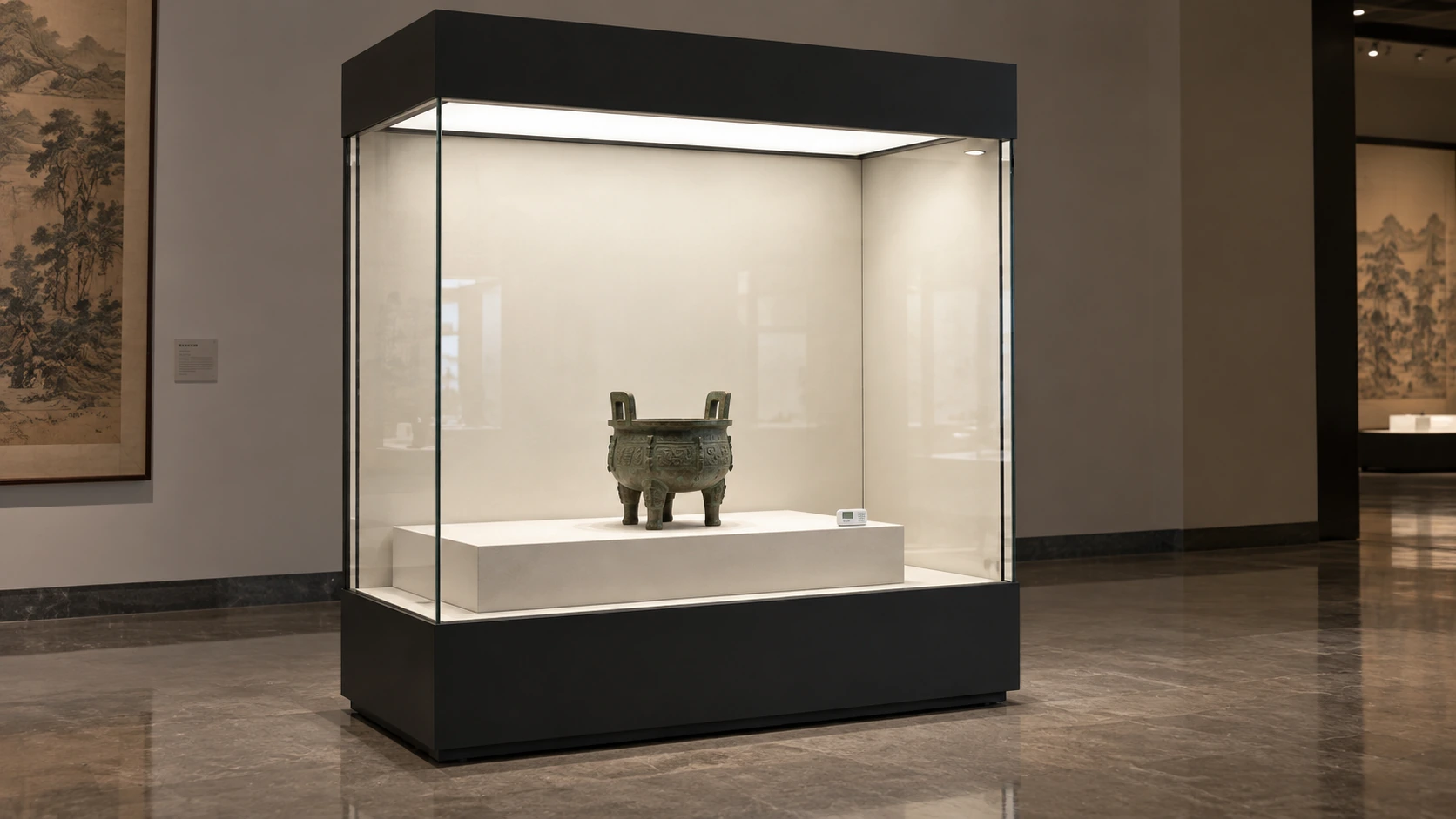
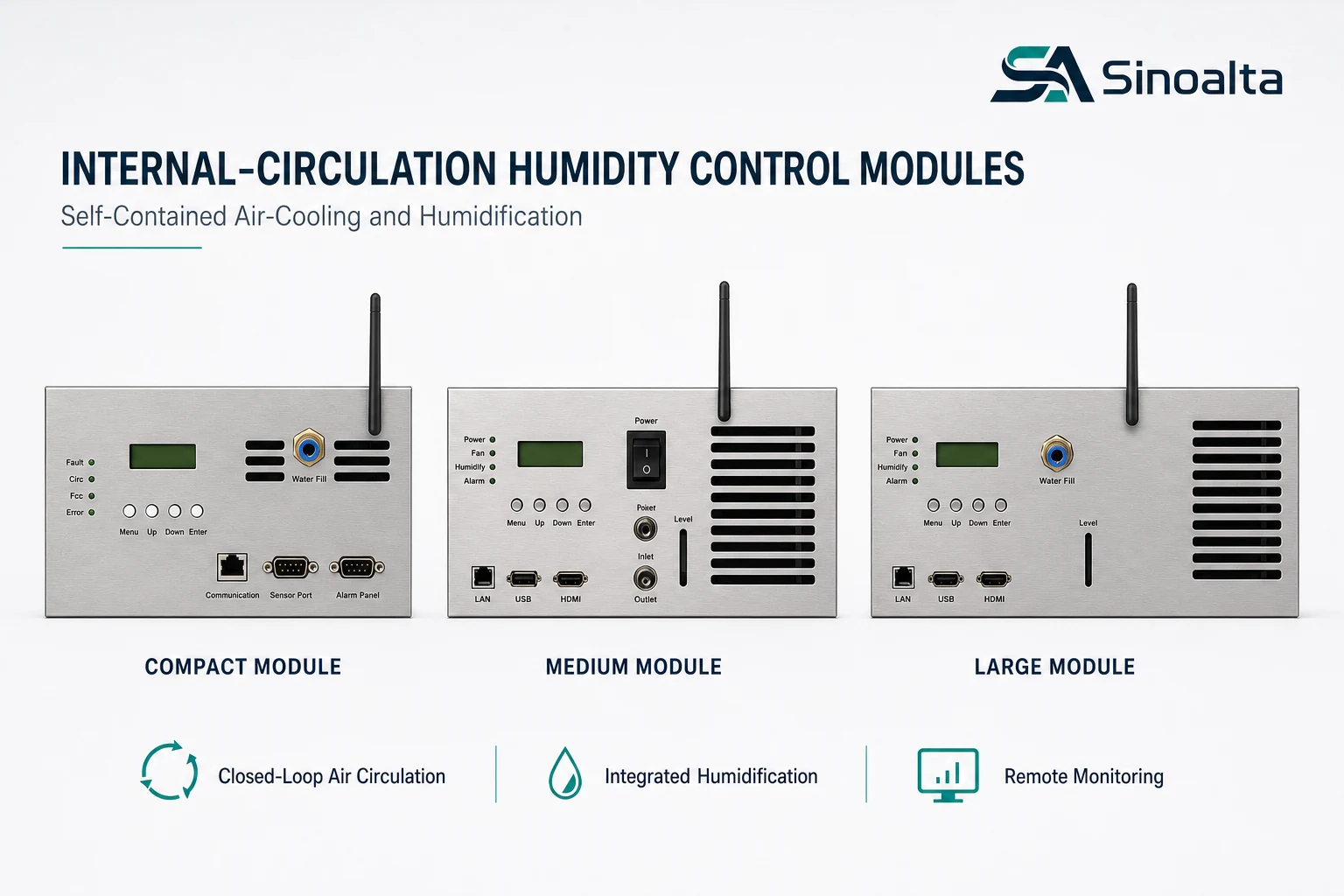
An active system measures the case environment and adds or removes moisture to move conditions toward the defined target.
Depending on the system design, it may use:
- internal recirculation;
- conditioned air supplied from outside the case;
- positive-pressure air supply;
- humidification and dehumidification;
- integrated filtration;
- remote monitoring and data logging.
The main advantage is not that active control is “more advanced.” It is that the system can continuously respond to environmental load rather than relying entirely on stored moisture capacity.
That can be useful where room conditions, leakage, case volume or access patterns create a load that passive buffering cannot handle efficiently.
7. Active control still depends on a good case
Active control does not make enclosure design irrelevant.
A poorly sealed case can require a larger conditioning rate, increase noise and energy use, make pollutant control harder and reduce stability when the system stops.
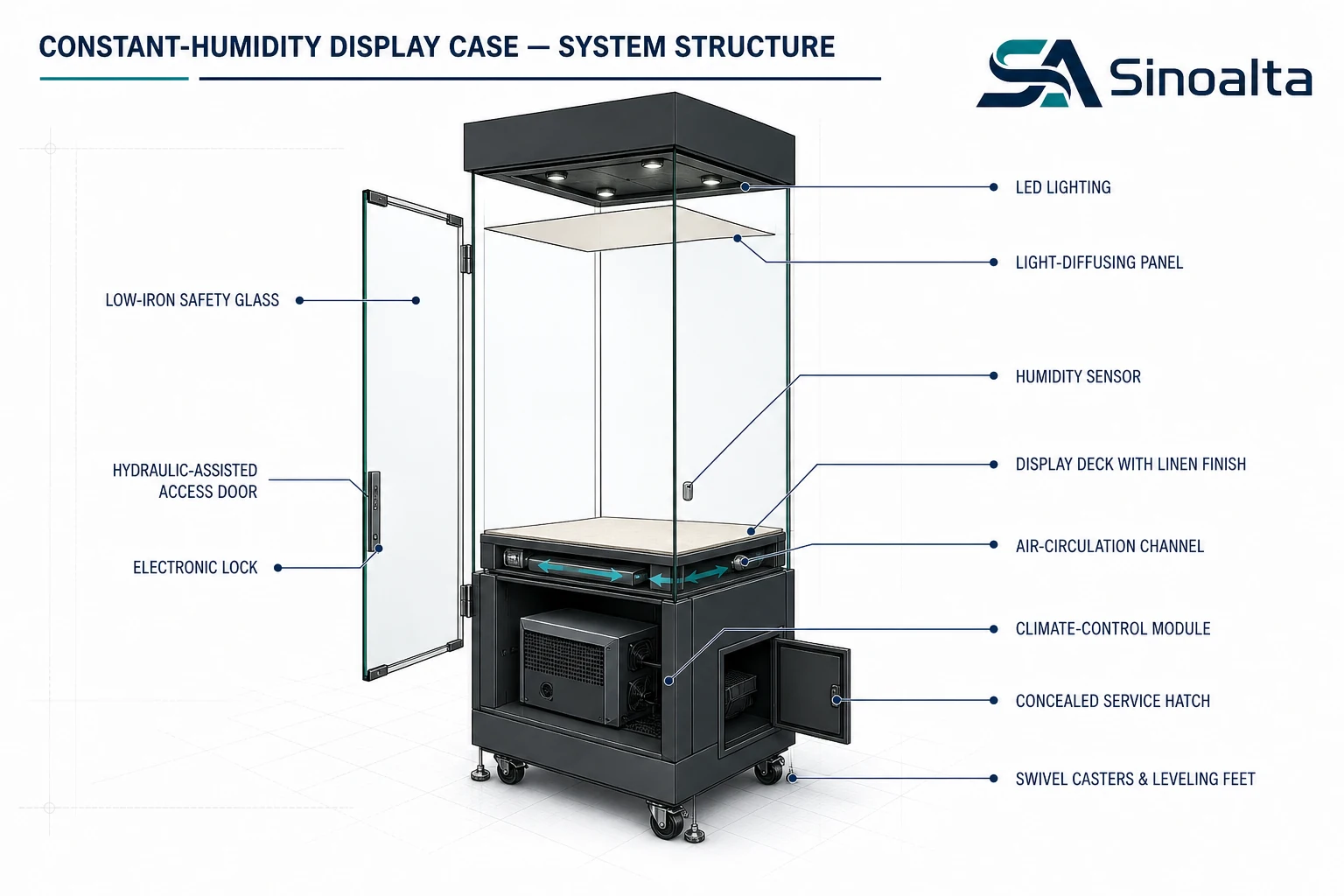
For a controlled microclimate, review the case and the control unit as one system:
Object requirement → enclosure → airflow path → conditioning → sensing → monitoring → commissioning
That sequence also helps prevent a common procurement problem: buying a humidity-control unit before confirming whether the case has the air path, tightness, service compartment and maintenance access needed to use it properly.
8. Passive, active or hybrid? Use a decision matrix
The table below provides a screening framework. It is not a substitute for a conservation specification.
| Condition | Passive buffering | Active control | Hybrid approach |
|---|---|---|---|
| Stable gallery, moderate object requirement | Strong candidate | Usually unnecessary | Possible |
| Tight case, infrequent opening | Strong candidate | Optional | Strong candidate |
| Large difference between gallery and target | May be maintenance-heavy | Strong candidate | Strong candidate |
| Frequent access | Weak to moderate | Strong candidate | Strong candidate |
| Large showcase | Project-dependent | Often practical | Often practical |
| Long-term loan with documented RH requirement | Possible if proven | Strong candidate | Strong candidate |
| Multiple linked cases | Labour-intensive | Often practical | Project-dependent |
| Limited electrical/service access | Strong candidate | May be difficult | Project-dependent |
A hybrid strategy can combine a well-sealed enclosure and passive buffer with a smaller active system. The passive material can reduce short-term load or provide resilience during service interruption, while the active system maintains the long-term target.
9. Do not ignore temperature and internal heat
RH is temperature-dependent. A case can have stable moisture content but still show RH movement when internal temperature changes.
Check for:
- lighting inside or near the case;
- display electronics;
- solar gain;
- visitor heat near interactive cases;
- air supplied at a different temperature from the case interior.
If temperature varies strongly, an RH-only solution may not address the underlying driver.
Where both temperature and RH need active control, the system should be selected and commissioned as a combined environmental-control problem.
10. A very tight case can create a pollutant problem
Tightness is valuable, but it can also trap pollutants released from objects, paints, adhesives, boards, seals or display materials.
CCI’s airtightness guidance specifically notes that extreme tightness is not always beneficial when deterioration agents are generated inside the enclosure.
For sensitive objects, review:
- internal construction materials;
- adhesives and sealants;
- paint curing;
- wood products;
- object off-gassing;
- filtration or sorbent requirements;
- air-circulation strategy.
Airtightness should serve the preservation objective rather than become an isolated performance goal.
11. Monitoring is required whichever strategy you choose
Passive and active cases both need measurement.
For passive systems, monitoring tells you whether the buffer is still maintaining the intended range and when maintenance is needed.
For active systems, monitoring verifies whether the control loop actually performs under real gallery conditions.
A useful commissioning record can include:
- internal RH and temperature;
- room RH and temperature;
- air-exchange-rate test where specified;
- door-opening or access test;
- recovery after service access;
- alarm operation;
- data export;
- system behaviour during temporary power interruption.
The purpose of commissioning is to prove the case as an environmental system, not just prove that the control unit switches on.
12. Information to provide before requesting an active system quotation
Before asking for a microclimate-control quotation, prepare:
- case internal volume;
- case type and construction;
- measured or specified airtightness if available;
- object/material type;
- target RH and acceptable band, if already defined;
- gallery RH and temperature data;
- exhibition duration;
- expected opening frequency;
- whether several cases must be linked;
- filtration requirements;
- monitoring/data requirements;
- available power and service space.
This allows the control capacity and system configuration to be based on a real environmental load rather than case volume alone.
Final decision principle
The most useful question is not:
“Is active humidity control better than silica gel?”
It is:
“Can this object’s required environment be maintained reliably, maintainably and verifiably with a passive strategy in this particular case and gallery?”
If the answer is yes, passive control may be the simpler solution.
If the answer is no—because of a demanding target, poor room stability, frequent access, large volume or long-term maintenance burden—active control becomes a practical engineering option.
Frequently asked questions
Does every museum display case need humidity control?
No. Many objects can be displayed safely in cases that provide physical protection and environmental buffering without dedicated humidity control. The need depends on object sensitivity, gallery conditions and exhibition requirements.
Is silica gel enough for a museum display case?
It can be. Conditioned silica gel is a proven passive RH-control method when case tightness, external conditions, sorbent quantity and maintenance interval are suitable. It is not a universal solution for every case.
Does a more airtight case always give better preservation?
Not always. Airtightness can improve RH buffering and reduce external pollutants and dust, but a very tight case can also retain pollutants generated inside. The enclosure design must be considered as a whole.
When is active humidity control most useful?
It is particularly useful when the object requires a controlled microclimate that is difficult to maintain passively because of room instability, frequent case opening, case size, long display duration or a demanding project specification.
Should the humidity-control system be sized only by case volume?
No. Volume is only one input. Airtightness, room conditions, target conditions, access frequency, internal heat, airflow and the number of connected cases also influence system load.
Related Sinoalta resources
- Museum Display Case Microclimate Control Guide: https://sinoalta.com/resources/technical-guides/museum-display-case-microclimate-control/
- Display Case Microclimate Planning: https://sinoalta.com/solutions/museum-display-case-microclimate-control/
- Museum Display & Microclimate Control Systems: https://sinoalta.com/products/museum-display-microclimate-control-systems/
- Museum Display Case Microclimate Generator: https://sinoalta.com/products/museum-display-case-microclimate-generator/
Sources and further reading
- Canadian Conservation Institute, Airtightness Measurement of Display Cases and Other Enclosures – Technical Bulletin 38: https://www.canada.ca/en/conservation-institute/services/conservation-preservation-publications/technical-bulletins/airtightness-measurement-display-cases.html
- Canadian Conservation Institute, Silica Gel: Passive Control of Relative Humidity – Technical Bulletin 33: https://www.canada.ca/en/conservation-institute/services/conservation-preservation-publications/technical-bulletins/silica-gel-relative-humidity.html
- Canadian Conservation Institute, Incorrect relative humidity: https://www.canada.ca/en/conservation-institute/services/agents-deterioration/humidity.html
- Canadian Conservation Institute, Framework for Preserving Heritage Collections: https://www.canada.ca/en/conservation-institute/services/preventive-conservation/framework-preserving-heritage-collections.html