
Product overview
What Is an Anoxic Treatment Bag?
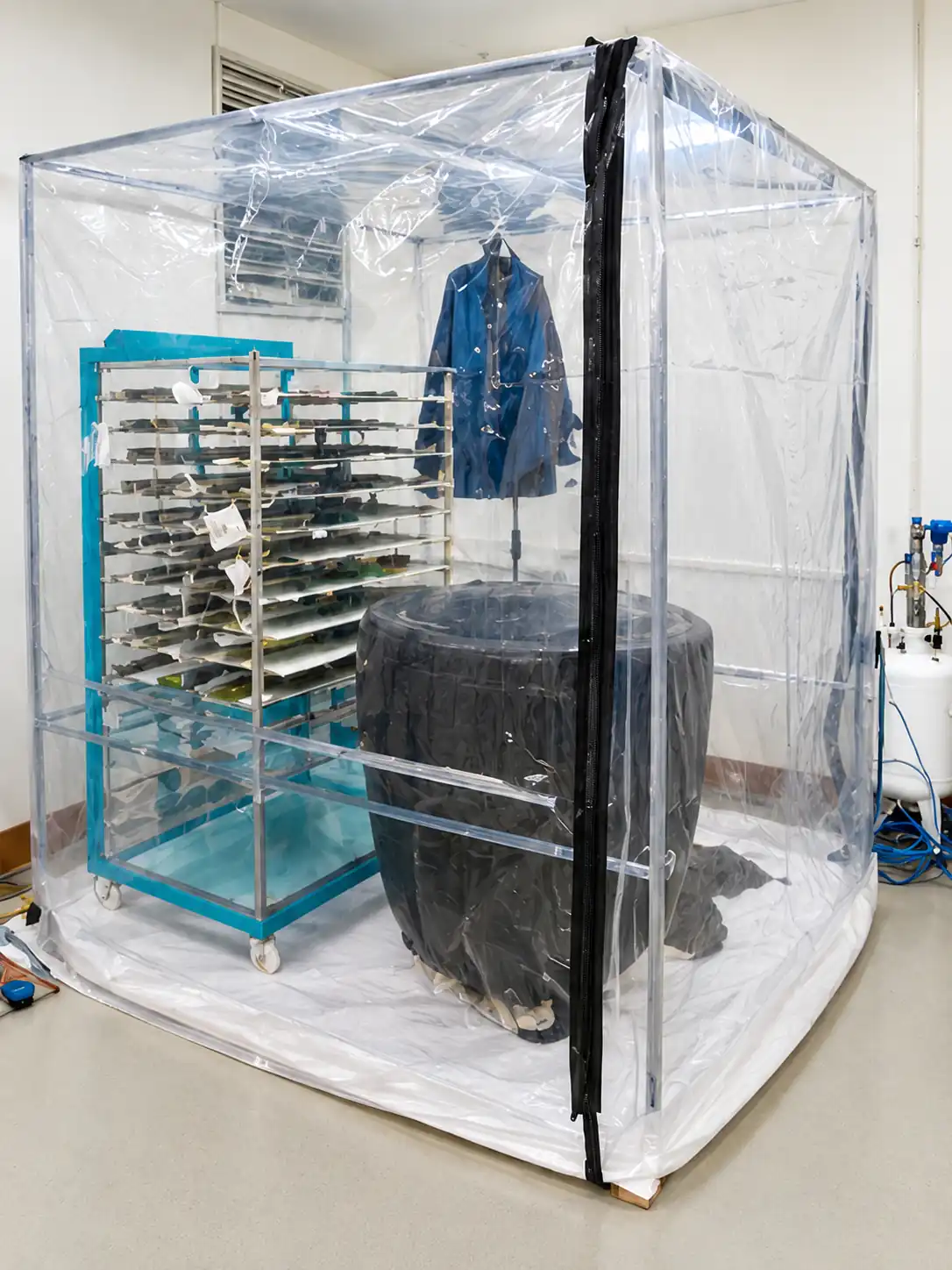
The Sinoalta Anoxic Treatment Bag is a flexible, gas-tight enclosure designed to create and maintain a controlled low-oxygen environment around museum, archive and library collections during insect-pest treatment.
Also known as an anoxia treatment bag, oxygen-barrier bag, barrier-film treatment bag or anoxia bubble, it allows normal air to be displaced with nitrogen while oxygen concentration is monitored throughout the treatment cycle.
Unlike a rigid chamber with a fixed internal volume, the flexible anoxic enclosure can be manufactured around the approximate dimensions of an object or batch. It provides the sealed enclosure for nitrogen-anoxia pest treatment; it does not chemically fumigate the collection.
Treatment workflow
How to Use an Anoxic Treatment Bag
Prepare & Load
Confirm nitrogen anoxia is appropriate. Load the assessed object or batch with clearance and protect sharp corners or rough surfaces that could damage the barrier film.
Seal & Connect
Close the enclosure, connect the selected gas and monitoring ports, and check the closure, seams and fittings before atmosphere replacement.
Replace Air & Monitor Oxygen
Introduce nitrogen as normal air leaves the enclosure. Where suitable, partial air extraction can aid replacement. Verify residual oxygen with a low-range analyzer.
Maintain, Verify & Re-Aerate
Maintain and monitor the defined low-oxygen conditions, then gradually return the enclosure to normal atmosphere before opening it.
Treatment duration is not determined by bag size alone. Pest species and life stage, residual oxygen, temperature, relative humidity, leakage and collection condition all affect the protocol. Review the nitrogen anoxia treatment guide for deeper technical planning.
System configuration
Configure the Anoxic Treatment Bag and Supporting Equipment
Treatment Bag & Gas Connections
- Custom-size oxygen-barrier treatment enclosure
- Gas-tight seams and closure system
- Nitrogen inlet and gas outlet connections
- Oxygen, temperature and RH monitoring access
- Optional air-extraction connection
- Sealing and repair accessories
Gas Supply & Monitoring
- Nitrogen cylinder connection or compatible generator
- Pressure regulator and gas-flow components where required
- Low-range oxygen analyzer and sampling arrangement
- Temperature and relative-humidity monitoring
- Optional data logging, flow monitoring and treatment records
The enclosure can be supplied individually or with selected supporting equipment. Nitrogen purging is the primary operating method. Partial air extraction can aid atmosphere replacement for suitable objects; it is not the insect-control mechanism. Oxygen scavengers may support an appropriate small-volume protocol. Final configuration depends on treatment volume, collection materials, nitrogen source, monitoring needs and institutional workflow.
Selection comparison
Anoxia Bag or Rigid Anoxic Chamber?
| Decision factor | Anoxic Treatment Bag | Rigid Anoxic Chamber |
|---|---|---|
| Initial requirement | Lower and scalable by treatment size | Higher fixed equipment investment |
| Treatment volume | Selected around the object or batch | Defined by chamber dimensions |
| Object size | Flexible and customizable | Limited by access and internal dimensions |
| Storage | Limited permanent floor space | Dedicated equipment space |
| Treatment frequency | Occasional or variable batches | Frequent standardized cycles |
| Portability | High | Low |
| Automation | Basic to configurable monitoring | Easier to integrate with automated control |
| Best suited to | Individual objects, small batches and changing dimensions | Regular treatment and higher throughput |
For occasional treatment or changing collection sizes, a bag can be a practical entry point. For frequent, repeatable or higher-volume work, consider a rigid nitrogen anoxic treatment system.
Where it fits
Anoxic Pest Treatment for Museums, Archives and Libraries
Anoxic treatment bags provide a flexible treatment option within a wider Integrated Pest Management programme. Potential applications include assessed books, paper archives, textiles, wooden collections, leather, ethnographic materials and furniture components. They can also support quarantine workflows for incoming or returning collections. Suitability must be assessed against the complete object's materials, construction, condition and conservation requirements. See Museum & Archive Pest Control for wider planning.
FAQ
Anoxic Treatment Bag — Common Questions
What is an anoxic treatment bag?
It is a gas-tight oxygen-barrier film enclosure for controlled low-oxygen treatment of collection objects. Normal air is displaced with nitrogen, and the atmosphere is monitored and maintained according to the required pest-treatment protocol.
Is an anoxia bag the same as an anoxia bubble?
The terms often describe similar flexible treatment concepts. Anoxia bag, anoxia bubble, oxygen-barrier bag and barrier-film enclosure can all refer to gas-tight enclosures used around objects. Sinoalta uses “Anoxic Treatment Bag” as the primary product term.
How does nitrogen anoxia control museum insect pests?
Nitrogen displaces oxygen inside the sealed enclosure. The collection is maintained under controlled very-low-oxygen conditions for the required period. Effectiveness depends on oxygen concentration, temperature, target pest, life stage and exposure duration.
What oxygen level is used for anoxic treatment?
Professional conservation literature commonly refers to very low residual oxygen conditions, including around or below 0.1% O₂. A single reading does not demonstrate successful treatment; the selected protocol defines the level and how long it must be maintained.
How long does anoxia treatment take?
There is no universal duration. Treatment may require days or weeks depending on the pest and life stage, oxygen concentration, temperature, relative humidity, enclosure integrity and validated protocol.
Does the vacuum kill the insects?
No. Partial air extraction can improve atmosphere replacement before nitrogen is introduced, but the primary treatment condition is prolonged exposure to a controlled low-oxygen atmosphere.
Do I need an oxygen analyzer?
For professional controlled treatment, oxygen measurement is strongly recommended. A sealed or collapsed bag does not prove that the required concentration has been achieved or maintained.
Can bottled nitrogen be used?
Yes. Depending on treatment volume and site conditions, the enclosure can be configured for cylinders or a suitable nitrogen generator, with gas-flow and pressure-control accessories selected for the arrangement.
Can oxygen scavengers be used?
Yes, in suitable small-volume protocols they may remove residual oxygen or help maintain low-oxygen conditions. The required quantity and method depend on enclosure volume and treatment conditions.
Can the anoxic treatment bag be reused?
Reusable closure configurations are available. Actual reuse depends on film construction, sealing method, handling, puncture risk and enclosure integrity. Inspect the bag for damage and leakage before every cycle.
What collections can be treated in an anoxic bag?
Potential applications include assessed books, archives, paper, textiles, wooden objects, leather, ethnographic materials and furniture components. Determine suitability from the complete material composition and condition.
Can you manufacture custom-size anoxia bags?
Yes. Sinoalta can manufacture project-specific enclosures according to object or batch dimensions, treatment volume, connection layout, nitrogen source and monitoring requirements.
What information is needed for a quotation?
Provide object or batch dimensions, collection material, quantity per batch, treatment frequency, available nitrogen source and monitoring needs. Photos, drawings, specifications or an RFQ can also be reviewed.