
1. What Is Plasma-Generated Ozone Treatment?
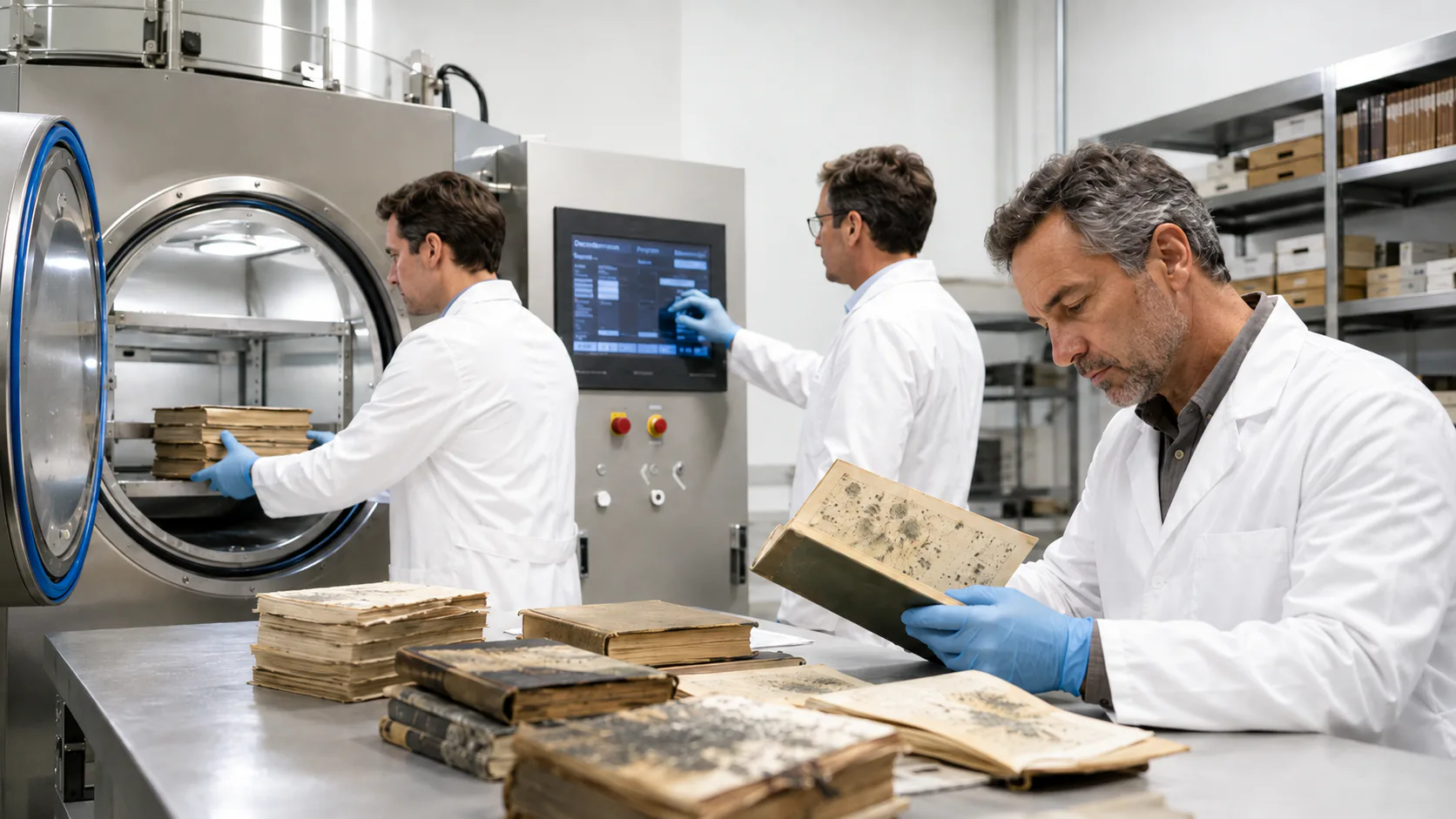
Plasma-generated ozone treatment uses an electrical plasma process to generate ozone, which is then introduced into a controlled treatment chamber or enclosure.
The active treatment agent is ozone (O₃).
This distinction matters because the conservation risks, process controls and validation requirements should be evaluated in relation to ozone exposure rather than described simply as “plasma treatment.”
Ozone is a highly reactive oxidizing gas. Its reactivity gives it antimicrobial potential, but the same chemistry can also affect organic collection materials, including cellulose, dyes, pigments, natural rubber and some other polymers.
For that reason, controlled ozone treatment for books and archives should be approached as:
Defined treatment objective → Material assessment → Controlled ozone exposure → Aeration → Verification
rather than as a general-purpose method that can be applied to every paper collection.
Disinfection is not the same as sterilization
Terms such as disinfection, microbial decontamination and sterilization should not be used interchangeably.
A treatment may reduce or inactivate selected microorganisms without meeting the much stricter validation requirements associated with sterilization.
For cultural-heritage applications, the treatment objective should therefore be stated precisely.
Examples may include:
- reducing viable surface microbial contamination;
- supporting a defined mould-remediation workflow after moisture control and physical cleaning;
- treating odour or biological contamination where a validated protocol exists;
- processing selected collection materials within a controlled chamber.
The chosen claim should be supported by the actual protocol and verification method.
2. Where Ozone May Fit Within a Collection-Care Workflow
Ozone treatment should not replace the basic causes of microbial deterioration.
If books or archival records have mould because of:
- water leakage;
- sustained high relative humidity;
- wet materials;
- inadequate air movement;
- contaminated storage;
- poor housekeeping,
those conditions must be corrected.
Otherwise, treatment may reduce current contamination while leaving the collection vulnerable to recurrence.
A professional workflow therefore begins with:
Stop moisture source → Stabilize environment → Isolate affected materials → Assess condition → Clean where appropriate → Consider controlled treatment → Return to suitable storage
For active mould outbreaks, occupational-health controls are also required because spores, fragments and microbial debris may remain hazardous even after organisms are no longer viable.
Ozone treatment is therefore best considered as one component of a wider preservation workflow rather than as a substitute for moisture control, cleaning and environmental management.
3. The Critical Process Variables
The effectiveness and material impact of ozone are determined by a combination of process conditions.
The most important variables include:
Ozone Concentration
Higher concentration increases the oxidative dose delivered to the object.
However, the appropriate concentration cannot be chosen solely on the basis of microbiological effectiveness. It must also be evaluated against the sensitivity of paper, media, binding components and other materials.
Exposure Time
Ozone treatment should be based on a defined concentration–time relationship rather than on a generic “longer is better” approach.
Excessive exposure can increase oxidation risk.
Short, engineered treatment cycles are fundamentally different from leaving books for long periods in an uncontrolled ozone-rich environment, but short duration alone does not prove material safety.
Temperature and Relative Humidity
Temperature and moisture influence both microbial response and chemical reaction rates.
Relative humidity also affects hygroscopic paper, leather, parchment, adhesives and bindings.
A treatment chamber should therefore monitor environmental conditions rather than controlling ozone concentration in isolation.
Gas Distribution
The chamber must deliver ozone consistently around the treatment load.
Dense stacking, closed boxes, tightly packed books and poorly arranged shelves can create areas with different gas exposure.
For batch treatment, loading configuration should be considered part of the validated process.
Object Composition
A “book” may contain:
- cellulose paper;
- coated paper;
- iron-gall or other historic inks;
- printing inks;
- watercolours;
- dyes and pigments;
- leather;
- parchment;
- cloth;
- starch or protein adhesives;
- synthetic adhesives;
- rubber or elastomeric components;
- plastics and photographic materials.
Material assessment is therefore essential before treatment.
4. Material Compatibility: Why Ozone Requires Caution
Professional conservation literature treats ozone as an airborne pollutant because it can oxidize and damage heritage materials.
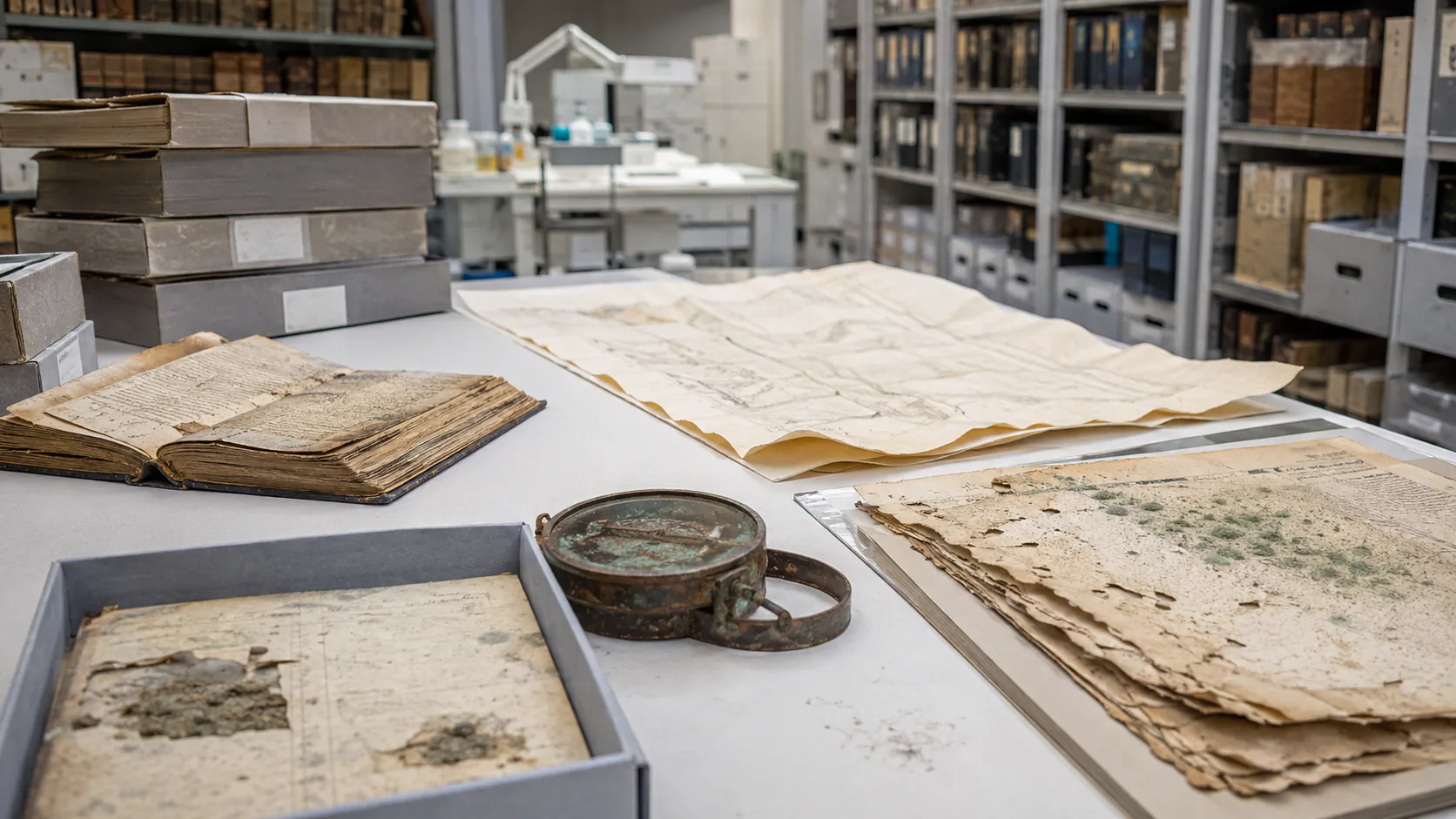
Canadian Conservation Institute guidance notes that ozone can fade colourants, yellow paper and weaken organic structures. Getty Conservation Institute research has also documented the vulnerability of artists’ pigments and natural organic colourants to atmospheric ozone.
Smithsonian recovery guidance for smoke-damaged books specifically warns against uncontrolled ozone-generator use because ozone can act as a bleach on books and paper and because effects may not be immediately visible.
These cautions are important.
They do not mean that every controlled short-duration chamber process produces unacceptable damage. They do mean that a conservation-grade ozone process cannot be marketed responsibly as universally safe.
Paper and cellulose
Cellulose is vulnerable to oxidation.
Potential concerns include:
- colour change or yellowing;
- changes to fibre chemistry;
- accelerated loss of mechanical strength under excessive exposure;
- interaction with pre-existing acids or degraded paper.
The risk depends on dose, paper composition, prior ageing and treatment conditions.
Inks, dyes and pigments
Colourants may respond differently to ozone.
Particular caution is appropriate for:
- original drawings;
- watercolours;
- manuscripts with unknown inks;
- coloured printing;
- photographs;
- dyed papers;
- painted book edges;
- mixed-media works on paper.
A representative test or material-specific review may be required before collection-scale treatment.
Leather, adhesives and binding materials
Bindings often contain materials that are more chemically diverse than the paper text block.
Natural leather, starches, proteins, pressure-sensitive adhesives, synthetic polymers and elastomers may each respond differently.
The treatment decision should therefore be based on the entire object, not only on the paper.
5. Short Controlled Treatment Is Not the Same as Long-Term Ozone Exposure
A key technical distinction is the difference between:
Controlled Treatment
A defined ozone concentration is applied for a limited treatment period in a purpose-designed chamber, followed by controlled aeration and return to normal storage.
Uncontrolled or Long-Term Exposure
Ozone is present in a room, storage area or enclosure for prolonged periods without material-specific dose control.
The second situation is clearly undesirable for heritage collections.
A short treatment may limit cumulative ozone dose, but it must still be validated.
Any system-specific treatment time—including a short cycle such as a sub-two-hour process—should be presented as a validated process parameter for a defined application, not as an industry-wide rule.
The key question is not simply:
“How fast is the cycle?”
It is:
What ozone dose was delivered, what organisms were targeted, what materials were treated, and what evidence confirms acceptable efficacy and material response?
6. Chamber Design and Treatment Uniformity
An ozone treatment chamber is not merely a sealed box.
Its design should support:
- controlled ozone generation;
- consistent gas distribution;
- concentration measurement;
- temperature and RH monitoring;
- defined loading patterns;
- leakage control;
- safe gas destruction or exhaust;
- controlled re-aeration;
- treatment documentation.
Gas circulation
Ozone must reach the surfaces intended for treatment.
Overloading the chamber or obstructing circulation can reduce treatment uniformity.
Where necessary, circulation fans or engineered gas distribution may be used to improve consistency, provided that airflow does not physically disturb fragile objects.
Materials inside the chamber
Ozone can react with chamber components as well as collection objects.
Gaskets, hoses, seals and other materials should therefore be selected for appropriate ozone resistance.
Unexpected ozone consumption by reactive chamber materials can also change the actual concentration available for treatment.
7. Planning a Treatment Protocol
A controlled protocol should begin with a clearly defined objective.
Step 1 — Assess the collection
Record:
- object type;
- paper and binding materials;
- inks, pigments and coatings;
- current condition;
- previous treatments;
- evidence of microbial activity;
- whether contamination is active or inactive;
- whether the material is wet, damp or dry.
Wet collections should first be stabilized. Ozone should not be used as a substitute for emergency drying.
Step 2 — Define the treatment objective
Specify whether the project is intended to:
- reduce viable microbial contamination;
- support mould remediation;
- address a defined odour or contamination issue;
- test a treatment protocol on representative materials.
Step 3 — Establish operating parameters
Define:
- ozone concentration;
- exposure time;
- temperature;
- RH;
- chamber loading;
- circulation strategy;
- concentration measurement method;
- aeration endpoint.
Step 4 — Validate material response
For valuable, unique or compositionally uncertain material, use representative testing or conservator review where appropriate.
Step 5 — Treat and monitor
Do not begin the validated exposure period until the specified treatment conditions have been achieved.
Step 6 — Aerate
After ozone generation stops, residual ozone must be reduced to a safe release or access level using the system’s validated aeration or destruction process.
Step 7 — Inspect and document
Record process data, treatment observations and any material changes.
8. Off-Gassing and Operator Safety
Ozone is hazardous to people at concentrations far below those used in many treatment processes.
It is a strong respiratory irritant and should not be released uncontrolled into occupied workspaces.
A professional installation may therefore require:
- a sealed treatment chamber;
- ozone concentration monitoring;
- automatic shut-off;
- leak detection or room monitoring where appropriate;
- forced aeration;
- catalytic ozone destruction or controlled exhaust;
- access interlocks;
- warning indicators;
- operating procedures;
- emergency procedures.
The chamber should not be opened simply because a programmed timer has ended.
The system should first confirm that the chamber has completed its aeration sequence and that residual ozone meets the applicable safety criterion for access.
Local occupational-safety regulations take precedence over generic equipment guidance.
9. Verification: What Makes a Treatment Defensible?
Treatment verification should address both process performance and treatment outcome.
Process verification
Useful records may include:
- batch ID;
- object group;
- loading diagram;
- target ozone concentration;
- actual concentration trend;
- temperature;
- RH;
- exposure duration after reaching target;
- alarms or deviations;
- aeration start and completion;
- residual ozone before opening.
Microbiological verification
Where a defined microbial claim is made, verification may require:
- culture-based testing;
- validated biological indicators;
- swab or surface sampling;
- comparison of pre- and post-treatment microbial load;
- another method appropriate to the treatment objective.
The verification method should match the claim.
A visual reduction in mould staining, for example, is not equivalent to proof of sterilization.
Material verification
For conservation-sensitive applications, monitoring may include:
- colour measurement;
- pH;
- mechanical testing of representative samples;
- microscopy;
- visual examination of inks and pigments;
- accelerated-ageing evaluation during process development.
The depth of testing should be proportional to object significance, uncertainty and proposed treatment scale.
10. When Another Method May Be More Appropriate
Ozone is not the correct solution for every collection problem.
Another approach may be preferred when:
- the primary issue is insect infestation rather than microbial contamination;
- material compatibility is uncertain;
- highly ozone-sensitive colourants or elastomers are present;
- objects are wet and require disaster stabilization;
- the objective can be achieved through physical cleaning and environmental correction alone;
- the collection contains mixed media that cannot be screened adequately.
Possible alternatives may include:
- HEPA-assisted surface cleaning;
- quarantine and environmental control;
- nitrogen anoxia for insect pests;
- low-temperature pest treatment;
- freeze-drying for water-damaged paper;
- object-specific conservation treatment.
The method should be selected from the conservation problem—not from the availability of a machine.
Planning & Verification
Assess
Identify contamination, material composition, condition and treatment sensitivity.
Plan
Define the microbiological objective, ozone dose, chamber conditions, loading method and safety controls.
Monitor
Record ozone concentration, time, temperature, RH and process deviations.
Verify
Confirm the treatment outcome, complete aeration, inspect the collection and retain the treatment record.
Assess → Plan → Monitor → Verify
Frequently Asked Questions
Is ozone treatment safe for books and archives?
Ozone is a strong oxidizer and cannot be described as universally safe for heritage materials. Controlled short-duration treatment may be considered for selected materials when process conditions and material compatibility have been validated. Uncontrolled or prolonged ozone exposure should be avoided.
Does ozone kill mould on books?
Ozone has antimicrobial activity, but effectiveness depends on organism, ozone concentration, exposure time, humidity, loading and whether the contamination is accessible to the gas. A validated protocol is required for any specific claim.
Is ozone treatment the same as sterilization?
No. Sterilization is a strict microbiological claim requiring validated evidence. A treatment that reduces microbial contamination should normally be described as disinfection or microbial decontamination unless sterilization has been demonstrated to the applicable standard.
Why use plasma to generate ozone?
Plasma is one engineering method for producing ozone from oxygen-containing gas. In this treatment route, the plasma generator is the ozone source; ozone is the active treatment agent within the chamber.
Can ozone remove mould stains?
Inactivating microorganisms does not necessarily remove staining or degraded material. Physical cleaning or conservation treatment may still be required after the biological risk has been controlled.
Can wet books be treated with ozone?
Wet books should first be stabilized through an emergency recovery process. Moisture control and drying are priorities because persistent dampness supports renewed microbial growth.
Can all books be treated in the same cycle?
No. Material composition, binding, media, paper condition and microbial objective can differ substantially. A validated treatment protocol should define the materials and loading conditions to which it applies.
Why is chamber loading important?
Dense or obstructed loading can create non-uniform gas exposure. Loading configuration and gas circulation should be part of process validation.
What happens after ozone treatment?
The chamber should complete a controlled aeration or ozone-destruction stage. The collection is then inspected, documented and returned only to an environment where the original moisture or contamination source has been corrected.
Planning a Controlled Decontamination Project?
For institutions evaluating chamber-based microbial treatment, Sinoalta can support the engineering of gas circulation, ozone control, residual management, monitoring and project-specific workflow.
The conservation decision should remain material-led and evidence-based.
Explore Decontamination Solutions →
Selected Technical References
- Canadian Conservation Institute, Control of Pollutants in Museums and Archives – Technical Bulletin 37
- Getty Conservation Institute, Protection of Works of Art from Atmospheric Ozone
- Smithsonian Libraries and Archives, technical guidance for salvaging smoke-damaged books
- Nithack, F.J. and Messal, C., Cleaning books with light? Plasma treatment on mould infested paper, Conservar Património, 2026
- Review literature on biodeterioration and treatment of paper-based cultural heritage
Scope and review note: Written by Stella Wynn for Sinoalta. Sinoalta is responsible for this institutional content. Issued and most recently reviewed in August 2026. It summarizes selected conservation sources for project planning and does not replace object-specific assessment, qualified conservation advice, applicable safety requirements or project validation.
 Guide
Guide Guide
Guide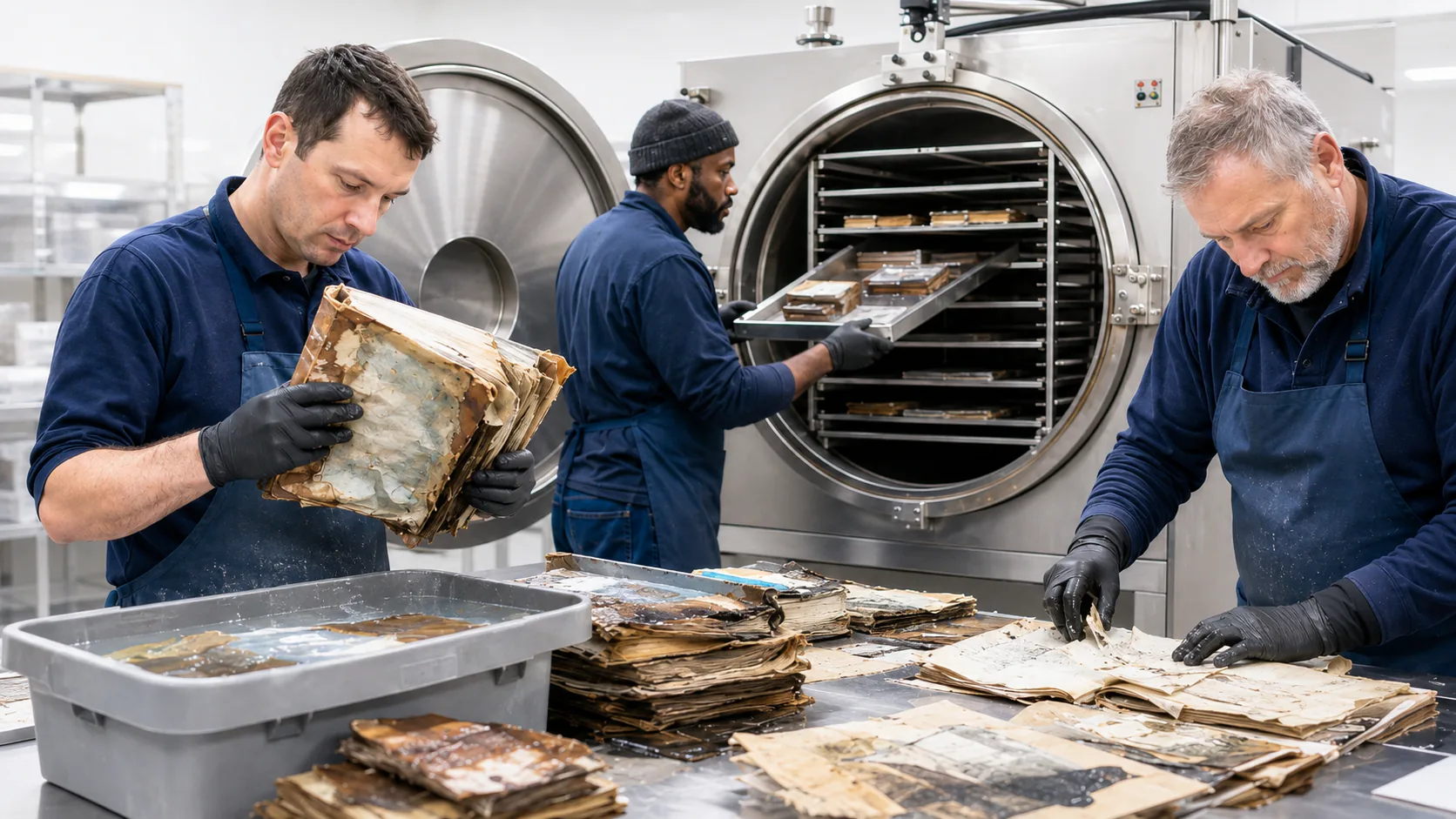 Guide
Guide