Product Positioning
Designed for trained practitioners mounting, repairing, lining and finishing Chinese paintings, calligraphy, rare books and paper archives, this table provides a broad, stable horizontal work surface for traditional conservation processes. It is intended for workflows that require a substantial handcrafted tabletop, alignment reference and nearby storage for scrolls and paper. Selection should begin with the dimensions and handling needs of the works, the mounting methods used by the studio and the available room and access space. It is distinct from the absorbent mounting wall used for adhered drying and tension-flattening, and from washing tables, suction tables or general-purpose laboratory benches. It does not determine whether a particular object, adhesive or treatment method is suitable.
I. Product Name and Functional Overview
The traditional rare-book mounting table supports the controlled arrangement, alignment and manual working of paintings and calligraphy, rare books and archives during repair and lining. Its solid construction and broad surface distinguish it from smaller movable benches, while the separable tabletop and cabinet body support installation and studio planning. Before ordering, institutions should review the maximum object format, working clearances, preferred operator access, floor route and the need for cabinet and partition storage. Treatment decisions remain the responsibility of the conservator: fragile media, unstable pigments, cockled supports and previous repairs require object-specific examination before they are placed or worked on the table.
II. Materials and Manufacturing Process
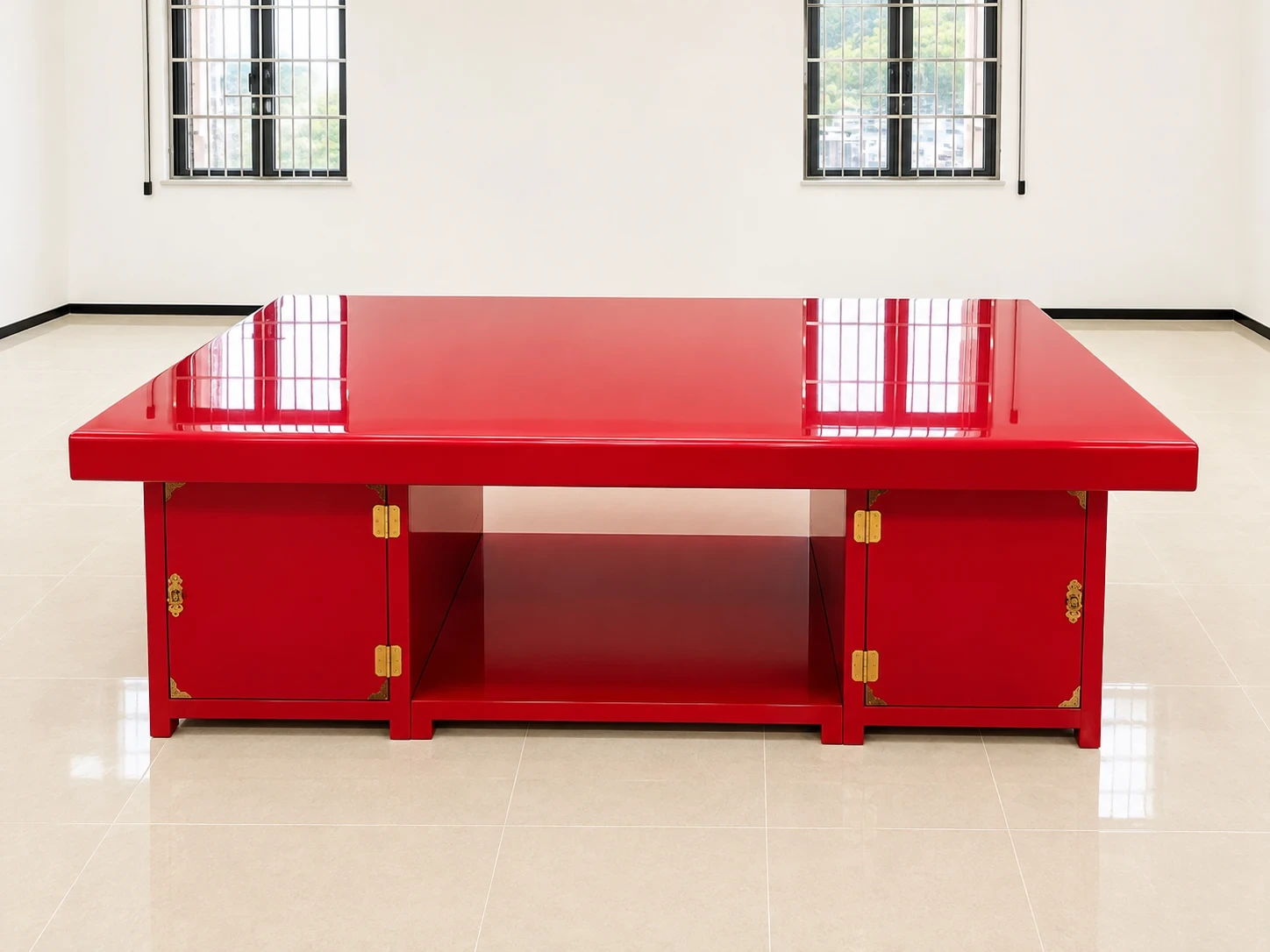
The equipment is made of solid wood and finished in vermilion, with a mortise-and-tenon main frame. The tabletop uses the stated natural materials—including pig blood, mineral filler, a hemp base and lacquer—and is handcrafted through the traditional fibre-and-ash layering process. This material construction is central to the product choice and should be evaluated against the institution’s conservation practice, cleaning procedures and installation environment. Project configuration should also account for the specified tabletop thickness, the mounting alignment line, two painting-and-calligraphy cabinets, internal partitions and the separable tabletop and cabinet body. Routine use should include inspection of the working surface, careful handling of tools and wet materials, and confirmation that storage compartments and the surrounding work zone remain suitable for the collection workflow.
III. Main Features and Structure
- The tabletop is flat, smooth, strong, durable, corrosion-resistant and water-resistant, and remains free from deformation and cracking during long-term use.
- Tabletop thickness ≥10cm, with a mounting alignment line.
- Equipped with 2 painting-and-calligraphy cabinets.
- Cabinet doors use Chinese-style antique copper handles.
- The tabletop and cabinet body are separable.
- Equipped with partitions for storing scrolls and paper.
IV. Specifications
| Item | Parameter |
|---|---|
| Overall dimensions | 2400×1500×780mm |
| Applicable materials | Paintings and calligraphy, rare books, archives |
| Main uses | Repair, lining and mounting |
| Tabletop thickness | ≥10cm |
| Number of painting-and-calligraphy cabinets | 2 |
| Structural form | Separable tabletop and cabinet body |